Yesterday was a great day to be outside. Good weather days have been rare this winter, so I took full advantage and starting trimming trees and collecting pecan scionwood. The young Kanza tree pictured at right needs a little corrective pruning. First, its time to remove the lowest limb (red arrow). But I also noticed that the tree looks like it trying to develop two central leaders (branches in yellow circle). This is a common problem in Kansas where south facing limbs seem to be blown back into the tree (and into an upright position) by strong winds that blow out of the south all summer long. I'll need attack this problem before a forked tree develops.

I'll start with the low limb. I'm pruning this limb off simply to make working around the tree easier and to ensure I have plenty of clear trunk to attach my trunk shaker at harvest. The series of photos above shows the process I used to remove the limb. This low limb actually forked close to the trunk so I needed to make 3 cuts to safely remove it from the tree. In photo A, the yellow arrow points to a crease in the bark that indicates where this limb is attached to the trunk. This is also the point where the limb should be removed. However, the forked structure of the side limb made it hard to get my chainsaw into proper position to make the cut. So in photo B, I removed the forked limbs. Now I had a clear shot at cutting the rest of the limb off back to the trunk (photo C).

I then turned my attention to correcting the dueling central leaders. The photo at left shows the two branches that are competing for role of central leader. I looked over the crotch where these two limbs diverge and noted a good strong branch connection. This lead me to simply cut back one of the two leaders rather than remove it entirely. I decide to cut back the south facing leader to an outward growing side branch. In the long run, I'll remove this entire branch because it arises only six feet up the trunk but for the next several years, I'll get some nut production from this limb.
Removing the upward growing portion of the competing leader (pointed out by blue arrow in photo A above) is two step process. Since I was holding the chainsaw at head height, I decided to make a quick cut to remove most of the branches weight (photo B). This way I was sure not to drop the limb on myself. I then came back to make a cut just above the point where a side limb grows outwards (photo C).
Once I had the competing central leader on the ground I noticed several nice long shoots that would make excellent scionwood. These shoots were originally growing at the very top of the tree which is always the best place to find good scions. I used my shears to remove last years new growth (photo above).
In collecting scionwood, make sure to cut only the wood that grew last year. The photo above will help you identify one-year-old wood over two-year-old wood. Right in the center of the shoot note a darkened ring around the stem. To the left is one-year-old wood with its large plump buds. To the right of the ring, note that the buds have aborted from the two-year-old wood. For grafting pecans, its best to have the healthy buds found on one-year-old shoots.
You can find one-year-old shoots at the terminals of all shoots. However, side limbs and nut bearing limbs often produce only short shoots with so many buds close together that it makes difficult wood for grafting (photo at left).
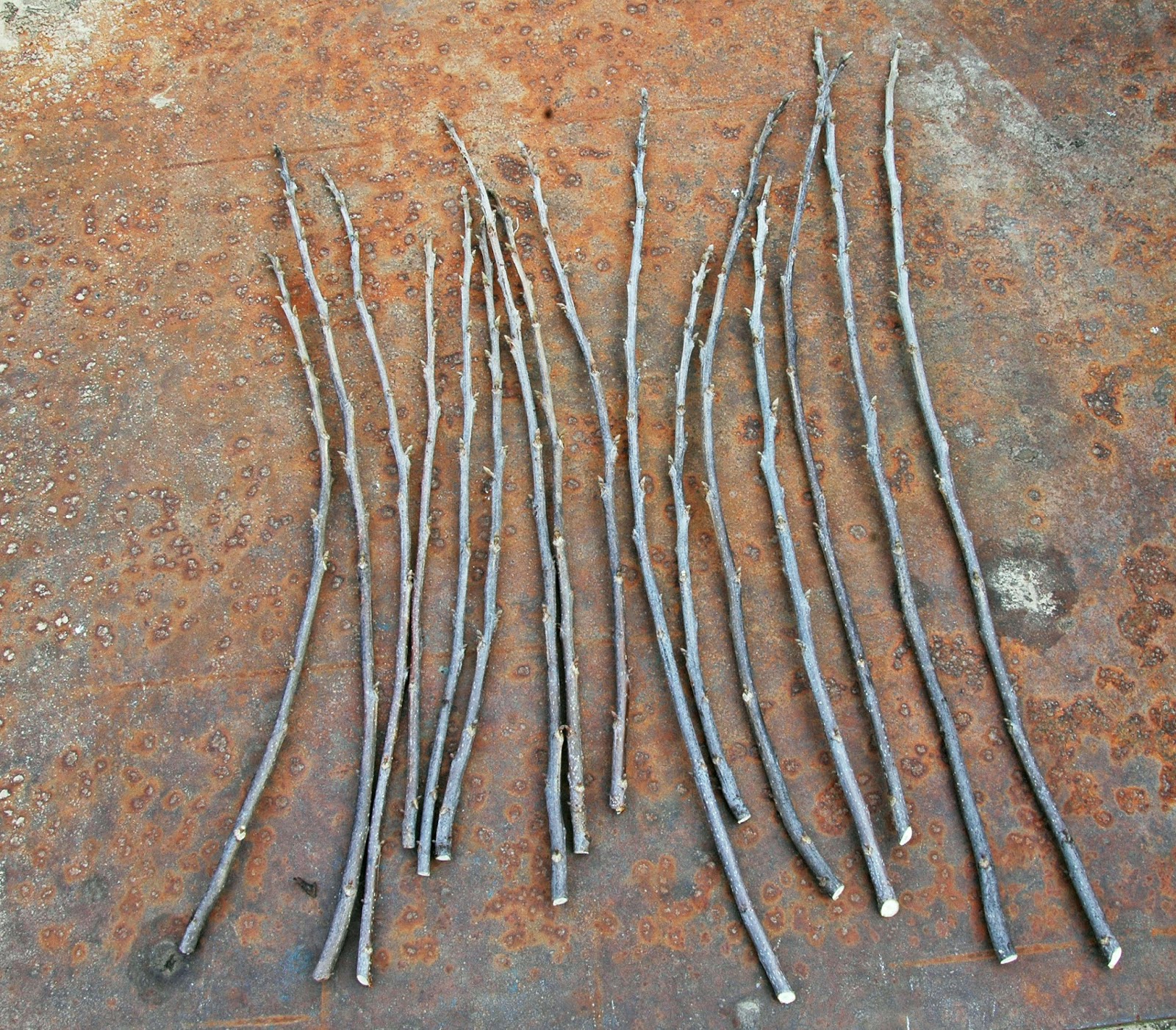
From trimming just one Kanza tree I collected numerous long shoots (photo at right). From these shoots, I can harvest several good scions.
I find the best scions are cut from the basal portion of a long shoot. The photos above demonstrate how I cut scions. Starting with a 2 foot long shoot, I cut 7-8 inch long scions making sure that I create nice straight scion with at least 2 buds near the top of the stick. From this shoot, I cut two scions. I discarded the top of the shoot because it was too small in diameter (small wood has poor graft success).
When cutting scions, I am always thinking about how to making the grafting process easier. The shoot above has a pronounced curve in the lower portion of the stem. Rather that trying to carve a crooked scion at grafting time, I cut off the curve and the cut a nice straight scion directly above the curve (photos above).
After pruning trees for several hours, I brought my scions up to the house to prepare the wood for refrigerator storage. I use one gallon freezer bag to store the wood and paper towels to provide high humidity inside the bag (photo at left).
Before placing the wood in the bag, I mark the bag with the cultivar name and insert wet paper towels. I used 4 paper towels that were completely soaked with water then squeezed to remove any free water. Scions are live plant tissue and the high humidity created by the damp paper towels help to keep the wood fresh until the spring grafting season.
To help further prevent moisture loss during storage, I'll place several gallon bags of scions in a plastic storage box clearly marked with the cultivar name. I like to use plastic boxes with the locking lids--they seem to seal better (photo at left).
I store the wood at 34 degrees F (1 degree C). In storing scions, make sure you do not store them in the same refrigerator as apples. Apples produce the ripening hormone, ethylene, that can cause the buds the abort from your scions. Freezing pecan scionwood will also damage the wood, which is why I purchased a small thermometer to make sure I had the correct temperature setting for my fridge.
 Yesterday was a great day to be outside. Good weather days have been rare this winter, so I took full advantage and starting trimming trees and collecting pecan scionwood. The young Kanza tree pictured at right needs a little corrective pruning. First, its time to remove the lowest limb (red arrow). But I also noticed that the tree looks like it trying to develop two central leaders (branches in yellow circle). This is a common problem in Kansas where south facing limbs seem to be blown back into the tree (and into an upright position) by strong winds that blow out of the south all summer long. I'll need attack this problem before a forked tree develops.