While scouting for pecan nut casebearer damage yesterday, we discovered a newly hatched colony of walnut caterpillars (photo at right). At this point in their life cycle, the caterpillars are so small that they can't get their mouth parts open wide enough to chomp through the entire leaf blade. Instead, these first instar larvae simply scrape off green tissue from both surfaces of the leaf. Once walnut caterpillars molt into the second instar, they will be large enough to make entire leaflets disappear.
I turned over the leaf and found the egg mass where this colony started (photo at left). Walnut caterpillar moths lay row after row of small white eggs in a large cluster. The eggs that look like empty cups are simply eggs that have already hatched. You can see a few eggs that are solid white indicating that a larvae has not yet emerged. However, if the egg hasn't hatched by this point it probably has been parasitized by a trichogramma wasps.
The walnut caterpillar has two generations per year in Kansas. The first generation hatches in late June to early July while a second generation appears in August. Walnut caterpillars feed together in large colonies. When it comes time to molt the entire colony moves to the underside of a large limb or the trunk and sheds their exoskeletons together in a large clump. You can see photos of later instars in posts I've made during previous growing seasons (2011 & 2102).
Showing posts with label walnut caterpillar. Show all posts
Thursday, June 26, 2014
Friday, July 6, 2012
Insect Instars
When talking about insects the term instar often comes up. What is an instar and why does it matter?
The body of an insect is composed of a hardened outer shell or exoskelton that protects and supports soft vital tissues inside.
Insects must shed their exoskelton in order to grow larger and assume a new form. Each time an insect sheds its exoskelton it passes into a new life stage or instar. Differences between instars can often be seen in altered body proportions, colors, patterns, or changes in the number of body segments.
In the photo above, a colony of second instar walnut caterpillars are feeding on pecan leaves. The first instar of walnut caterpillars are olive green, while the 2nd, 3rd and 4th instars have a dark red color. The fifth and final walnut caterpillar instar will be entirely black.
Knowledge of instars is important important for two reasons. First, insects in the early stages of development (early instars) are much easier to control with insecticides than insects near maturity. Secondly, insects often are most damaging when fully sized during their their final instar.
The body of an insect is composed of a hardened outer shell or exoskelton that protects and supports soft vital tissues inside.
Insects must shed their exoskelton in order to grow larger and assume a new form. Each time an insect sheds its exoskelton it passes into a new life stage or instar. Differences between instars can often be seen in altered body proportions, colors, patterns, or changes in the number of body segments.
In the photo above, a colony of second instar walnut caterpillars are feeding on pecan leaves. The first instar of walnut caterpillars are olive green, while the 2nd, 3rd and 4th instars have a dark red color. The fifth and final walnut caterpillar instar will be entirely black.
Knowledge of instars is important important for two reasons. First, insects in the early stages of development (early instars) are much easier to control with insecticides than insects near maturity. Secondly, insects often are most damaging when fully sized during their their final instar.
Thursday, June 21, 2012
Walnut caterpillar hatching
Just like fall webworm, walnut caterpillars have arrived right on schedule--late June. Today, we found a couple of newly hatched walnut caterpillar colonies (photo at right). Newly hatched larvae are quite small and olive green in color.
I looked around the foliage near the colony of feeding caterpillars and found the egg mass from which they hatched (photo at left). Looking closely at the egg mass, I learned two things. First, the egg mass is much larger than normal. And second, not all the eggs hatched indicating possible parasitition by the wasp, Trichogramma minutum. The laying of large egg masses is often a precursor for an outbreak of walnut caterpillars. The fact that less than 10% of the eggs were parasitized means that wasp parasites were not numerous enough to keep walnut caterpillar in check. Everything I saw today, points to a walnut caterpillar outbreak, at least in and around the Pecan Field.
To scout for newly hatched walnut caterpillar colonies look for brown, skeletonized leaves in the canopy of your pecan trees (note brown leaf in center of photo at right). The mouth parts of newly hatched larvae are so small they can not eat the entire leaf. Instead, the young insects scrape both upper and lower surfaces of the leaf, turning the leaf brown. The photo below shows a close up of the brown, skeletonized leaves and a feeding colony of first instar walnut caterpillars.
I looked around the foliage near the colony of feeding caterpillars and found the egg mass from which they hatched (photo at left). Looking closely at the egg mass, I learned two things. First, the egg mass is much larger than normal. And second, not all the eggs hatched indicating possible parasitition by the wasp, Trichogramma minutum. The laying of large egg masses is often a precursor for an outbreak of walnut caterpillars. The fact that less than 10% of the eggs were parasitized means that wasp parasites were not numerous enough to keep walnut caterpillar in check. Everything I saw today, points to a walnut caterpillar outbreak, at least in and around the Pecan Field.
To scout for newly hatched walnut caterpillar colonies look for brown, skeletonized leaves in the canopy of your pecan trees (note brown leaf in center of photo at right). The mouth parts of newly hatched larvae are so small they can not eat the entire leaf. Instead, the young insects scrape both upper and lower surfaces of the leaf, turning the leaf brown. The photo below shows a close up of the brown, skeletonized leaves and a feeding colony of first instar walnut caterpillars.
Thursday, July 14, 2011
Summer Caterpillars
Sometimes they seem to appear overnight, stripping the leaves from you pecan trees to satisfy their voracious appetites. Walnut caterpillar and fall webworm are easy to spot at this time of year. The first summer generation of these insects is nearing completion with a second, and larger generation staring in mid to late Augusts.
Pictured at right are the tell-tale stripped leaves left by the feeding of a colony of walnut caterpillars. Look closely at one of the lower branch terminals and you will see a clump of caste skins left behind by the colony of caterpillars that chewed off all the leaves.
In an earlier post, you can see a walnut caterpillar egg mass. Once these eggs hatch the caterpillars that emerge stay together in a group, eating together, molting together, and eventually dropping out of the trees together to pupate in the turf. Walnut caterpillar larvae are green when first emerging from the egg (1st instar). After the caterpillars molt, the larvae become maroon in color with log dark hairs. They keep this maroon color during the 2nd, 3rd, and 4th instars. At the 5th and final instar the large become totally black with long white hairs (zoom in on photo at left). These 5th instar larvae do 80% of the defoliation that will occur from this pest.
Over the years, we have noticed that walnut caterpillar populations vary greatly. Some years you can hardly find a colony while other year this insect seems to defoliating every tree in the grove. Walnut caterpillar populations are kept in check my a small parasitic wasp. In our area, the colonies we've found are small indicating that the wasp is active and working to suppress an outbreak of caterpillars. However, nut growers in Miami Co., KS and Barton Co. MO have seen much larger colonies indicating that that natural biological controls have broken down in those areas. If you have seen a large number of walnut caterpillar colonies during the 1st generation, be prepared for an even bigger 2nd generation.
With its dirty white web, the fall webworm, can be spotted a half mile away (photo at right). These caterpillars appear to stay within the web they create but that web is expanded every night as the larvae devore an ever increasing number of leaves.
Fall webworm populations flucuate from year to year depending on the survival of pupae over the winter months. Warm, wet winters seem to favor the fungi that attack fall webworm pupae reducing the size of the 1st summer generation. Dry weather provides prefect conditions for insect survival so the second summer generation should prove more troublesome.
Pictured at right are the tell-tale stripped leaves left by the feeding of a colony of walnut caterpillars. Look closely at one of the lower branch terminals and you will see a clump of caste skins left behind by the colony of caterpillars that chewed off all the leaves.
In an earlier post, you can see a walnut caterpillar egg mass. Once these eggs hatch the caterpillars that emerge stay together in a group, eating together, molting together, and eventually dropping out of the trees together to pupate in the turf. Walnut caterpillar larvae are green when first emerging from the egg (1st instar). After the caterpillars molt, the larvae become maroon in color with log dark hairs. They keep this maroon color during the 2nd, 3rd, and 4th instars. At the 5th and final instar the large become totally black with long white hairs (zoom in on photo at left). These 5th instar larvae do 80% of the defoliation that will occur from this pest.
Over the years, we have noticed that walnut caterpillar populations vary greatly. Some years you can hardly find a colony while other year this insect seems to defoliating every tree in the grove. Walnut caterpillar populations are kept in check my a small parasitic wasp. In our area, the colonies we've found are small indicating that the wasp is active and working to suppress an outbreak of caterpillars. However, nut growers in Miami Co., KS and Barton Co. MO have seen much larger colonies indicating that that natural biological controls have broken down in those areas. If you have seen a large number of walnut caterpillar colonies during the 1st generation, be prepared for an even bigger 2nd generation.
With its dirty white web, the fall webworm, can be spotted a half mile away (photo at right). These caterpillars appear to stay within the web they create but that web is expanded every night as the larvae devore an ever increasing number of leaves.
Fall webworm populations flucuate from year to year depending on the survival of pupae over the winter months. Warm, wet winters seem to favor the fungi that attack fall webworm pupae reducing the size of the 1st summer generation. Dry weather provides prefect conditions for insect survival so the second summer generation should prove more troublesome.
Friday, June 10, 2011
Walnut caterpillar eggs
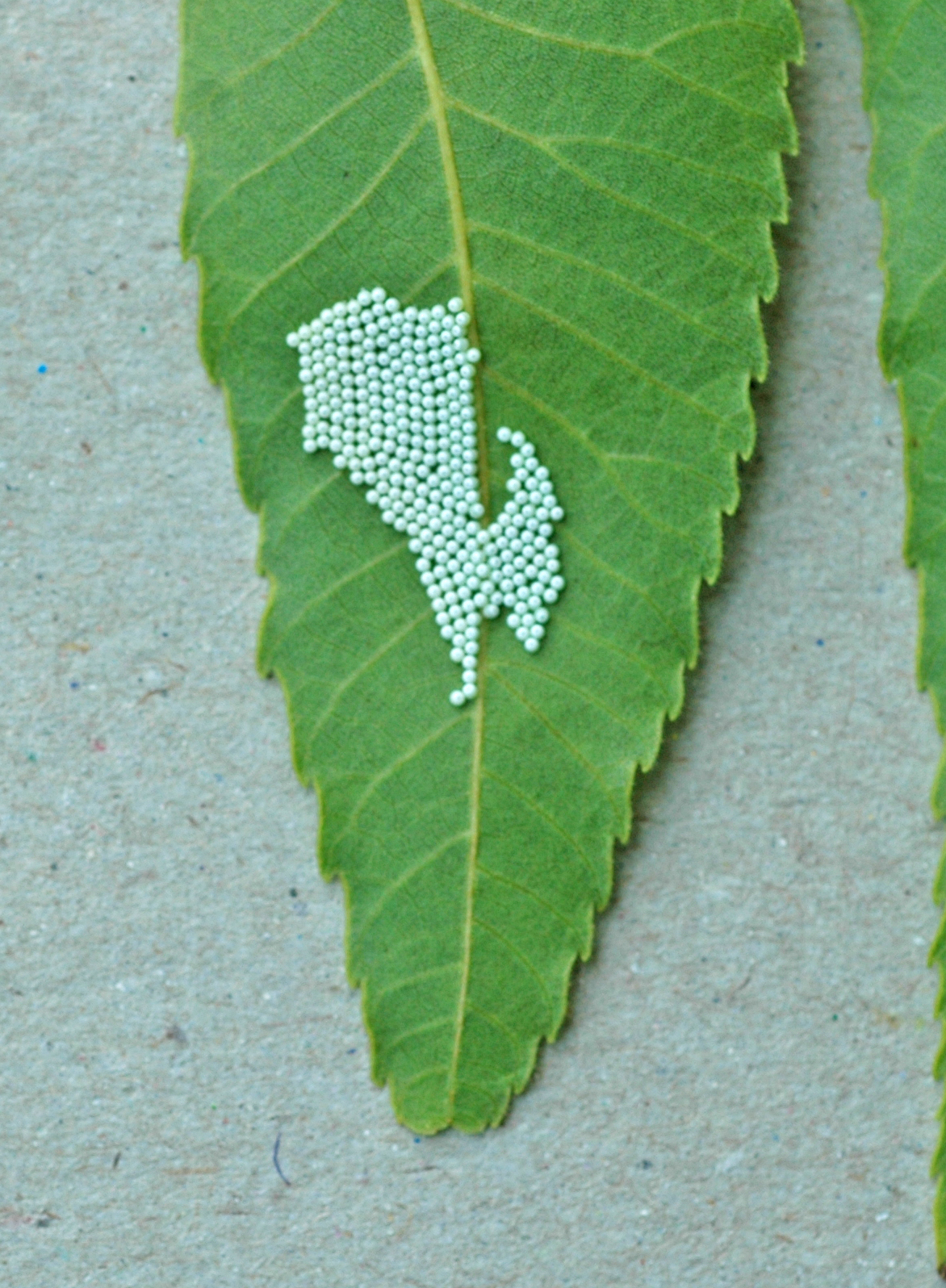
I was doing some summer pruning a couple of days ago and spotted this egg mass (at left) on the underside of a leaflet. These are the eggs of the walnut caterpillar (Datana integerrima), a major defoliating pest of pecans.
When I see one of these egg masses, I carefully observe the eggs for a while waiting to see if any parasitic wasps show up. The tiny black wasps, Trichogramma minutum, seem to dance over the egg mass and lay their own eggs inside the caterpillar eggs. These wasps usually keep walnut caterpillar in check, but unfortunately, I didn't see any on this egg mass.
We will need to keep close tabs on walnut caterpillar this summer, watching of signs of a population outbreak that requires an insecticide treatment.
When I see one of these egg masses, I carefully observe the eggs for a while waiting to see if any parasitic wasps show up. The tiny black wasps, Trichogramma minutum, seem to dance over the egg mass and lay their own eggs inside the caterpillar eggs. These wasps usually keep walnut caterpillar in check, but unfortunately, I didn't see any on this egg mass.
We will need to keep close tabs on walnut caterpillar this summer, watching of signs of a population outbreak that requires an insecticide treatment.
Subscribe to:
Posts (Atom)