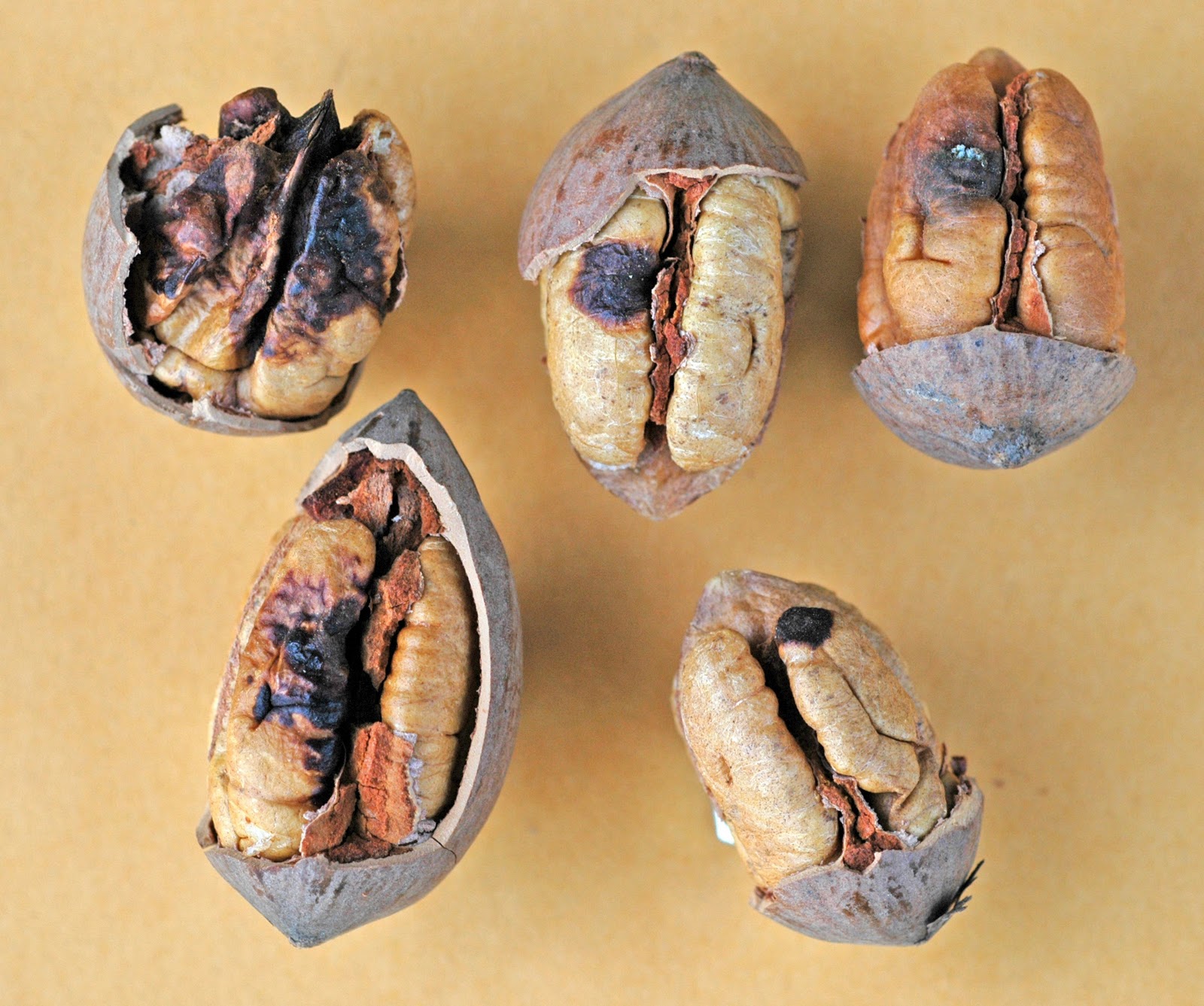
Here's a photo of three pecans we picked up with the harvester this fall. You might recognize these nuts as being all from the same cultivar--Kanza. The light colored nut on the right is from this year's crop, while the other 2 nuts were left behind from the 2010 crop. One of the things we look to remove from the cleaning table are old nuts that usually appear as dark reddish black nuts (nut pictured in the center). After sitting on the ground an entire year, these nuts become rancid and/or moldy.
We missed the moldy nut on the far left on the cleaning table only to find it later in a batch of cracked nuts. Look at the shell that still remains on the moldy nut. Its darker than the new crop nut but doesn't have that oil soaked appearance of the nut pictured in the middle. With thousands of nuts moving across the cleaning table, it easy to see how we missed pulling the moldy nut (before it was cracked) out of our 2011 crop.
I find it remarkable that pecans missed at harvest can survive an entire year out in the field without being discovered by squirrels, mice, crows, woodpeckers, insects and even deer. However, every year we find just a few old nuts come racing across the cleaning table that need to be thrown in trash pile.
Thursday, December 15, 2011
Wednesday, December 14, 2011
Pecan harvest 2011
| Sonja raking sticks off the orchard floor |
While shaking our trees, I started thinking about area farmers that have spent most of harvest season complaining about a lack of nuts in their groves. One guy even argued that the cold temperatures we had last February (-17 F) were the reason he didn't have a crop. But when confronted by the fact that the Experiment Field was producing nuts in 2011, he simply stated that a dome of warm temperatures protected the trees just east of Chetopa. Talk about hot air!
| Darrell harvesting pecans |
Pesticides are another major input for pecan producers. This year we invested $42.63/acre in insecticides and fungicides. We sprayed for casebearer and scab in June, stinkbug and weevil in August, and weevil in September. This year's dry summer helped prevent the spread of pecan scab. As a result, our fungicide applications were kept to a bare minimum and we were able to save a little money.
| Cracked pecans |
Labels:
native pecans
Saturday, December 3, 2011
Fewer black spots on kernels in 2011.
Its not until you crack open a sample of this year's pecan crop do you discover the level of damage created by stink bug feeding. As I mentioned in an earlier post, the black spots found on pecan kernels are the result of feeding by stinkbugs and/or leaf-footed bugs (photo at right).
Last year (2010) we found quite a bit of stink bug damage. This year (2011) the number of kernels with black spots are far fewer. I wish I could come up with a good explanation for the year-to-year variation in stink bug damage but it turns out that the movements and population numbers for this group of plant feeding bugs are very hard to predict.
Over the past several years, our control strategy for kernel feeding bugs has been to apply an insecticide (Warrior II) in early August. Subsequent insecticide applications aimed at pecan weevil also help decrease stink bug populations. These control measures are not perfect but seem to keep kernel damage down to less that 1% of kernels.
Last year (2010) we found quite a bit of stink bug damage. This year (2011) the number of kernels with black spots are far fewer. I wish I could come up with a good explanation for the year-to-year variation in stink bug damage but it turns out that the movements and population numbers for this group of plant feeding bugs are very hard to predict.
Over the past several years, our control strategy for kernel feeding bugs has been to apply an insecticide (Warrior II) in early August. Subsequent insecticide applications aimed at pecan weevil also help decrease stink bug populations. These control measures are not perfect but seem to keep kernel damage down to less that 1% of kernels.
Thursday, December 1, 2011
Ice storm recovery update
Its been 4 years since the pecan groves around Chetopa,Kansas were hit by a massive ice storm. Once the leaves have fallen from the trees you can still see the scars of limb breakage left behind in the canopies of our trees. In the photo at right, you can see that vigorous new shoots have developed where limbs were torn from the tree by the weight of the ice. With each passing year, our trees are filling out their canopies, increasing the area where nuts can be produced.
But where are the nuts? It seems that the native pecan trees that did not set nuts on undamaged limbs, didn't set a crop on the new shoots either. In contrast, native trees that did set a crop (photo at left) produced pecans on both old and new branches. What we are seeing at this point is that the new shoots developed in response to ice-induced limb loss are now fully mature (able to produce a nut crop) and synchronized with the entire tree.
If you take a closer look at the regrowth associated with ice-storm-related limb breakage, you can see that an over-abundance of new shoots have developed in many areas (photo at right). Note that these vigorous branches have also developed numerous lateral shoots. As the trees continue to grow, competition for sunlight among these new shoots will eventually lead to the natural thinning of the most heavily shaded limbs (the so called self pruning process).
Squirrel damage has also led to some much needed limb thinning on ice-damaged trees. I've been shaking trees this harvest season only to find several branches that have developed since the ice storm on the ground (photo left). Note the dried leaves still attached to the shoot indicating that this shoot was injured by squirrels last summer.
If you look at the base of the shoot you can clearly see that the bark had been stripped back by squirrels feeding on the cambial layer of the shoot. A combination of summer winds and harvest tree shaking snapped these dead shoots out of the tree.
But where are the nuts? It seems that the native pecan trees that did not set nuts on undamaged limbs, didn't set a crop on the new shoots either. In contrast, native trees that did set a crop (photo at left) produced pecans on both old and new branches. What we are seeing at this point is that the new shoots developed in response to ice-induced limb loss are now fully mature (able to produce a nut crop) and synchronized with the entire tree.
If you take a closer look at the regrowth associated with ice-storm-related limb breakage, you can see that an over-abundance of new shoots have developed in many areas (photo at right). Note that these vigorous branches have also developed numerous lateral shoots. As the trees continue to grow, competition for sunlight among these new shoots will eventually lead to the natural thinning of the most heavily shaded limbs (the so called self pruning process).
Squirrel damage has also led to some much needed limb thinning on ice-damaged trees. I've been shaking trees this harvest season only to find several branches that have developed since the ice storm on the ground (photo left). Note the dried leaves still attached to the shoot indicating that this shoot was injured by squirrels last summer.
If you look at the base of the shoot you can clearly see that the bark had been stripped back by squirrels feeding on the cambial layer of the shoot. A combination of summer winds and harvest tree shaking snapped these dead shoots out of the tree.
Subscribe to:
Posts (Atom)