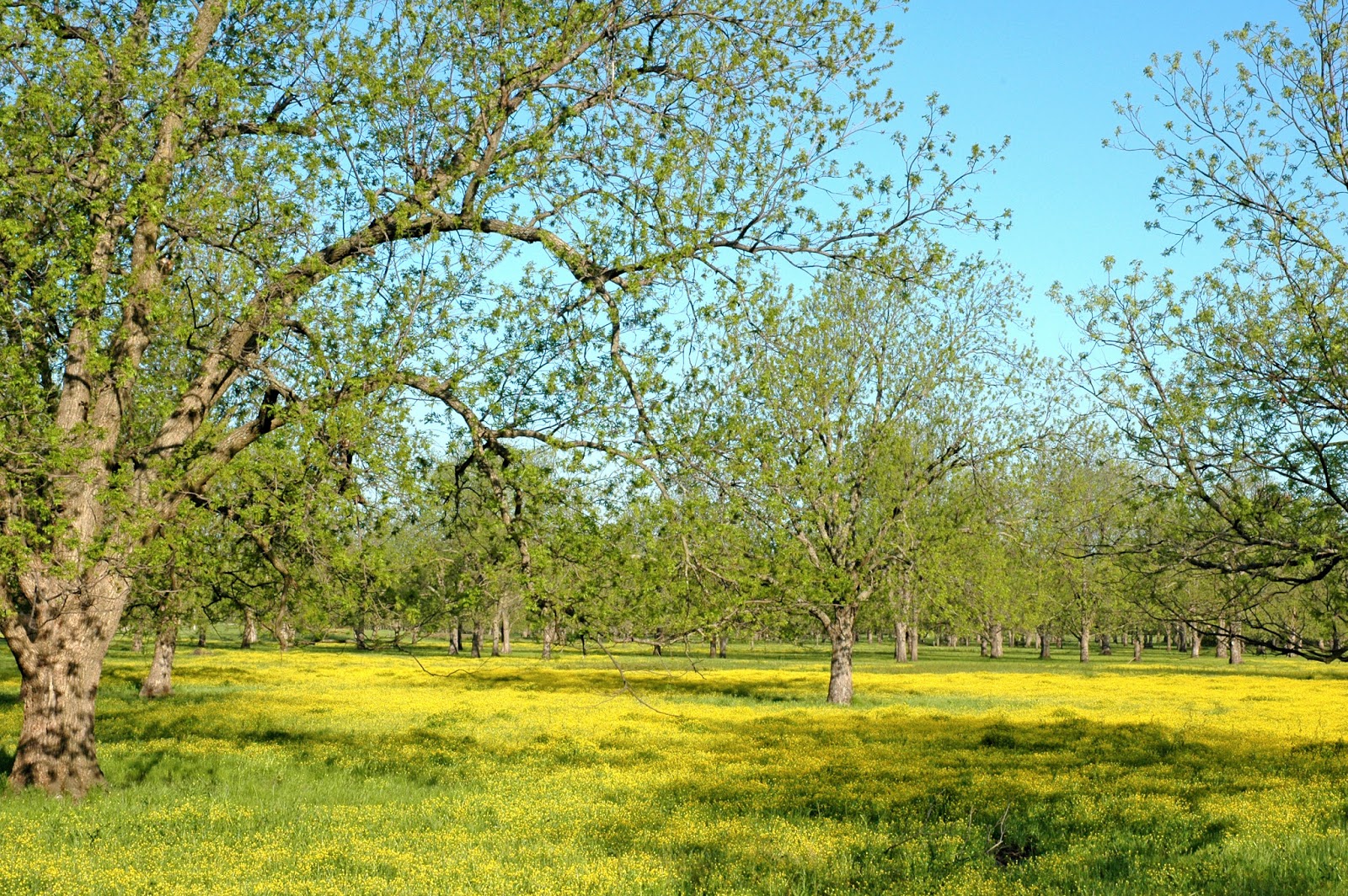
Over the past week, its been largely cloudy with frequent rain showers. I've recorded over 7 inches of rain in the past 8 days with more predicted to come tonight. With all this gloomy weather, I find it refreshing to enjoy this photo I took during a brief sunshine break we had a few days ago. To me, a native pecan grove is one of the most beautiful locations in the world and a place that always refreshes my spirit.
Showing posts with label native pecans. Show all posts
Wednesday, May 8, 2019
Spring blooms in a native pecan grove
Over the past week, its been largely cloudy with frequent rain showers. I've recorded over 7 inches of rain in the past 8 days with more predicted to come tonight. With all this gloomy weather, I find it refreshing to enjoy this photo I took during a brief sunshine break we had a few days ago. To me, a native pecan grove is one of the most beautiful locations in the world and a place that always refreshes my spirit.
Labels:
native pecans
Friday, January 5, 2018
Native pecan yield 2017
Every year I learn something new about native pecans. This past summer (2017), the branches of our native trees were hanging low with, what I thought, was a heavy nut crop. However, this past year our native trees fooled me. The limbs were weighted down with a huge leaf crop that hid a below average nut crop.
It was only when we began shaking trees, that we discovered the true nature of the 2017 native crop.
For 37 years we have be recording the yields from 6, one-half-acre plots of native pecans. The 2017 yields are presented in the table above (numbers listed in Lbs.). The half-acre plots are labeled A thru F. We always harvest each plot twice; the first time in mid November and then again in late December. The weight of nuts collected at each harvest time is listed above.
The 37 yield average yield/acre for these plots is 1150 lbs. The 2017 crop averaged 798 lbs./acre or 30% below average. What was interesting about the 2017 harvest was that we harvested almost one third of the crop (32%) during the second harvest. Prior to 2017, second harvest yielded 15% to 20% of the total crop. Why the difference in 2017?
I blame the heavy leaf crop. During the first harvest, our pecan harvester had a tough time digesting all those leaves. A lot of nuts ended up riding on a stream of leaves and getting blown out of the back of the machine. When we went back for the second harvest, the leaves had been chopped up and partially broken down by our first harvest operation. During the second pass over the field, the harvester could easily process the ground up leaves and orchard floor was swept clean of nuts.
A below-average nut crop and an above-average leaf crop in 2017 is a sure sign that the potential for the 2018 native crop will be huge.
Labels:
harvest,
native pecans
Friday, February 3, 2017
Pecan yields from a native grove
Many readers of this blog are interested in planting new orchards of grafted pecan trees. However, Southeast Kansas is blessed to have thousands of acres of mature native pecan trees growing in the flood plains of major rivers (photo above). The proper care of these seedling trees helps to fill the niche market for small, sweet, oily kernels that are the perfect size for fitting on top of cookies, pies, and cakes.
At the Pecan Experiment Field we have been recording pecan production from native trees for over 35 years. Each year, we harvest the pecans from six half-acre plots. The chart above illustrates the fluctuations in yield we have observed over the past eleven years (click on the chart to enlarge). I chose this time period so you can see how I trees responded following two catastrophic weather events that impacted our native trees. In 2007, the Easter freeze killed emerging pecan buds and destroyed 3/4 of all our pistillate blossoms. The impact on yield was dramatic. Then in December of 2007, we suffered an ice storm that ended up breaking about half the limbs off our trees. Pecan yield in 2008 and 2009 suffered. After 2 years of vigorous shoot regrowth, the trees returned to normal yields in 2010 (1157 lbs/acre is our 35 year average). Since 2010, native pecan yield hit a high in 2012 and failed to impress in 2015. We've basically returned to a normal level of yield fluctuation. I wonder how our natives will bear in 2017. Only time will tell.
Thursday, January 7, 2016
Native pecan yields drop in 2015
The 2015 native pecan crop at the Pecan Experiment Field was a little disappointing. For 35 years, we have been recording the yield from 6 plots of native pecan trees and this past season, our native trees produced a below-average crop. The 2015 native crop came in at 825 lbs./acre as compared to our long-term average yield of 1156 lbs./acre. The yield history of our native plots is given in the chart below.
If you study the chart for a bit, you'll see that there is no obvious pattern to yield variation from year to year. Record low yield in 1990, followed a winter when temperatures dropped to -26 F in mid- December causing serious shoot damage. The Easter freeze of 2007 destroyed emerging shoots and limited pistillate flower production. And finally, the December 2007 ice storm caused massive limb loss negatively impacting yield for following two growing seasons. Besides these three major weather events, I'm sure that natural variation in weather patterns have a lot to do with how trees perform over time. Unfortunately, all we can do about the weather is complain about it.
Labels:
harvest,
native pecans
Friday, May 29, 2015
Pecans set on native pecans
Yesterday, I drove through flood waters to get down to our pecan grove. At that time, not all our orchards were under water and I was able to get up in our hydraulic lift to check on pecan nut set (photo at right). Because of the flooding, I was only able to check about a dozen trees but what I saw looked promising. On many trees, every terminal bore a cluster of 5 to 6 nuts.
When newly set nuts are so small, it is hard to look up at a pecan tree and get a good feel for the size of the nut crop. The photo at left is my attempt to show you how prolific our native trees are this year. From terminal buds on last year's growth, two shoots grew and both produced a cluster of pistillate flowers. Currently, five pollinated nuts have set on each of these terminals (photo at left).
Not pictured in the photo is a shoot that developed from a bud eight inches behind the two shoots in the photo. Sprouting from one-year-old wood and back inside the tree's canopy, this new shoot also produced a cluster of five nuts.
With the heavy nut set I'm seeing on our trees, I plan to skip making an insecticide treatment to control pecan nut casebearer in early June. This doesn't mean I don't plan to spray our trees during the coming month. The super wet conditions we've experienced over the past couple of weeks has been ideal for the spread of pecan scab and a myriad of foliage diseases. Once we can get over the field with our spray rig, we'll be applying a fungicide to our trees.
Tuesday, December 23, 2014
Native pecan yields for 2014
| Native pecan plots 2014 |
In the photo at right, the scars from the 2007 ice storm are still visible but you can see how well our native trees have grown back over the past 7 years. This year we harvested an average of 1127 lbs/acre from the native plots, down from the previous year's yield of 1640 lbs/acre (see chart below).
Whenever I look at a plot of pecan yields, I always seem to concentrate on finding reasons for why the tree produce below-average yields in certain years. Nut yield in 2007 was depressed by a extremely late hard freeze on Easter weekend that destroyed many emerging shoots and pistillate flowers. Yield in 2008 was impacted by the loss of roughly 50% of tree canopies from a serious ice storm that occurred in December of 2007. In fact, it took several years for the trees to regrow their canopies and get back to full nut production.
So what happened in 2014? After two big crops in 2012 and 2013, it seems like our trees decided to take a little break. However, I should point out that 2014's yield at 1127 lbs/acre is only slightly below our 34 year average of 1165 lbs/acre.
When we harvest pecans, we always run over the field twice. In the table above, the 2014 yields for our six native pecan plots are presented in pounds per acre. These numbers give you some idea of how variable native pecan yields can be and how important a second harvest is for capturing the full value of a grove's nut production. In harvesting pecans, we shake and harvest the entire farm before going back for the second harvest. This year the second harvest represented about 14% of our total yields.
Friday, January 17, 2014
Mid-winter pecan harvest
It looks like mid-January will represent the longest stretch of harvesting weather we've going to get to pick up the 2013 pecan crop. This past week the Neosho River bottom was humming with the sound of pecan harvesters (photo above). At the Pecan Experiment Field we finally finished picking the entire grove and have now started on our second picking.
You would think that we could get the majority of nuts picked up on the first pass across the orchard, but several trees have required a second shake to bring all the nuts down. And frankly, mechanical harvesters always leave nuts behind during the first harvest. How much do we harvest on the second pass? The chart below provides some numbers.
At the Experiment Field, we have 6 native pecan plots that we record annual yield. These plots are labeled A through F and we record the weight of clean, harvested nuts from both the first and second harvests. In 2013, the plots averaged 1640 lbs/acre in total harvest. A little over 20% of that yield was collected from the second harvest.
Tuesday, December 10, 2013
Snow stalls pecan harvest
A two inch blanket of snow fell on our pecan grove last night putting a halt to our pecan harvest. Weather delays are a part of pecan farming that I've come to accept. So instead of cursing the weather, I decided to enjoy the moment and take a few "artistic" photographs (below). There is no place on earth more beautiful than a pecan grove.
Labels:
native pecans
Wednesday, June 5, 2013
Phomopsis trunk galls on pecan
Every once in a while, I come across a native pecan tree with a baseball-sized, woody gall growing on the side of the trunk (photo at right). Look carefully and it doesn't even look like the gall is firmly attached to the tree. In fact, a sharp blow with your hand or hammer will usually pop the gall right off the tree.
This gall is caused by a slow growing fungus in the genus, Phomopsis. The woody gall is formed by the tree's natural wound response to fungal attack. To prevent wood decay, pecan trees try to grow over and seal out invading fungi. However, in the case of a Phompsis gall, neither tree nor fungus seem to gain the upper hand in the wood decay battle. As a consequence the gall just grows larger.
I knocked this gall off the tree with just the palm of my hand (photo at left). This was a fairly unique gall in that it represented the fusion of two infections into one elongated gall. Phomopsis infections usually start at a single point, most often at the site of a small broken off limb. In the photo, the yellow arrows point to the infection points of this double gall.
Looking at the underside of the gall, (held in my hand) you can see that the woody gall is composed of a jumbled up mix of bark, wood, and fungus tissues. You can also see that this gall actually started off as two round galls that later fused together when they began to touch.
Phomopsis galls are not that hard to find in native pecan groves and they seem to have zero impact on nut production.
Labels:
cankers,
native pecans
Friday, May 10, 2013
Spring time in a native pecan grove
A yellow carpet of swamp buttercup flowers adds to the spring beauty of this native pecan grove. (Photo taken near Chetopa, KS)
Labels:
native pecans
Friday, January 11, 2013
Still harvesting the 2012 native pecan crop
To many city folks, one of the most surprising parts of pecan farming is the fact that the harvest season often extends well into the winter months. This week, pecan harvesters could be seen buzzing around local native pecan groves still gathering the crop. This is the time of year for "second harvest". During second harvest, native trees that did not release all their pecans when shook the first time (in Nov.) are shook again. Then the entire grove is harvested again to capture newly fallen nuts and pecans missed during the first pass of the harvesters. At the Pecan Experiment Field, our native plots yielded 1530 lbs/ac during the first harvest with an additional 406 lbs/acre collected during the second harvest. Harvesting the pecan grove twice definitely pays for itself.
Labels:
harvest,
native pecans
Monday, December 3, 2012
Native Yield 2012
Lately, I've been spending a lot of time in the cab of this tractor enjoying the sound of nuts hitting the roof as I shake our native trees (photo at right). Ever since 1981, we've been collecting yield data from the same 6 one-half-acre plots of native pecans in order to provide baseline data for economic projections.
In spite of the 2012 drought, our native plots produced the second highest yield on record. We averaged 1936 lbs./acre this year. Our highest recorded yield was 2145 lbs./acre produced in 1997. If the summer of 2012 had provided plentiful rainfall and the larger average nut size that comes with adequate moisture, 2012 might have set a new record.
The big crop this year was set up by the combination of 2 major weather events, both occuring in 2007. The Easter freeze of 2007 destroyed potential nut production by freezing emerging flower buds. During the fall of 2007 we harvest only 490 lbs./acre. This freeze set in motion an alternate bearing pattern that has continued since that time. We currently expect larger crops in even numbered years.
Later, during December of 2007 we had an ice storm that ripped 50% of the branches from our trees. The removal of so much of the tree's canopy ended up reducing what should have been a big crop in 2008 by more than half. Since that time our trees have been growing back new limbs and refilling their canopies. The 2012 season marks the first time since 2006 that our native trees have returned to their full nut producing potential. The last ten years of native pecan production from our plots is shown below.
Labels:
harvest,
native pecans
Friday, February 17, 2012
Identifying pecan trunk injuries
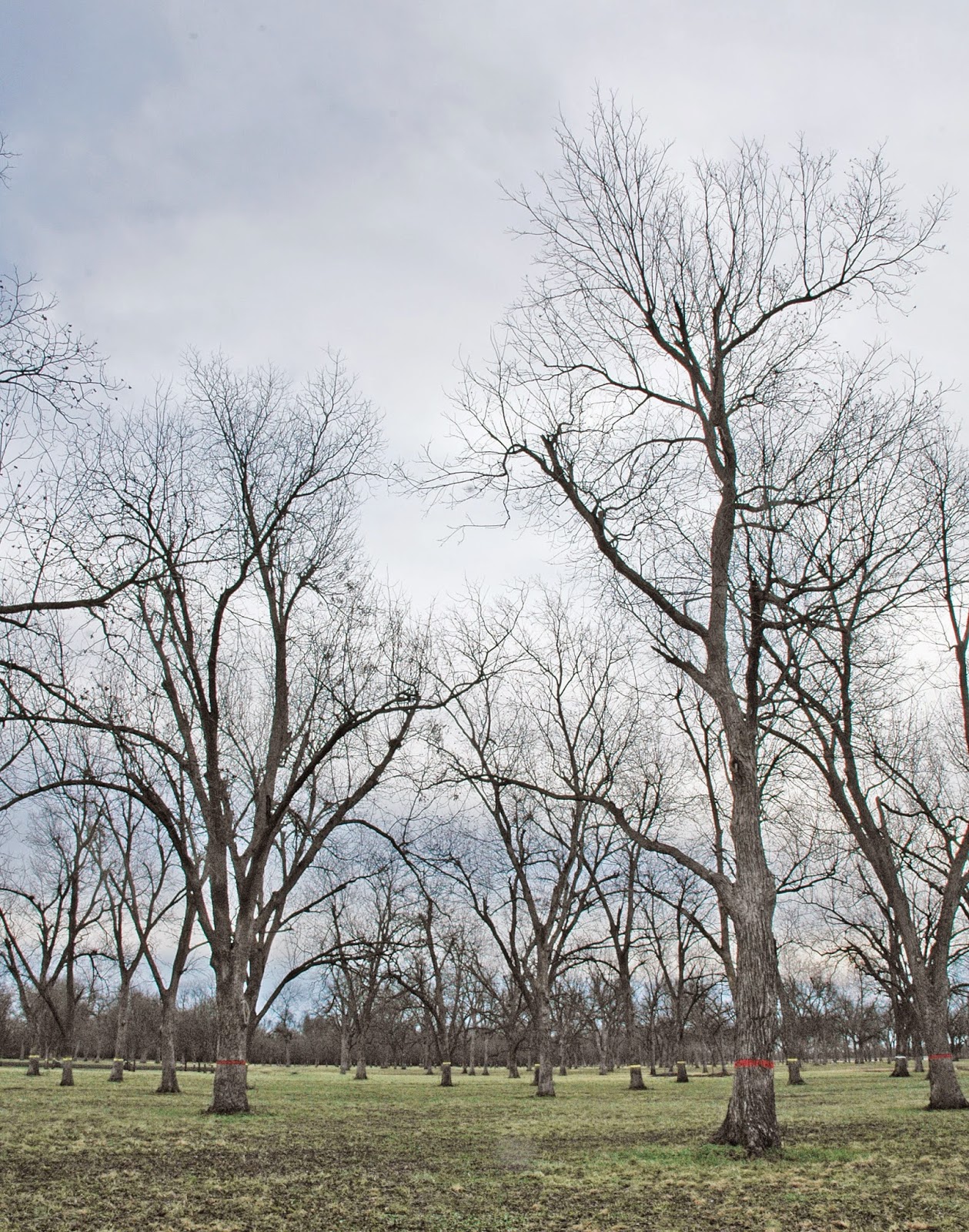
Today, I enjoyed a late winter walk through our native pecan grove. In the bright sunshine and without a canopy of leaves, the immense size of pecan trees really struck me. Many trees are now over 3 feet in diameter and over 100 years old (photo at left).
As I walked around, I was able to spot some common problems associated with tree trunks. Many of these problems are man-made, the result of pruning trees or mowing the ground cover. Let's take a look.
A healthy trunk is straight with flared roots at the very base of the tree (photo above). The tree trunk at right has a swollen base that features rough, pebbled bark. This type of trunk is the result of an infestation of wood boring insects that attack a tree already under stress. The stress is usually water related--either too little water (shallow soils) or too much flooding (high water table). You can tell this tree is in trouble when you look at the tree's crown (photo below).
The canopy of the tree with a swollen base has several dead limbs and has very narrow crown (photo at left). This tree is not crowded by adjacent trees, it is just simply a tree in decline. If you are planning a tree thinning operation in your grove, this type of tree should be among the first to be removed.
Here's an all-too-common trunk problem that I like to call mower blight (photo at right). If you hit a tree trunk with a mower and pop off the bark, you have opened up the tree to wood rotting fungi. The kind of wood rot pictured here took years to develop yet the tree has remained productive. However, there will come a time when advancing decay will make this tree subject to wind throw. Pecan trees seem to tolerate a lot of abuse but its best to avoid hitting trees with farm equipment.
A lopsided trunk (photo at left) is usually associated with an old pruning wound. Forty years ago this was a forked tree. At that time, one of the forks was removed to encourage the development of a single trunk. This tree must have had two fairly large forks at the time of pruning because the crease in the side of the tree is a remnant of the old pruning wound. However, it seems the pruning was done correctly (pruned on a slant) and the trees remains healthy.
If the pruning cut to remove a fork in a tree is not preformed correctly, massive wood rot can occur. Here's an example of a tree fork that was removed with a horizontal cut (photo at right).
The flat surface of the pruning wound held moisture from rainfall and accelerated the rate of fungal wood rot. At this point, the decomposition of the wood is so advanced that it is proving a place for weeds to grow. Cutting a forked tree to one trunk is a good idea, but the way you make the cut is critical for preserving tree trunk health.
Sunday, January 29, 2012
Carving out a new native pecan grove
Every native pecan grove starts out as a forest of river-bottom, hardwood trees that includes pecan in a mix of oak, ash, hackberry, and hickory. With high pecan prices comes increased interest in developing native stands of pecan trees into productive groves. Pictured above are native pecan trees that have just been released from a forest of competing trees. In the background, you can still see some pin oaks (pin oaks hold their brown leaves all winter long) that have yet to be cleared and brush piles waiting to be burned.
Trees that have just been released from the forest are tall and narrow (photo at left). Over the next few years, these trees will take advantage of increased sunlight and start to fill out their crowns and maybe even produce a few nuts. Note that the trees in this native grove are fairly young (under 16 inches DBH). These smaller native trees will respond to fertilizer and sunlight much faster than mature trees (>36 inch DBH), giving this grove a much greater potential for a rapid increase in nut production..
Clearing a new native grove is a lot of work but it still remains the fastest way for expanding your pecan acres. Over the next few months and years, I'll be watching this native grove for signs of further development. Will a ground cover be planted? Will we see cattle grazing under the trees? How soon will we see a nut crop? Only time will answer these questions.
Friday, December 30, 2011
2011 Native pecan yields
For over 30 years, we have harvested native pecans from 6 one-half acre plots in an effort to create a historical record of nut production from well managed trees. After cleaning pecans for nearly 2 weeks straight, the yield data from these native plots has been recorded. The plots averaged 1294 lbs./acre in 2011. The lowest yielding plot produced at the rate of 866 lbs./ac while the highest yielding plot made 1910 lbs./ac. These same plots averaged 1286 lbs./ac last year (2010).
Here's a chart of yields from our native plots over the last 10 years. As noted on the graph, the 2007 crop was limited by the Easter Freeze which destroyed most emerging new shoots and the pistillate flowers contained in those shoots. The 2008 crop was limited by the December 2007 ice storm that broke nearly 50% of the limbs off our native trees. After 2 years of strong vegetative growth (2008 and 2009), our native trees have begun to bear at pre-2007 levels. It will be interesting to see how our trees react next year, following the stress of the 2011 drought.
Labels:
native pecans
Wednesday, December 14, 2011
Pecan harvest 2011
| Sonja raking sticks off the orchard floor |
While shaking our trees, I started thinking about area farmers that have spent most of harvest season complaining about a lack of nuts in their groves. One guy even argued that the cold temperatures we had last February (-17 F) were the reason he didn't have a crop. But when confronted by the fact that the Experiment Field was producing nuts in 2011, he simply stated that a dome of warm temperatures protected the trees just east of Chetopa. Talk about hot air!
| Darrell harvesting pecans |
Pesticides are another major input for pecan producers. This year we invested $42.63/acre in insecticides and fungicides. We sprayed for casebearer and scab in June, stinkbug and weevil in August, and weevil in September. This year's dry summer helped prevent the spread of pecan scab. As a result, our fungicide applications were kept to a bare minimum and we were able to save a little money.
| Cracked pecans |
Labels:
native pecans
Thursday, December 1, 2011
Ice storm recovery update
Its been 4 years since the pecan groves around Chetopa,Kansas were hit by a massive ice storm. Once the leaves have fallen from the trees you can still see the scars of limb breakage left behind in the canopies of our trees. In the photo at right, you can see that vigorous new shoots have developed where limbs were torn from the tree by the weight of the ice. With each passing year, our trees are filling out their canopies, increasing the area where nuts can be produced.
But where are the nuts? It seems that the native pecan trees that did not set nuts on undamaged limbs, didn't set a crop on the new shoots either. In contrast, native trees that did set a crop (photo at left) produced pecans on both old and new branches. What we are seeing at this point is that the new shoots developed in response to ice-induced limb loss are now fully mature (able to produce a nut crop) and synchronized with the entire tree.
If you take a closer look at the regrowth associated with ice-storm-related limb breakage, you can see that an over-abundance of new shoots have developed in many areas (photo at right). Note that these vigorous branches have also developed numerous lateral shoots. As the trees continue to grow, competition for sunlight among these new shoots will eventually lead to the natural thinning of the most heavily shaded limbs (the so called self pruning process).
Squirrel damage has also led to some much needed limb thinning on ice-damaged trees. I've been shaking trees this harvest season only to find several branches that have developed since the ice storm on the ground (photo left). Note the dried leaves still attached to the shoot indicating that this shoot was injured by squirrels last summer.
If you look at the base of the shoot you can clearly see that the bark had been stripped back by squirrels feeding on the cambial layer of the shoot. A combination of summer winds and harvest tree shaking snapped these dead shoots out of the tree.
Thursday, October 13, 2011
The Glory of Fall
Pecan trees are not known for brilliant fall color. During normal years, pecan trees hold their green leaves up until the first killing freeze. When the freeze comes, pecan leaves turn brown and fall from the trees almost over night. But this year's drought has changed everything. Pecan trees are shutting down early and putting on a beautiful display of golden leaves.
Labels:
native pecans
Wednesday, October 12, 2011
Time for Fall fertilization of native pecan groves
Today we applied 100 lbs.of urea per acre (46 lbs N/Ac) to our pecan grove (photo above). Fall fertilization has proven to be a good way to build nitrogen reserves in native pecan trees, boost yields, and reduce alternate bearing. We generally make this fall application soon after Oct. 1 but wait to time the application to coincide with a rainfall event. This morning, we had a brief shower (.11 inches) so we decided to rush over to the COOP and pick up a load of urea. The ground was still damp when we applied the fertilizer allowing the urea to melt into soil almost immediately.
Next March we will make another fertilizer application but will add potassium to the mix. Our normal Spring fertilizer application is 150 lbs. urea and 100 lbs. potash/ acre (69 lbs. N and 60 Lbs. K).
Wednesday, September 14, 2011
Subscribe to:
Posts (Atom)