Showing posts with label pollination. Show all posts

Monday, May 17, 2021

Pecan pollination underway

Kanza catkins and new growth
    During mid-May I scout my pecan orchard for the intensity of pistillate flower production on new branch terminals. If I find a flower cluster on nearly every shoot, I expect a good nut harvest come this fall.

   The amount of catkins produced by a tree has no bearing of the nut crop produced in the Fall. Although large amounts of wind-blown pollen is necessary to fertilize a large pistillate flower crop, there never seems to be a shortage of fine yellow pollen grains floating in the breeze during the month of May (in our area).

Kanza pistillate flowers
     Pecan pistillate flowers (female) are found on the very terminal end on the current seasons new growth. Each flower in the cluster has a prominent stigmatal surface that is designed to capture pollen grains out of the air. Each stigma has two horns and features a very rough surface. The stigmas of Kanza flowers are green. However,  stigma color among pecan cultivars can varyfrom green, to orange, to red. Since insects are not required for pecan pollination, stigma color has no impact of pollination success. 


Pecan trees have one of two flowering habits. Trees that release pollen before their female flowers become receptive, have a protandrous flowering habit. Trees that produce female flowers that are receptive to pollen before they release their own pollen are termed protogynous.  Today, I found several protandrous cultivars had started releasing their pollen. You can tell pollen is being released because the pollen sacs on the catkins have split open and are turning brown. Gardner pecan, as seen in the photo above, was  releasing pollen today.  

    Pecan trees have developed this dichogamous system of  flowering to prevent self pollination and inbreeding depression.

    If you would like to discover the flowering type of your pecan trees, simply collect some catkins from each cultivar. The first thing you will notice is that catkins are produced in clusters of three. Even before pollen release you can identify flowering type by the shape of the catkins produced. Catkins of protandrous cultivars are short and fat while the catkins of protogynous cultivars are long and narrow (photo at left).

Saturday, April 17, 2021

New pecan shoots emerging


     With a week of cool days and even cooler nights, pecan shoot growth has slowed to a crawl. However, when I looked at my trees a few days ago I could already see new leaves and catkins emerging from terminal branches. The photo at right shows the terminal of a 'Gardner' branch. The stem seems to be covered with emerging catkins with a single vegetative bud at the top of the shoot. This type of spring bud emergence is typical for a protandrous pecan cultivar such as 'Gardner'. The word, "protandrous", can be roughly translated as "first male" and describes a pecan cultivar that sheds pollen before the pistillate flowers on the same tree become receptive to pollination.  

    The photo at left shows the terminal of a 'Kanza' shoot. Vegetative growth on this shoot is far more advanced with catkins only now starting to emerge from their bud scales. 'Kanza' is a protogynous cultivar. The word "protogynous" can be loosely translated as "first female". Pecan pistillate flowers are produced on the ends of new shoots which means that protogynous cultivars prioritize shoot growth over catkin growth during the initial phases of bud development. Ultimately, this advanced vegetative growth will lead to the pistillate flower clusters becoming receptive during the earliest part of the pollination season. 

   In the grand scheme of things, a protandrous cultivar will pollinate a protogynous cultivar and vice versa. Since pecan trees are wind pollinated this dicogamy of flowering types ensures that nuts form as the result of cross pollination. Cross polination imparts hybrid vigor in the next generation of pecan trees (seedling trees grown from nuts) ensuring the continued survival of the species.

Wednesday, May 20, 2020

Pecan pollination season


Gardner pistillate flowers
    The weather in SE Kansas this spring has been cool, cloudy, and wet with only a few days of sunshine and warm temperatures. As a result, pecan bud break and flowering has been very uneven. This year my pecan trees responded to the brief periods of warm temperatures (especially warm over-night temps) with spurts of rapid grow. However, when the cool, wet weather returned, spring growth slowed to a crawl. The results has been an extended pollination season characterized by uneven pollen release and widely variable pistillate flower development.

    It looks like we are about half way through the pollination season. The pistillate flowers of protogynous cultivars, like Kanza, appear to be pollinated (photo at left).  The tips of the female's stigmas turn black in color after they have received pollen. 
     Protandrous cultivars have either shed all their pollen and dropped their catkins or are releasing pollen grains now. The photo at right shows the catkins of Yates 68. The center cluster of catkins has released its pollen and is starting to turn brown. The catkin clusters to the right and left are yellow in color indicating that the pollen sacs are fully mature and ready to burst open.

     In the past, I've noted that pecan flowering type can be determined by the  size and shape of the catkins. But in addition, protandrous and protogynous cultivars differ in the appearance of their pistillate flowers.  The pistillate flowers of protogynous cultivars appear early and are often small in size. In contrast, the pistillate flowers of protandrous cultivars develop later and have much larger stigmas.

       KT149 is protandrous and has showy red stigmas much like its Pawnee parent (photo at left). Kanza is protogynous and produces pistillate flowers that are smaller with yellow-green stigmas. The color of pecan stigmas can range from green to yellow to orange to red and is not related to flowering type. However, the size of the stigmas found on protandrous cultivars always seems much larger in comparison to the stigmas found on protogynous cultivars.

    Most growers look forward to pollination season because they get their first glimpse into next fall's nut crop. Remember, the number of catkins produced by a tree is not related to nut load. Look for pistillate flower clusters as they emerge from the tips of this Spring's new growth (circled in photo at right). A full nut crop is produced when 50-70% of all new shoots are terminated by a pistillate flower cluster.

Thursday, May 16, 2019

Pecan pollination half-way complete

    Today, I checked pecan flowering to see how things were progressing. My first stop was a Gardner tree. As you can see in the photo at right this protandrous cultivar has shed all its pollen, the catkins have turned brown but have yet to fall from the tree. Hardly visible in the photo is a cluster of female flowers at the end of the new shoot.

  The photo at left is a close-up of a nearly receptive cluster of Gardner pistillate blooms. The bright red stigmatal surface of Gardner flowers really make these blooms easy to spot.
    Next, I moved on to a protogynous cultivar--Kanza (photo at right). Kanza catkins have turned yellow in color and will begin opening soon to release pollen. If you look carefully you can spot a cluster of female flowers at the end of the new growth.

    Kanza pistillate blooms appear to be already pollinated (photo at left). The stigmatal surfaces of Kanza flowers are a light greenish-yellow. However, note that the tips of the stigmas have turned black which is a good indicator that these flowers have been pollinated.
   From what I have seen so far during this year's pollination season, the potential for a good nut crop look very good.

Thursday, April 18, 2019

Pecan catkins emerging

     Yesterday, I spent some time out in my pecan grove inspecting emerging leaves and catkins. Its much too early to see the kind of nut crop we are going to have in 2019, but by looking carefully at catkins I can determine a pecan tree's flowering habit.

    Pecan cultivars that shed pollen before their pistillate blooms are receptive are said to have a protandrous flowering habit. Cultivars that produce receptive female flowers before shedding their pollen have a protogynous flowering habit. Nature has designed pecan trees with two flowering habits to ensure that every nut produced by a tree has the hybrid vigor that results from cross pollination.
    In the photo above, Oswego is an example of a protogynous cultivar while Yates 68 is protandrous. Now look at the emerging catkins. The Yates 68 catkins are already quite large, seemingly developing  faster that the new leaves. In contrast, the catkins on Oswego are just emerging  while several new leaves are expanding on the new shoot.

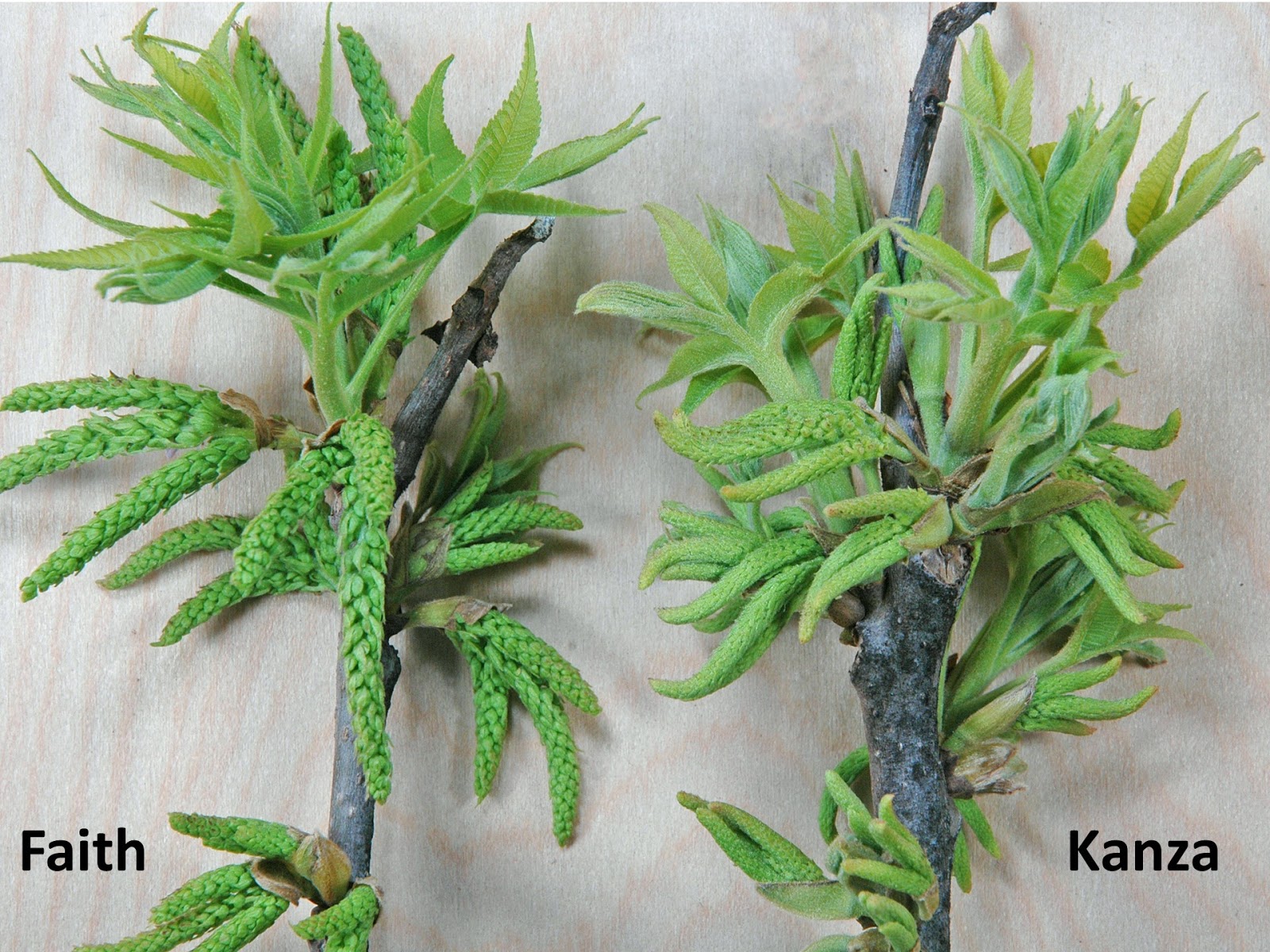
      This distinctive difference in catkin appearance can been seen as spring growth continues.. The photo at left shows the protandrous Faith cultivar in comparison to protogynous Kanza. As a general rule the catkins of protandrous cultivars are short and fat while catkins of protogynous cultivars are long and thin.
    While inspecting my trees, I collected shoots from three protandrous cultivar and three protogynous cultivars. Since the time of bud break differs among cultivars, these photographs offer a glimpse at early shoot development.

    The first set of shoots were collected from protandrous cultivars (photo at right).  Starting with Hark, note that the catkins of protandrous cultivars emerge before the leaves start to unfurl. As bud break continues, catkins continue developing at a fast rate becoming quite large early in the season.
   
    The photo of protogynous cultivars (at left) illustrates that shoot growth starts of quickly while catkin development is delayed.  Remember that pistillate flowers are produced on the terminals of new shoots. So, early shoot growth is just a precursor of early female flower receptivity. Catkin emergence on protogynous cultivars seems much slower than new shoot growth.

Saturday, May 19, 2018

Pecan pollination season

Faith female flower cluster 2018
   I finished up all my grafting projects last week just in time to record the flowering habits of all the trees in my pecan breeding plot. On Saturday, all the protandrous cultivars had already shed their pollen while pistillate flowers on these trees were only now becoming receptive. In contrast, trees with the  protogynous flowering habit had pollinated female blooms with catkins that were still not releasing pollen.


    Lets look at two cultivars to see the differences between protandrous and protogynous cultivars.  I'll start will Kanza, a protogynous cultivar. The photo at left shows a cluster of Kanza female flowers. Note that the stigmatal surface of each flower is tinged black. This is the first indication that these flowers are already pollinated.
    Kanza catkins, the male flowers, are still green (photo at right). Catkins will turn yellow in color just before each pollen sac opens up to release pollen into the air. These catkins will be opening up sometime this week.
     Hark is a protandrous cultivar. In the photo at left, Hark catkins have turned fully brown indicating that pollen sacs have already opened and pollen has been released. Look closely at the catkins and you'll see that each pollen sac is split open and the catkin is almost ready to fall from the tree.
   
Hark pistillate flowers are not very showy, but as a wind pollinated crop, it doesn't need colorful flowers (photo at right). These Hark female flowers have not yet started to glisten with stigmatal fluid. When a female flowers becomes receptive to pollen the stigma produces a fluid to help capture pollen from the air.
   It takes trees with both flowering habits to ensure a successful pollination season. A protandrous cultivar like Hark was shedding pollen when a protogynous cultivar like Kanza had receptive pistillate blooms. In a few days, Kanza will start to release pollen just in time to land on receptive Hark female flowers.
   Pecan trees  have developed this flowering dichogamy to ensure cross pollination and preserve hybrid vigor within the species. 

Friday, May 4, 2018

Pecan pollination habit revealed at budbreak

     While I was checking pecan budbreak, I cut shoots from two popular pecan cultivars (photo at right). These two cultivars represent the two flowering types pecan cultivars can exhibit. Kanza is a protogynous cultivar, meaning that female flowers become receptive before pollen is released. Hark is protandrous which means that pollen is shed before pistillate flowers become receptive. These two cultivars will pollinate each other. The early pollen shed by Hark will pollinate the early female flowers set by Kanza. Later in the pollination season, Kanza pollen will be released just in time to pollinate the late female flowers on Hark.
    During bud break you can already see clues to the flowering habit of any cultivar. The catkins of protandrous cultivars will be large and fat right at bud break. In contrast, the catkins on a protogynous cultivar at this time of year will be small and thin. One close up look at the photo and you can easily see the difference. Remember, you can click on any photo in this blog to get a larger image of that photo.

Friday, May 19, 2017

Checking on pecan pollination

    Yesterday, I wandered through our pecan cultivar trials to check on the progress of pecan pollination.  At this point, we are half way through pollination. All of the protogynous cultivars are releasing pollen and the protandrous cultivars have receptive pistillate flowers. Pawnee is a protandrous cultivar that is now displaying large, red stigmas on the ends of pistillate flowers (photo above).  The catkins on Pawnee shed their pollen a while back and have now dropped to the ground.

     The pistillate flowers of Kanza are fully pollinated (photo at left). Stigmas of female flowers dry up and turn black once they become pollinated.
    Kanza, being a protogynous cultivar, has late pollen release. Yesterday, Kanza catkins were releasing millions of pollen grains into the warm springtime winds.

    One thing I noticed about pecan flowers is that pistillate flowers of protogynous cultivars are smaller than pistillate flowers of protandrous cultivars.  In the photo above, you can see this size difference. Posey is protogynous while Pawnee is protandrous. By the end of the growing season the nuts of these two cultivars will be roughly the same size.


    While inspecting pecan flowers, I was also reminded that the color of receptive stigmas can vary from green, to orange, to bright red. The photo above illustrates some of this color variation. Both Major and Waccamaw had fully receptive pistillate flowers yesterday. Major displayed green stigmas while the Waccamaw stigmas are bright red. Since pecan trees are wind pollinated, stigma color has zero impact on pollination success. However, stigma color can sometimes be used to help identify certain cultivars. 

Thursday, June 2, 2016

Pecan crop load and pistillate flower strength

   Yesterday, I spent some time scouting the orchard to get a feel for the 2016 pecan crop. All of the pistillate flowers have been pollinated and I was encouraged when I found a cluster of five nuts on a Kanza tree (photo at right)
    However, most pecan nut clusters have 3 to 4 nuts at this time of year.  Look closely at the nut cluster pictured at left. Above the 4 nuts in this cluster you can see an empty flower stalk (red arrow). This portion of the pistillate flower inflorescence had also produced additional female flowers that have since dropped off the stem. Look closely enough and you will see a nut attachment scar on the stem that indicates the position of the now aborted flower. Now look at the very top of the stem. You should see four small sepals and a rudimentary pistillate flower stigma. This  is an example of a small, poorly-formed flower that would never have the strength to become fertilized or grow into a pecan.
   This single photo can help explain how pecan trees create flower clusters and why some flower clusters are larger than others. Pistillate flower stalks are formed at the end of the current seasons new grow. The number of flowers produced and the ability of those flowers to remain viable is determined by the energy stored in last year's wood. Given enough plant energy, a current season's terminal will start creating pistillate flowers and continue producing new flowers up the stem until the shoot basically "runs out of gas".  Flowers near the base of the flowering stalk are the strongest and are the most likely to become fertilized and produce a viable pecan. As the tree produces additional flowers, the tree gets to a point where it only has enough energy left to produce small or poorly formed pistillate flowers. These poorly formed flowers drop from the tree during the final stages of the pollination season.
   
    The amount of energy a shoot has available to create female flowers is largely determined by the general health of the tree and by the previous season's crop load. A heavy crop load can drain the tree's energy reserves to a point where a tree finds it difficult to produce viable female flowers or even initiate a pistillate inflorescence during the spring following a heavy crop the previous fall. The photo at right shows a flowering stalk that has dried up and all pistillate flowers have aborted (red arrow). Although this shoot had enough energy to initiate flowing, the size of this flower stalk indicates that the flowers were all small and weak.
    Many might think the lack of nut set on this shoot was due to a lack of pollination. However, pollination has nothing to do with the abortion of the flowers on this terminal. Weak and poorly formed flowers will never produce nuts regardless of the amount of pollen flying through the air.

   This year, I've also seen some trees that never bothered to try to create a pistillate flower clusters. Totally vegetative shoots are easy to spot at this time of year because they are still elongating and setting on new leaves (photo at left).  Trees covered with vegetative shoots this year are setting themselves up for a massive nut crop next year. 

Monday, June 15, 2015

Post-pollination nut drop

       Every spring we scout for pecan nut casebearer damage starting shortly after the end of the pollination season. While I'm up in the canopy searching for casebearer, I have noticed that a certain percentage of  flowers simply drop from the tree. I even found what looks like a perfectly normal pistillate flower dropped off and resting on a leaf (photo at left).

      During the the month of May (pollination season in SE Kansas), we experienced several extended periods of rainy weather. Several growers have been concerned that the wet weather inhibited pollination and nuts are dropping due to a lack of proper pollination. The nut clusters pictured above were from the same tree. The photo on the left has two pistillate flowers that are drying up and are ready to drop off. Only one healthy nut remains. In contrast, the nut cluster on the right has five healthy nuts. If rain was a factor in nut drop this year, all pistillate flowers clusters on a single tree would be showing signs of poor pollination. 

   There are actually two types of pollination season nut abortions. The first occurs early, during pollination. A pecan shoot that has insufficient resources can create a entire cluster of small, ill-formed pistillate flowers. These flowers often fall off right in the middle of pollination season. Later, the dried up peduncle will also fall off (photo above left). The second period of nut loss occurs after pollination has been completed.  In this case, what looks like healthy flowers drop from the tree sometimes leaving the entire peduncle bare (photo above right).
 

   One of the most common types of nut abortion I have seen is the dropping off of terminal flowers in the cluster (photo at right). As a tree creates a new pistillate flower cluster, nutlets are formed from base of the peduncle to the terminal. As pistillate flowers are formed, a flowering shoot can simply "run out of gas" and create small or ill-formed flowers at the cluster's terminal.  What ends up looking like a lack of pollination, is actually nut abortion caused by a weak female flower. Although weak female flowers usually occur at the terminal of a cluster, poorly formed flowers can occur anywhere in the cluster (photo above right)  

    We've recorded post-pollination nut drop for a period of several years and noticed some definite trends. In the graph at right, I've plotted the number of nuts per cluster over time (the month of June). Notice that during odd-numbered years, cluster counts start off high but dropped off sharply. During even-numbered years, trees produced fewer
nuts/cluster but suffered less nut drop. Switching over to yield data for those same 6 years (table at right), we find that odd-numbered years were high crop load years while even-number year produced lesser crops.
    Taken together, these two data sets tell me that pecan trees may have a way of regulating crop load that has nothing to do with pollination. If a tree produces an excess of pistillate flowers ("on" years) post-pollination nut drop will appear severe. In contrast, trees during "off" years seem to want to hang on to every flower they can. 
    This year, our groves are experiencing an "on" year. That might be why we are noticing more post-pollination nut drop. 

Friday, May 29, 2015

Pecans set on native pecans

    Yesterday, I drove through flood waters to get down to our pecan grove. At that time, not all our orchards were under water and I was able to get up in our hydraulic lift to check on pecan nut set (photo at right).  Because of the flooding, I was only able to check about a dozen trees but what I saw looked promising.  On many trees, every terminal bore a cluster of 5 to 6 nuts.
    When newly set nuts are so small, it is hard to look up at a pecan tree and get a good feel for the size of the nut crop. The photo at left is my attempt to show you how prolific our native trees are this year.  From terminal buds on last year's growth, two shoots grew and both produced a cluster of pistillate flowers. Currently, five pollinated nuts have set on each of these terminals (photo at left).
    Not pictured in the photo is a shoot that developed from a bud eight inches behind the two shoots in the photo. Sprouting from one-year-old wood and back inside the tree's canopy, this new shoot also produced a cluster of five nuts.
    With the heavy nut set I'm seeing on our trees, I plan to skip making an insecticide treatment to control pecan nut casebearer in early June. This doesn't mean I don't plan to spray our trees during the coming month. The super wet conditions we've experienced over the past couple of weeks has been ideal for the spread of pecan scab and a myriad of foliage diseases. Once we can get over the field with our spray rig, we'll be applying a fungicide to our trees.

Wednesday, May 7, 2014

Checking pecan cultivars for flowering habit

Mullahy, 5 May 2014
   As our pecan trees bud out and start to develop catkins, I've been checking out the flowering habits of several cultivars. In a previous post, I showed you how to tell if a pecan cultivar is protandrous (early pollen shedding) or protogynous (late pollen shedding) just by looking at the shape of emerging catkins. Earlier this week I photographed the catkins of several pecan cultivars so I could determine their flowering habit.
    The photo at right is a Mullahy terminal. Note that the catkins are long and thin, which tells me that Mullahy is a protogynous cultivar and will shed pollen late in the pollination season.

Hark, 5 May 2014
   The photo at left shows a Hark shoot. Hark catkins are short and fat indicating that this cultivar has a protandrous flowering habit. Hark will release its pollen early during the pollination season.
   In the photos below you should be able to see that the shape of the catkins indicate that Warren 346 and USDA 61-1-X are protandrous cultivars while City Park is a protogynous cultivar. It is interesting to note that the catkins of City Park are still elongating at the time this photo was taken and have not yet achieved their full length. It looks like City Park will be shedding its pollen at the tail end of the pollination season.

Warren 346, 5 May 2014
USDA 61-1-X, 5 May 2014
City Park, 5 May 2014


Monday, June 3, 2013

Natural crop load regulation during bloom

   
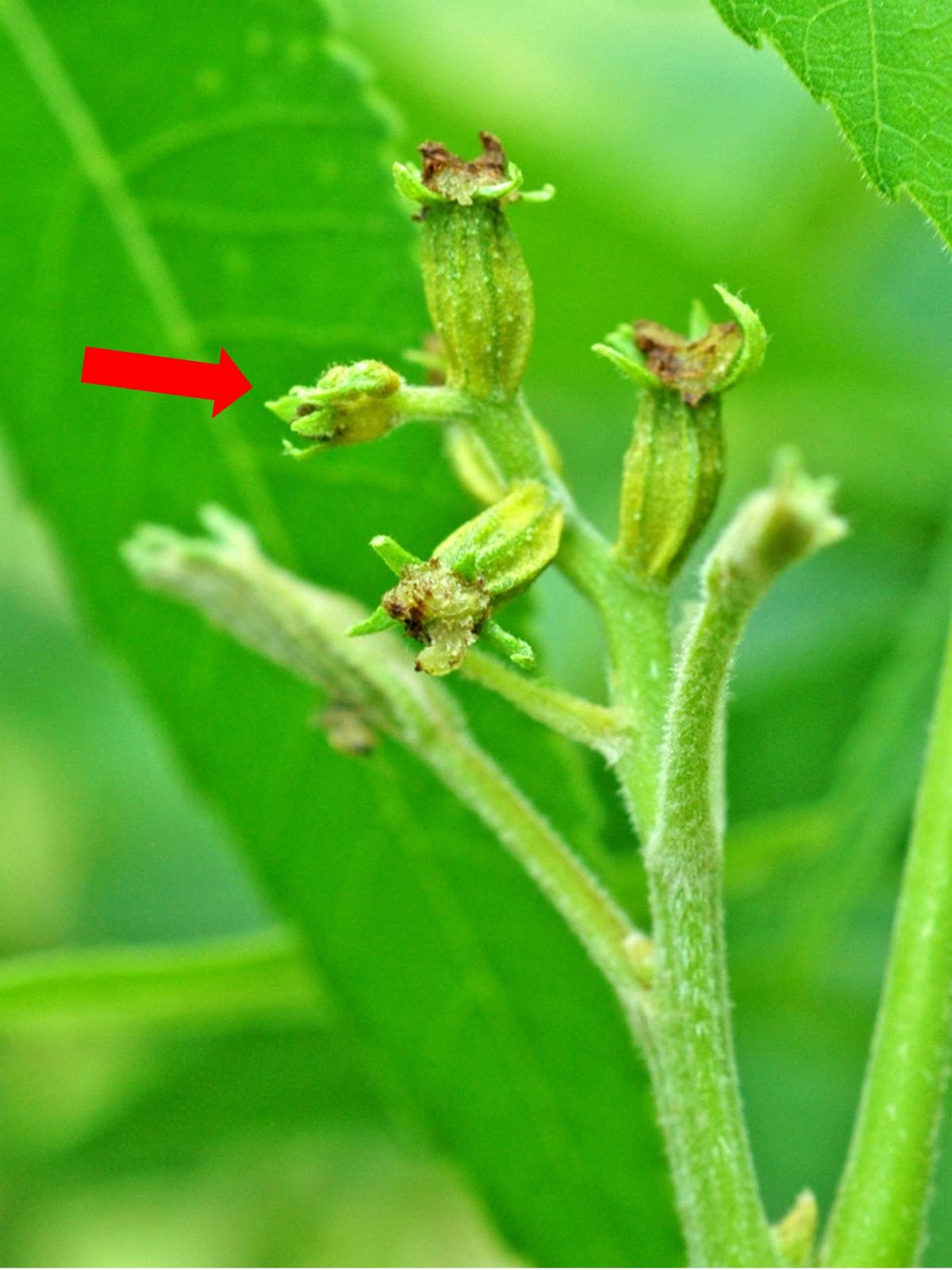
    Many pecan growers like to blame poor weather conditions during the pecan pollination season for a poor nut set. This happens whenever they see a developing nut cluster that has one or two flowers shriveled up and ready to drop off (red arrow points to 2 aborted flowers in the photo at right). Got to be poor pollination right? Wrong--its more often the case that the flowers aborting at this time of year were weak or poorly formed way back when the flower cluster was first created. Even if pollen lands and germinates on the stigma of a poorly formed pistillate flower, that flower is not strong enough to complete the fertilization process and will drop from the tree.
   
    In the photo at right, the red arrow points to a small, misshaped pistillate flower. This flower will never form a pecan and will eventually abort at the end of the pollination season. Note that this weak flower is located at the very terminal of the flower cluster. When a pecan tree develops pistillate flowers in the spring, the first flowers formed are found at the base of the flowering stalk (also known as the peduncle). As the flower cluster continues to grow, more pistillate flowers are formed along the peduncle. Eventually, the tree runs out of reproductive steam often resulting in the formation of small, weak flowers at the terminal of the flower cluster.
   The reproductive energy needed to create female flowers each spring is determined by the previous season's nut set and the tree's overall vigor. An excessive crop load one year is often followed by a year of weak pistillate flower formation (hence pecan's tendency towards alternate bearing). Drought, excessive flooding, lack of soil nutrients, insects and diseases can all put stress on a tree and reduce the strength of flower formation the following spring.
   So next time you start blaming poor pollination weather on your lack of pecan crop, think back to what happened last year. Did you do everything possible to ensure healthy tree growth?  

Tuesday, May 21, 2013

Pecan pollination half way complete

    After receiving some welcomed rainfall, I spent some time checking of the progress of our pollination season. All pecan cultivars have pistillate flowers showing and many of our protogynous cultivars have fully pollinated nutlets. One cultivar that was fully pollinated was Oswego (photo at right). After a nutlet is pollinated, the stigma of the flower turns black in color. 
    Compare the color of the Oswego stigmas (above) to the bright red stigmas now visible on Faith pecan trees (photo at left). Faith stigmas are just entering the stage when they become receptive to pollen. Oswego is an example of a protogynous cultivar while Faith is protandrous. At this point in the season Faith trees have released all their pollen while the pollen sacs on Oswego catkins have yet to open.
    
    If you are watching the pecan flowering process on your trees, the first sign that a pistillate flower has been pollinated is the appearance of black tips of the stigmatic surface. The Posey flowers pictured at right provide a prefect example of a recently pollinated flower.