Showing posts with label bud break. Show all posts

Friday, April 12, 2024

Spring bud development 2024

Kanza, 8 Apr. 2024

     On April 8th, while the nation was enamored with watching a solar eclipse, I was in my pecan grove watching new growth emerge from branch terminals in my pecan grove.  It's the start of a new pecan season and a time of great optimism for the coming nut crop.


Hark, 8 Apr. 2024

   While inspecting the emerging buds of multiple pecan cultivars two key observations came to the forefront. The first was the fact that the cultivar, Hark, breaks bud later than any cultivar in my orchard (photo at left). While most cultivars were showing some some green tissue development, Hark buds were just starting to swell or were still dormant.

    The second observation I could make was the obvious difference in catkin emergence between protandrous (type 1) and protogynous (type 2) cultivars. In the photos above, the red arrows point to the male flowers on both flowering types. With the protandrous cultivar (Caney),  the catkins have already emerged from their bud scales. In contrast, bud scales still tightly cover the catkins of the protogynous cultivar (Kanza). Later this Spring, female flowers will appear at the terminals of new shoots. Female flower clusters will first become visible on protogynous cultivars while protandrous cultivars develop their pistillate flowers during the later half of the pollination season. 

   I recorded bud break for numerous cultivars on April 8th including all of the cultivars from my pecan breeding project. This year, bud break seems fairly uniform across cultivars with the exception of the late leafing Hark. In the photos below, you'll see slight differences in bud development. The bottom line is that if a late spring freeze came now, a majority of cultivars would suffer significant cold damage. The good news is that with each passing day the chances for sub freezing temperatures becomes more remote.

Caney
   

Earlton   


Gardner   


Labette

Liberty  


Pleasanton

St. Paul


Thayer

Thursday, April 27, 2023

Observing pecan budbreak

     After a long winter, Spring finally arrived to the pecan grove. This year, I decided to photograph pecan bud development and leaf burst as it occurred during the month of April.  Each week, I snapped photos of pecan shoots on a Kanza tree (protogynous flowering) and a Liberty tree (protandrous flowering).

   On April 5th, the buds on Kanza trees had broken open their outer scales and were starting to show swelling green buds (photo at right).  


      On the same date (April 5) Liberty buds had swollen in size but had yet to split open their outer scales (photo at left).  

     One week later (April 12) Kanza buds were showing the first stages of leaf burst (photo at right). At this point, the two lateral buds that flank each vegetative shoot are still tightly closed. These lateral buds will eventually produce catkins.

   As a protandrous cultivar, Liberty displays its catkins first as buds start to open up in the Spring (photo at left, April 12). The vegetative bud has emerged but leaves have yet to burst forth.

       By April 18, Kanza leaves have unfurled and catkins are now visible (photo at right). You should note that Kanza catkins are long and narrow which is typical of catkins produced by protogynous cultivars.

     By the same date (18 Apr.), the leaves of Liberty have begun to expand but the catkins are still the dominate feature of this cultivar's new growth. Note that pollen sacs are already quite large on each catkin (photo at left). The short and wide catkins of Liberty are typical of cultivars with a protandrous flowering habit. 


    One week later (April 25),  the new vegetative shoots on Kanza trees have grown 4 to 5 inches in length (photo at right). The extremely long catkins have reached their final length. At this date I could still not detect the formation of a pistillate flower clusters at the apex of new shoot Kanza shoots. Hopefully that will come soon.

     On April 25, Liberty leaves have expanded but shoot length lags behind adjacent Kanza trees. However, Liberty catkins are now fully formed and will be ready to shed pollen about the same time as Kanza pistillate flowers appear in early May. (photo at left).


    On April 25, I searched long and hard for any signs of pistillate flower formation. After last year's extreme drought, I'm extremely curious to see how my trees will flower this Spring. I did find a single Caney terminal that displayed the early stages of pistillate flower development. In the photo at right, look carefully between the youngest emerging leaves. Note the oval-shaped structure nestled in the shoot's growing tip. That's the first sign of a pistillate flower cluster.


Tuesday, May 3, 2022

Pecan leaf burst and first signs of pollination season

Kanza leaf burst, 26 Apr 2022
      Last week I was able to photograph several pecan cultivars as new spring growth emerged from long-dormant branches. As buds break, you should note the strong apical dominance of new shoot growth that is characteristic of pecan trees.  In the photo at right, new shoots and leaves sprout primarily from a cluster of terminal buds that developed as shoot growth slowed to a stop during the summer of last year.  Further down the stem, you will note that buds have broken open but seem to only produce male flowers or catkins. This is a consequence of apical dominance. The buds at the terminal of the branch break first and their growth sends a hormonal signal down the branch to suppress the development of  vegetative buds lower on the branch. 

    For sexually mature pecan trees, each primary bud on last year's shoot contains a central vegetative bud and two lateral male reproductive buds. Note that each male reproductive bud produces 3 catkins. As terminal growth continues to expand the hormonal signals become so strong that it causes central vegetative buds lower on the stem to abort from the tree. The catkins, however,  remain until they complete pollen shed later in May. 

Gardner, 26 Apr 2022
    As I moved through my orchard, I observed obvious differences between cultivars in terms of bud development and the appearance of catkins. Some trees appear to produce catkins well before new shoot growth. This occurs with protandrous pecan cultivars like Gardner (photo at left).

    Pecan trees have one of two flowering habits. Trees that release pollen before their female flowers become receptive, have a protandrous flowering habit. Trees that produce female flowers that are receptive to pollen before they release their own pollen are termed protogynous.  

   Over the years, I have also noted that the catkins on protandrous cultivars appear short and fat while catkins on protogynous cultivar are much longer and narrow.

Labette, 26 Apr 2022

    The photo at right is of a  Labette shoot and is typical of the early Spring appearance of a protogynous cultivar. Note how far the leaves have expanded in contrast to the Gardner shoot pictured above. Catkins on Labette have also emerged but they are not nearly a prominent as the catkins on Gardner at this point. However, note that even though Labette catkins are still enlarging they are already longer than Gardner catkins.


    During my tour of the orchard I noted two cultivars that had significantly later bud development.  Both Liberty and Hark are protandrous cultivars. Liberty appears to lag several days behind the leaf burst of other protandrous cultivars. In striking contrast, Hark leaf burst is far behind all other cultivars on my farm. Late leafing is a desirable cultivar characteristic for a pecan cultivar when grown in areas with a high risk of late Spring frosts. 

Friday, April 15, 2022

Bud Break and Spring Fertilization

Kanza buds 14 April 2022

    As I have mentioned in previous posts, I like to time the application of fertilizer to my pecan grove to coincide with the very first signs of tree bud growth. We've had a cool spring in SE Kansas this year which has delayed the bursting of pecan buds. Here we are in mid-April and our pecan trees still appear largely barren of new growth. However, on close inspection I've found some trees have started to push their buds open (Kanza buds pictured at right).  

    Seeing bud growth, I rented a fertilizer spreader and applied 150 lbs./ac urea and 100 lbs./acre K-Mag. K-Mag is a naturally occurring mineral that contains potassium (K), Magnesium, and Sulfur. In my pecan grove, previous leaf analysis results indicated that my trees were low in Magnesium. This is what prompted my switch to K-Mag rather than use the more common potassium fertilizer, muriate of potash (potassium chloride).

    The cost of all fertilizer materials have increased dramatically over the past 18 months, which has made many pecan producers pause to question; "Can I really afford to apply fertilizer this year?".  At first, skipping a regular fertilizer application will seem to have little effect on pecan yield. The yield for 2022 is largely programed in the tree before you ever make a spring fertilizer application. The negative affect of skipping a fertilizer application this year will come in 2023. Without adequate nutrient applications in 2022, the tree will drain all of its reserves to grow and mature the current nut crop. This will leave the tree unable to create the pistillate flower buds that will form the basis of the 2023 crop.  Ultimately, skipping a fertilizer application will increase a pecan tree's tendency towards alternate bearing.   

USDA 61-1-X  14 Apr.2022

   While scouting my orchard for bud development, I observed that not all cultivars were at the same stage of bud development. For example, USDA 61-1-X had swollen buds that looked ready to burst open (photo at right).
Hark 14 Apr 2022


    In sharp contrast, Hark buds appeared fully dormant (photo at left). Late bud break is a positive trait for northern pecan cultivars. A delayed start to shoot growth often allows late budding pecan trees to avoid late spring frost damage.


    As a general rule, pecan trees are one of the latest tree species to break bud in the spring. On the same day that I was scouting pecans for bud break, my apple orchard was in full bloom, buzzing with the sound of hard-working honey bees (photo above).

Saturday, April 17, 2021

New pecan shoots emerging


     With a week of cool days and even cooler nights, pecan shoot growth has slowed to a crawl. However, when I looked at my trees a few days ago I could already see new leaves and catkins emerging from terminal branches. The photo at right shows the terminal of a 'Gardner' branch. The stem seems to be covered with emerging catkins with a single vegetative bud at the top of the shoot. This type of spring bud emergence is typical for a protandrous pecan cultivar such as 'Gardner'. The word, "protandrous", can be roughly translated as "first male" and describes a pecan cultivar that sheds pollen before the pistillate flowers on the same tree become receptive to pollination.  

    The photo at left shows the terminal of a 'Kanza' shoot. Vegetative growth on this shoot is far more advanced with catkins only now starting to emerge from their bud scales. 'Kanza' is a protogynous cultivar. The word "protogynous" can be loosely translated as "first female". Pecan pistillate flowers are produced on the ends of new shoots which means that protogynous cultivars prioritize shoot growth over catkin growth during the initial phases of bud development. Ultimately, this advanced vegetative growth will lead to the pistillate flower clusters becoming receptive during the earliest part of the pollination season. 

   In the grand scheme of things, a protandrous cultivar will pollinate a protogynous cultivar and vice versa. Since pecan trees are wind pollinated this dicogamy of flowering types ensures that nuts form as the result of cross pollination. Cross polination imparts hybrid vigor in the next generation of pecan trees (seedling trees grown from nuts) ensuring the continued survival of the species.

Wednesday, April 7, 2021

Pecan trees breaking bud

     Over the past week, I've been enjoying the spring weather by working in the pecan grove. Today, I collected terminal branches from several trees to illustrate the variation that occurs in time of budbreak between pecan cultivars. The photo below shows the stage of bud development for six pecan cultivars.  


    Greenriver buds were the most advanced with new leaves primed to unfurl. In sharp contrast, Hark buds were just starting to swell with their out scales recently split open.

   When folks look at variation among pecan cultivars they often try to make generalizations in terms of northern pecan cultivars vs. southern cultivars.  However, the earliest bud breaking cultivars shown above (Greenriver and Yates 68) are widely planted northern pecans. Lakota and Kanza are USDA creations that contain genes from both a southern cultivar and Major (a northern cultivar). Gardner and Hark are open pollinated seedlings of unknown parentage. From my experience, I have noticed an equal amount of variation in bud development among the native pecan trees that populate the Neosho River bottoms.   

    The timing of bud development has one important ramification. Trees that break bud early are more often damaged by late spring frosts. Over the years, I can clearly remember Greenriver buds suffering frost damage.   However, with cold enough temperatures, all stages of green tissue on pecan trees can be injured.
   

Monday, March 30, 2020

Pecan trees breaking bud

     Between rain showers, I noticed the slightest amount of green tissue emerging from the terminals of pecan tree branches. I decided to take a closer look to see how this Spring's new growth was developing on my trees. After a tour of the grove,
I found that some cultivars still looked dormant while others had broken open their inner bud scales. Posted below are photos of pecan buds that I took today (30 March 2020). Each photo is identified by cultivar and the stage of bud development. This year, bud break seems to have started about a week earlier than average.  If night-time temperature stay above 26 degrees F over the next three weeks, we should escape any freeze damage to emerging buds.

Hark, dormant, 30 Mar 2020
Kanza, Outer scale split, 30 Mar 2020


Greenriver, Bud elongation, 30 Mar 2020


Faith, Bud swell (protandrous cultivar), 30 Mar 2020

    
KT149, Bud swell (protogynous cultivar), 30 Mar 2020

Thursday, April 18, 2019

Pecan catkins emerging

     Yesterday, I spent some time out in my pecan grove inspecting emerging leaves and catkins. Its much too early to see the kind of nut crop we are going to have in 2019, but by looking carefully at catkins I can determine a pecan tree's flowering habit.

    Pecan cultivars that shed pollen before their pistillate blooms are receptive are said to have a protandrous flowering habit. Cultivars that produce receptive female flowers before shedding their pollen have a protogynous flowering habit. Nature has designed pecan trees with two flowering habits to ensure that every nut produced by a tree has the hybrid vigor that results from cross pollination.
    In the photo above, Oswego is an example of a protogynous cultivar while Yates 68 is protandrous. Now look at the emerging catkins. The Yates 68 catkins are already quite large, seemingly developing  faster that the new leaves. In contrast, the catkins on Oswego are just emerging  while several new leaves are expanding on the new shoot.

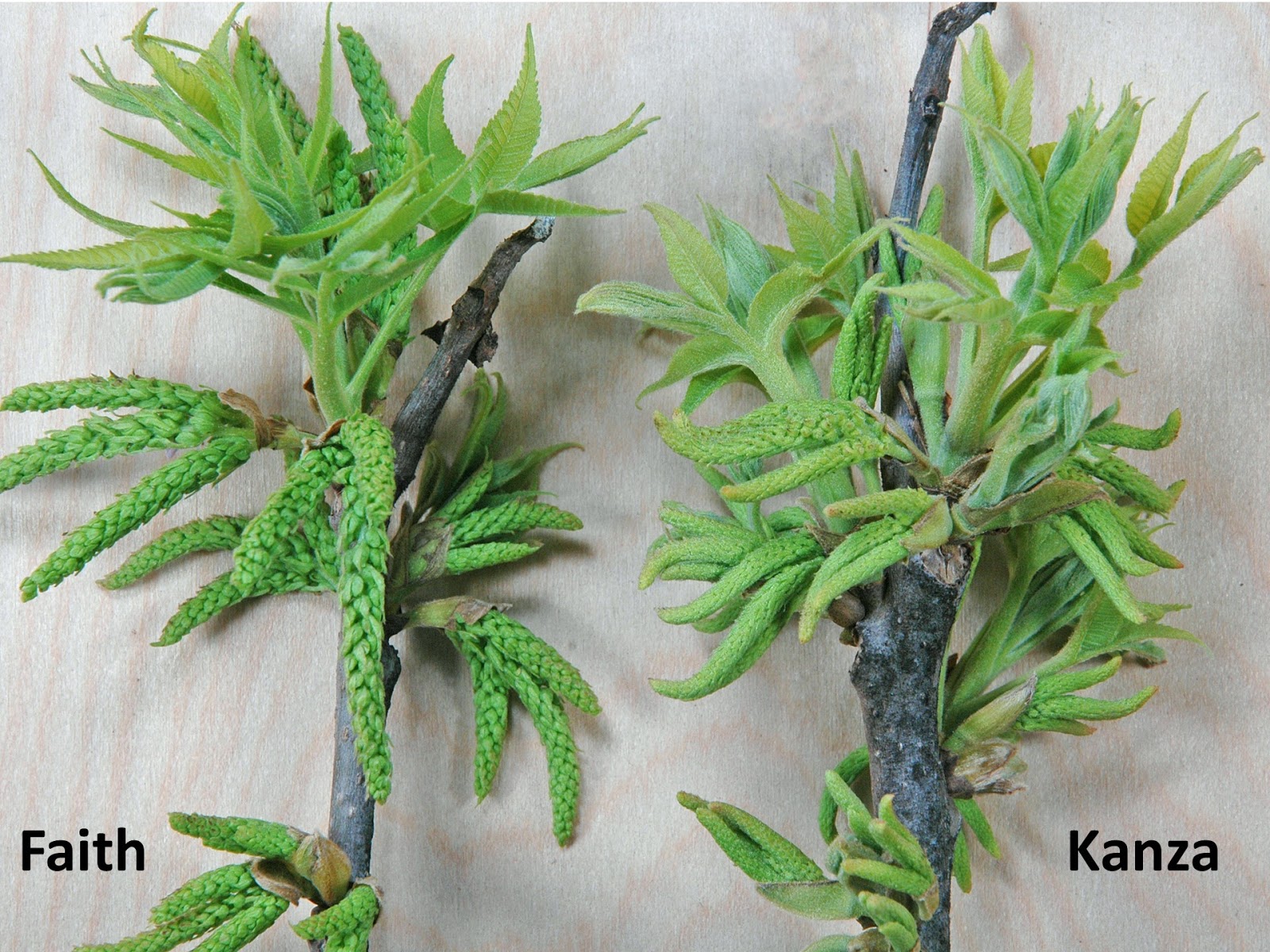
      This distinctive difference in catkin appearance can been seen as spring growth continues.. The photo at left shows the protandrous Faith cultivar in comparison to protogynous Kanza. As a general rule the catkins of protandrous cultivars are short and fat while catkins of protogynous cultivars are long and thin.
    While inspecting my trees, I collected shoots from three protandrous cultivar and three protogynous cultivars. Since the time of bud break differs among cultivars, these photographs offer a glimpse at early shoot development.

    The first set of shoots were collected from protandrous cultivars (photo at right).  Starting with Hark, note that the catkins of protandrous cultivars emerge before the leaves start to unfurl. As bud break continues, catkins continue developing at a fast rate becoming quite large early in the season.
   
    The photo of protogynous cultivars (at left) illustrates that shoot growth starts of quickly while catkin development is delayed.  Remember that pistillate flowers are produced on the terminals of new shoots. So, early shoot growth is just a precursor of early female flower receptivity. Catkin emergence on protogynous cultivars seems much slower than new shoot growth.

Sunday, March 31, 2019

Pecan buds starting to push

     My pecan trees have been slow to break bud this year, but finally, I noted the first signs of new growth. Pictured above is a Kanza shoot with the two primary buds nearest to the terminal in the bud stage called outer scale split.
   After checking my Kanza trees I took a quick survey of my other cultivars and found that some had split open their outer scales while others still appeared dormant. The photos below show bud development as of March 31, 2019.


    The start of budbreak is the signal to get started with fertilizing my pecan grove. However, we just had 3/4 of an inch of rain and I still have several puddles of water standing in the grove (photo at right). Its not a good idea to fertilize into standing water, so I will wait a couple of days for the water to seep into the ground before spreading my fertilizer.

Thursday, March 21, 2019

Pecan trees still dormant

     The calendar says its Spring and my peach trees are starting to show some pink buds. But it seems like its still winter in my pecan orchard.
    The first sign that pecan buds are beginning to expand is a bud stage that is termed outer scale split. I took the photo at right back in 2013 to illustrate what exactly outer scale split looks like. Note that the outer covering (or scale) that surrounds a dormant bud splits open when the bud inside starts to expand. Eventually the outer scale is pushed off the end of the bud to reveal a tight green bud underneath.
    I watch for outer scale split every year because this event coincides with the start of active tree root growth. Fertilizer is most efficiently taken up by actively growing tree roots so I make my Spring fertilizer application when I see outer scale split (I haven't fertilized yet).

   I checked three pecan cultivars for signs of bud growth; Faith, Hark, and Kanza. The photos above shown three twigs with fully dormant buds. From past experience, Faith will begin bud growth several days before Hark and Kanza. But as of today, Faith buds showed no signs of expansion.  Over the past few days we've experienced some mild daytime temperatures but our nights have still been chilly. It will take some warmer night time temperatures to wake up pecan trees from winter dormancy.     

Wednesday, May 2, 2018

Bud break after early April freezes

    During the last week of April, we finally received some warm night-time temperatures that have stimulated the buds on our pecan trees to finally push open (photo at right). In my last post, I mentioned that I discovered some freeze damage to buds from the April 16th freeze. Now that the trees are finally starting to grow I can see the extent of that damage.
   The first thing I noticed was a wide degree of variation in bud break over the entire tree's canopy. With some trees, freeze damage was pronounced on lower limbs while higher in the canopy the buds were breaking normally. The photos above are examples of bud break on the same tree. In the lower portion of the canopy, terminal buds were killed and you can see green buds pushing out from the base of last year's shoot. Twenty five feet up in the air, bud break appeared normal.  The difference in damage due to height within the tree canopy is due to the fact that on April 16th we experience a radiation freeze. During these types of freezes, temperatures are coldest closer to the ground.

        I discovered that most cultivars suffered only limited cold damage. On many trees, bud break on lower limbs appear almost normal, except if you look closely, the terminal buds are stunted and not growing normally (photo above). Buds just below the terminal are growing new shoots.This type of damage becomes obvious when you compare the lower shoot to one growing higher in the tree. Note that the terminal buds on the upper shoot are growing strait up from the terminal of last year's growth, just like they should.
    Since the vast majority of nuts are produced in the upper portion of the tree's canopy the impact the the April 16th freeze will be minimal. However, we won't know for certain until pollination season rolls around later this month.

Saturday, April 21, 2018

Freeze injury to pecan buds

Kanza buds, 20 June 2018
    On Monday morning, April 16th, a strong cold front ushered in some very cold temperatures. We recorded 24 degrees F (-4 C) just after sun rise. Dormant pecan buds can easily handle 24 degrees but green pecan tissues freeze at around 26 degrees. Pecan bud development had not advanced much by April 16 but after the freeze many buds seemed to remain in a state of suspended animation (photo at above, right).

Kanza buds, 20 June 2018
     I decided to cut open some buds to see if I could spot cold injury (photo at right). Healthy buds should appear bright green. These buds darkened with dark brown streaks, sure sign of cold injury.


Kanza buds, 20 April 2018
     I cut open some more buds and found some were still green while others were black. It seems that this Spring's cold injury will vary widely both withing the canopy of a tree and between cultivars. One thing is certain, the 2018 pecan crop will be reduced.


    I looked at several cultivars and found shoots with damaged buds (no signs of further buds enlargement)  and shoots with nice green buds. The photo at left shows two shoots cut from the same Faith tree. The shoot on the left has emerging pecan buds that are plump and green. The shoot on the right has buds that look almost shriveled and have failed to "green-up" since the freeze. This kind of variation in damage seems very common among several pecan cultivars.
   
      I was encouraged to find that the two buds I cut open from Hark shoots looked healthy and not damaged (photo at right).
    We have suffered through late spring frosts in previous years with each episode causing different amounts of crop loss depending on the stage of bud development when the frost hit and the health of the trees. Back in 2014, we saw significant bud injury but the trees were able to produce pistillate flowers from buds lower down on the shoot. Come this May, I'll be evaluating pecan cultivars for their ability to produce female flowers following this freeze.
    Although I don't know the full impact this year's Spring freeze will have on nut production, I do know that the start of the Spring grafting season will be pushed back at least a week. I always like to see active green growth on my stock trees before I start grafting.