Showing posts with label flowering. Show all posts

Friday, April 12, 2024

Spring bud development 2024

Kanza, 8 Apr. 2024

     On April 8th, while the nation was enamored with watching a solar eclipse, I was in my pecan grove watching new growth emerge from branch terminals in my pecan grove.  It's the start of a new pecan season and a time of great optimism for the coming nut crop.


Hark, 8 Apr. 2024

   While inspecting the emerging buds of multiple pecan cultivars two key observations came to the forefront. The first was the fact that the cultivar, Hark, breaks bud later than any cultivar in my orchard (photo at left). While most cultivars were showing some some green tissue development, Hark buds were just starting to swell or were still dormant.

    The second observation I could make was the obvious difference in catkin emergence between protandrous (type 1) and protogynous (type 2) cultivars. In the photos above, the red arrows point to the male flowers on both flowering types. With the protandrous cultivar (Caney),  the catkins have already emerged from their bud scales. In contrast, bud scales still tightly cover the catkins of the protogynous cultivar (Kanza). Later this Spring, female flowers will appear at the terminals of new shoots. Female flower clusters will first become visible on protogynous cultivars while protandrous cultivars develop their pistillate flowers during the later half of the pollination season. 

   I recorded bud break for numerous cultivars on April 8th including all of the cultivars from my pecan breeding project. This year, bud break seems fairly uniform across cultivars with the exception of the late leafing Hark. In the photos below, you'll see slight differences in bud development. The bottom line is that if a late spring freeze came now, a majority of cultivars would suffer significant cold damage. The good news is that with each passing day the chances for sub freezing temperatures becomes more remote.

Caney
   

Earlton   


Gardner   


Labette

Liberty  


Pleasanton

St. Paul


Thayer

Thursday, April 27, 2023

Observing pecan budbreak

     After a long winter, Spring finally arrived to the pecan grove. This year, I decided to photograph pecan bud development and leaf burst as it occurred during the month of April.  Each week, I snapped photos of pecan shoots on a Kanza tree (protogynous flowering) and a Liberty tree (protandrous flowering).

   On April 5th, the buds on Kanza trees had broken open their outer scales and were starting to show swelling green buds (photo at right).  


      On the same date (April 5) Liberty buds had swollen in size but had yet to split open their outer scales (photo at left).  

     One week later (April 12) Kanza buds were showing the first stages of leaf burst (photo at right). At this point, the two lateral buds that flank each vegetative shoot are still tightly closed. These lateral buds will eventually produce catkins.

   As a protandrous cultivar, Liberty displays its catkins first as buds start to open up in the Spring (photo at left, April 12). The vegetative bud has emerged but leaves have yet to burst forth.

       By April 18, Kanza leaves have unfurled and catkins are now visible (photo at right). You should note that Kanza catkins are long and narrow which is typical of catkins produced by protogynous cultivars.

     By the same date (18 Apr.), the leaves of Liberty have begun to expand but the catkins are still the dominate feature of this cultivar's new growth. Note that pollen sacs are already quite large on each catkin (photo at left). The short and wide catkins of Liberty are typical of cultivars with a protandrous flowering habit. 


    One week later (April 25),  the new vegetative shoots on Kanza trees have grown 4 to 5 inches in length (photo at right). The extremely long catkins have reached their final length. At this date I could still not detect the formation of a pistillate flower clusters at the apex of new shoot Kanza shoots. Hopefully that will come soon.

     On April 25, Liberty leaves have expanded but shoot length lags behind adjacent Kanza trees. However, Liberty catkins are now fully formed and will be ready to shed pollen about the same time as Kanza pistillate flowers appear in early May. (photo at left).


    On April 25, I searched long and hard for any signs of pistillate flower formation. After last year's extreme drought, I'm extremely curious to see how my trees will flower this Spring. I did find a single Caney terminal that displayed the early stages of pistillate flower development. In the photo at right, look carefully between the youngest emerging leaves. Note the oval-shaped structure nestled in the shoot's growing tip. That's the first sign of a pistillate flower cluster.


Wednesday, May 18, 2022

Notes on pecan pollination


     Last weekend I took advantage of calm winds and sunny skies to photograph pecan flowering and pollination. I also like to scout my orchard at this time of year to get a feel for this year's nut crop. During the month of May, my trees are always covered with catkins--the long worm-like structures that hang down from last year's shoot growth. Male flowers (pollen sacs) cover each catkin and eventually split open to release millions of yellow pollen grains into the air to hopefully find their way to a receptive female bloom.

    Pecan female blooms are not very showy (photo at right) and can be found at the terminal new spring shoot growth. Look carefully at the flower cluster in the photo and you will note that the ends of each flower (the stigmatal surface) has started to turn dark brown-black indicating these flowers have been pollinated. The flower cluster pictured here is from a Kanza tree. Kanza is a protogynous cultivar meaning the female flowers on the tree become receptive early in the pollination season while Kanza pollen is released late.

     When scouting my orchard for yield potential, I concentrate on counting the number of terminals on a tree that have developed female flower clusters. The good news for my orchard is that the 2022 crop looks very promising at this point.

On my trip around the orchard, I decided to concentrate recording the flowering habits of the pecan cultivars originating from my breeding project. I took 2 photos of each cultivar. The first shows the entire fruiting shoot. The second is a close-up of a female flower cluster. All photos were taken on May 14th. I've noted the flowering habit of each cultivar.

CANEY - PROTANDROUS


Caney was actively shedding pollen at the time this photo was taken.


Caney pistillate flowers were still growing and not yet receptive. The stigmas will be bright red at receptivity.


 EARLTON - PROTOGYNOUS

Earlton has long slender catkins typical of protogynous cultivars.


A Earlton flower cluster shows signs of already being pollinated.


LABETTE - PROTOGYNOUS

Look carefully. See if you can spot the female flower cluster held at the end of the new Labette shoot.


Labette female flowers look ready to receive pollen.


LIBERTY - PROTANDROUS

Liberty was shedding pollen and should make a good pollinator for Kanza.


Liberty female flowers were still growing in size. Stigmas will be red in color.


PLEASANTON - PROTOGYNOUS

Pleasanton catkins are starting to turn yellow in color. It won't be long before pollen sacs start to open and release their pollen grains.


Pleasanton female flowers have started to turn brown indicating pollination has occurred.


ST. PAUL - PROTANDROUS

St. Paul catkins were shedding pollen. So much pollen that I had to clean off my camera lens.


St. Paul female flowers were still not fully formed. These females will have green stigmas.


THAYER - PROTANDROUS

Thayer catkins have shed most of their pollen and have turned brown in color.


Thayer female flowers are still growing. The stigmas will be bright red when receptive to pollen


Tuesday, May 3, 2022

Pecan leaf burst and first signs of pollination season

Kanza leaf burst, 26 Apr 2022
      Last week I was able to photograph several pecan cultivars as new spring growth emerged from long-dormant branches. As buds break, you should note the strong apical dominance of new shoot growth that is characteristic of pecan trees.  In the photo at right, new shoots and leaves sprout primarily from a cluster of terminal buds that developed as shoot growth slowed to a stop during the summer of last year.  Further down the stem, you will note that buds have broken open but seem to only produce male flowers or catkins. This is a consequence of apical dominance. The buds at the terminal of the branch break first and their growth sends a hormonal signal down the branch to suppress the development of  vegetative buds lower on the branch. 

    For sexually mature pecan trees, each primary bud on last year's shoot contains a central vegetative bud and two lateral male reproductive buds. Note that each male reproductive bud produces 3 catkins. As terminal growth continues to expand the hormonal signals become so strong that it causes central vegetative buds lower on the stem to abort from the tree. The catkins, however,  remain until they complete pollen shed later in May. 

Gardner, 26 Apr 2022
    As I moved through my orchard, I observed obvious differences between cultivars in terms of bud development and the appearance of catkins. Some trees appear to produce catkins well before new shoot growth. This occurs with protandrous pecan cultivars like Gardner (photo at left).

    Pecan trees have one of two flowering habits. Trees that release pollen before their female flowers become receptive, have a protandrous flowering habit. Trees that produce female flowers that are receptive to pollen before they release their own pollen are termed protogynous.  

   Over the years, I have also noted that the catkins on protandrous cultivars appear short and fat while catkins on protogynous cultivar are much longer and narrow.

Labette, 26 Apr 2022

    The photo at right is of a  Labette shoot and is typical of the early Spring appearance of a protogynous cultivar. Note how far the leaves have expanded in contrast to the Gardner shoot pictured above. Catkins on Labette have also emerged but they are not nearly a prominent as the catkins on Gardner at this point. However, note that even though Labette catkins are still enlarging they are already longer than Gardner catkins.


    During my tour of the orchard I noted two cultivars that had significantly later bud development.  Both Liberty and Hark are protandrous cultivars. Liberty appears to lag several days behind the leaf burst of other protandrous cultivars. In striking contrast, Hark leaf burst is far behind all other cultivars on my farm. Late leafing is a desirable cultivar characteristic for a pecan cultivar when grown in areas with a high risk of late Spring frosts. 

Monday, May 17, 2021

Pecan pollination underway

Kanza catkins and new growth
    During mid-May I scout my pecan orchard for the intensity of pistillate flower production on new branch terminals. If I find a flower cluster on nearly every shoot, I expect a good nut harvest come this fall.

   The amount of catkins produced by a tree has no bearing of the nut crop produced in the Fall. Although large amounts of wind-blown pollen is necessary to fertilize a large pistillate flower crop, there never seems to be a shortage of fine yellow pollen grains floating in the breeze during the month of May (in our area).

Kanza pistillate flowers
     Pecan pistillate flowers (female) are found on the very terminal end on the current seasons new growth. Each flower in the cluster has a prominent stigmatal surface that is designed to capture pollen grains out of the air. Each stigma has two horns and features a very rough surface. The stigmas of Kanza flowers are green. However,  stigma color among pecan cultivars can varyfrom green, to orange, to red. Since insects are not required for pecan pollination, stigma color has no impact of pollination success. 


Pecan trees have one of two flowering habits. Trees that release pollen before their female flowers become receptive, have a protandrous flowering habit. Trees that produce female flowers that are receptive to pollen before they release their own pollen are termed protogynous.  Today, I found several protandrous cultivars had started releasing their pollen. You can tell pollen is being released because the pollen sacs on the catkins have split open and are turning brown. Gardner pecan, as seen in the photo above, was  releasing pollen today.  
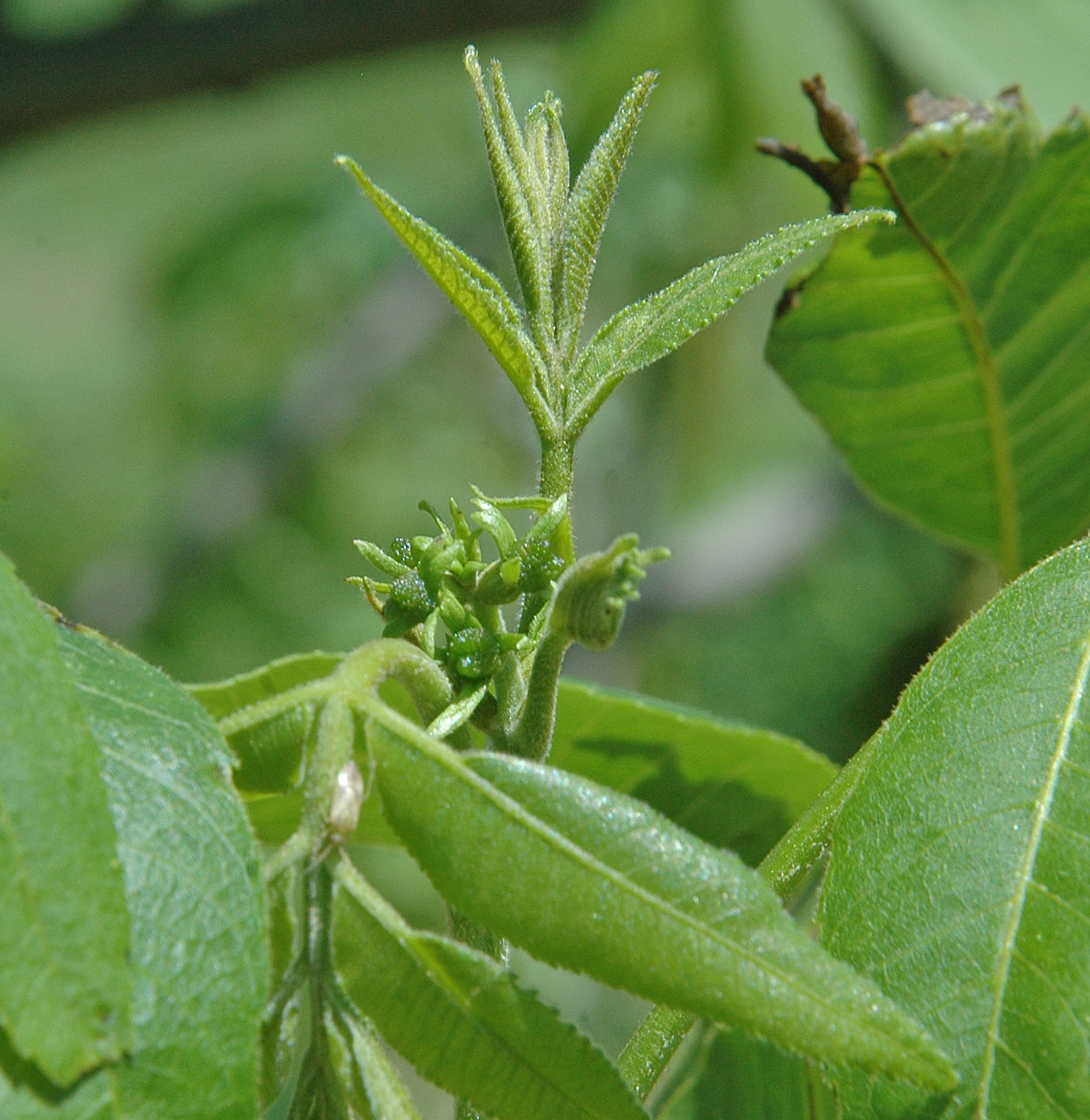
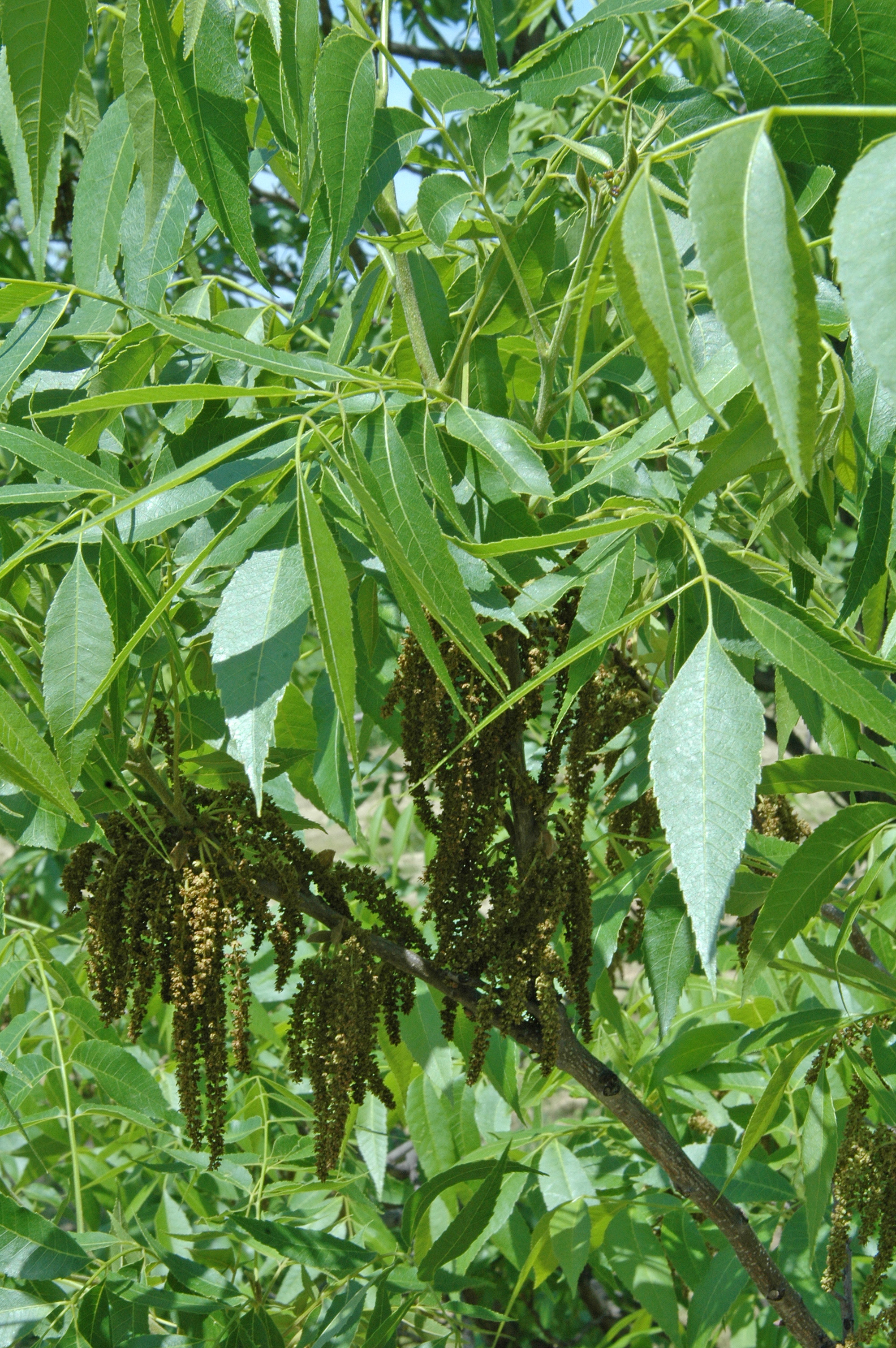
    Pecan trees have developed this dichogamous system of  flowering to prevent self pollination and inbreeding depression.

    If you would like to discover the flowering type of your pecan trees, simply collect some catkins from each cultivar. The first thing you will notice is that catkins are produced in clusters of three. Even before pollen release you can identify flowering type by the shape of the catkins produced. Catkins of protandrous cultivars are short and fat while the catkins of protogynous cultivars are long and narrow (photo at left).

Wednesday, May 20, 2020

Pecan pollination season


Gardner pistillate flowers
    The weather in SE Kansas this spring has been cool, cloudy, and wet with only a few days of sunshine and warm temperatures. As a result, pecan bud break and flowering has been very uneven. This year my pecan trees responded to the brief periods of warm temperatures (especially warm over-night temps) with spurts of rapid grow. However, when the cool, wet weather returned, spring growth slowed to a crawl. The results has been an extended pollination season characterized by uneven pollen release and widely variable pistillate flower development.

    It looks like we are about half way through the pollination season. The pistillate flowers of protogynous cultivars, like Kanza, appear to be pollinated (photo at left).  The tips of the female's stigmas turn black in color after they have received pollen. 
     Protandrous cultivars have either shed all their pollen and dropped their catkins or are releasing pollen grains now. The photo at right shows the catkins of Yates 68. The center cluster of catkins has released its pollen and is starting to turn brown. The catkin clusters to the right and left are yellow in color indicating that the pollen sacs are fully mature and ready to burst open.

     In the past, I've noted that pecan flowering type can be determined by the  size and shape of the catkins. But in addition, protandrous and protogynous cultivars differ in the appearance of their pistillate flowers.  The pistillate flowers of protogynous cultivars appear early and are often small in size. In contrast, the pistillate flowers of protandrous cultivars develop later and have much larger stigmas.

       KT149 is protandrous and has showy red stigmas much like its Pawnee parent (photo at left). Kanza is protogynous and produces pistillate flowers that are smaller with yellow-green stigmas. The color of pecan stigmas can range from green to yellow to orange to red and is not related to flowering type. However, the size of the stigmas found on protandrous cultivars always seems much larger in comparison to the stigmas found on protogynous cultivars.

    Most growers look forward to pollination season because they get their first glimpse into next fall's nut crop. Remember, the number of catkins produced by a tree is not related to nut load. Look for pistillate flower clusters as they emerge from the tips of this Spring's new growth (circled in photo at right). A full nut crop is produced when 50-70% of all new shoots are terminated by a pistillate flower cluster.

Thursday, May 16, 2019

Pecan pollination half-way complete

    Today, I checked pecan flowering to see how things were progressing. My first stop was a Gardner tree. As you can see in the photo at right this protandrous cultivar has shed all its pollen, the catkins have turned brown but have yet to fall from the tree. Hardly visible in the photo is a cluster of female flowers at the end of the new shoot.

  The photo at left is a close-up of a nearly receptive cluster of Gardner pistillate blooms. The bright red stigmatal surface of Gardner flowers really make these blooms easy to spot.
    Next, I moved on to a protogynous cultivar--Kanza (photo at right). Kanza catkins have turned yellow in color and will begin opening soon to release pollen. If you look carefully you can spot a cluster of female flowers at the end of the new growth.

    Kanza pistillate blooms appear to be already pollinated (photo at left). The stigmatal surfaces of Kanza flowers are a light greenish-yellow. However, note that the tips of the stigmas have turned black which is a good indicator that these flowers have been pollinated.
   From what I have seen so far during this year's pollination season, the potential for a good nut crop look very good.