Showing posts with label pecan tree biology. Show all posts

Saturday, September 1, 2018

Pecan seedling or grafted tree: How to tell the difference

   Several weeks ago I received and email from a grower that had was having trouble determining if the shoots growing from a newly planted tree were coming from the scion cultivar or from the seedling rootstock. Once you learn what to look for, telling the difference can be easy.
    In the photo at right, the leaf on the left was produced by a trunk sprout originating from below the graft union. The leaf on the right came from the grafted portion of the tree.
    Early in the growing season, juvenile leaves have a reddish appearance compared to the bright green of leaves growing from mature wood (the scion). But by mid summer the color differences are more muted. 
    Look at the color of the rachis of each leaf (the rachis is the stem-like structure to which the leaflets are attached). By mid-summer, the red coloration of the rachis of the juvenile leaf (at left in photo) has faded and is now dull greyish-green. In contrast, the mature (grafted) leaf has a rachis that is bright green in color.

    Taking a closer look at these two leaves reveals stronger differences between juvenile and mature leaves. I flipped the leaves over and took a close-up photo of the rachii of these two leaf types (photo at left). Note that red pigmentation can still be seen on the juvenile leaf, especially at the point where the leaflet attaches to the rachis. The mature leaf has no red coloration.
   Now, look closely at the surface of the juvenile rachis. Note the small hairs that cover the rachis and the petioles of the leaflets. To the touch, these plant parts feel rough especially when compared the the smooth rachis of the mature leave.
     Many pecan growing novices end up caring for a pecan tree for 20 years and never see a pecan crop.  They most likely ended up with a seedling tree because the graft died sometime after planting and then sprouted from the rootstock. To avoid wasting 20 years waiting for a seedling tree to produce, learn to recognize juvenile leaves, then brush up on your grafting skills to topwork any seedlings while they are still small enough to graft. 
    

Monday, March 27, 2017

Counting pecan wood rings

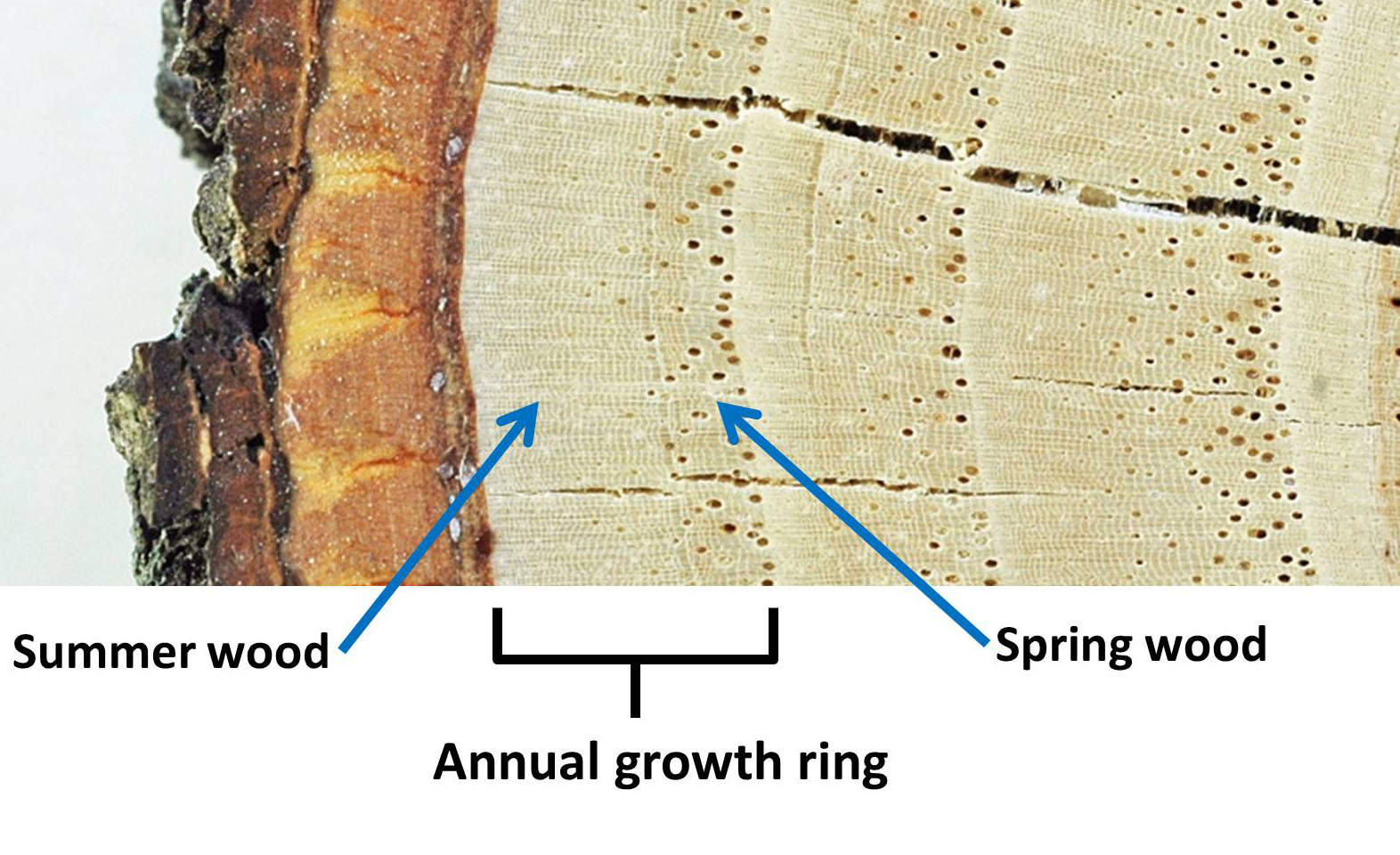
    Whenever we remove trees during an orchard thinning process, I like to stop for a minute and look at the rings in the wood. Each year pecan trees lay down a new and unique layer of wood tissue. Take a closer look at the rings of a tree and you'll discover a little bit more about how a tree grows. During the spring flush of growth, new wood tissue is created with numerous large vessel cells (large pores in the spring wood pictured above). These large vessels are needed to transport the massive amounts of water and nutrients required to build the spring flush of leaves and new shoots. As shoot growth ceases by early summer, demand for water and nutrients slows and the tree creates wood tissue with only small vessels (summer wood pictured above). Small wood vessel cells may not be able to conduct large volumes of water but their small diameter makes it easier to move water up the trunk during the dry summer months.  


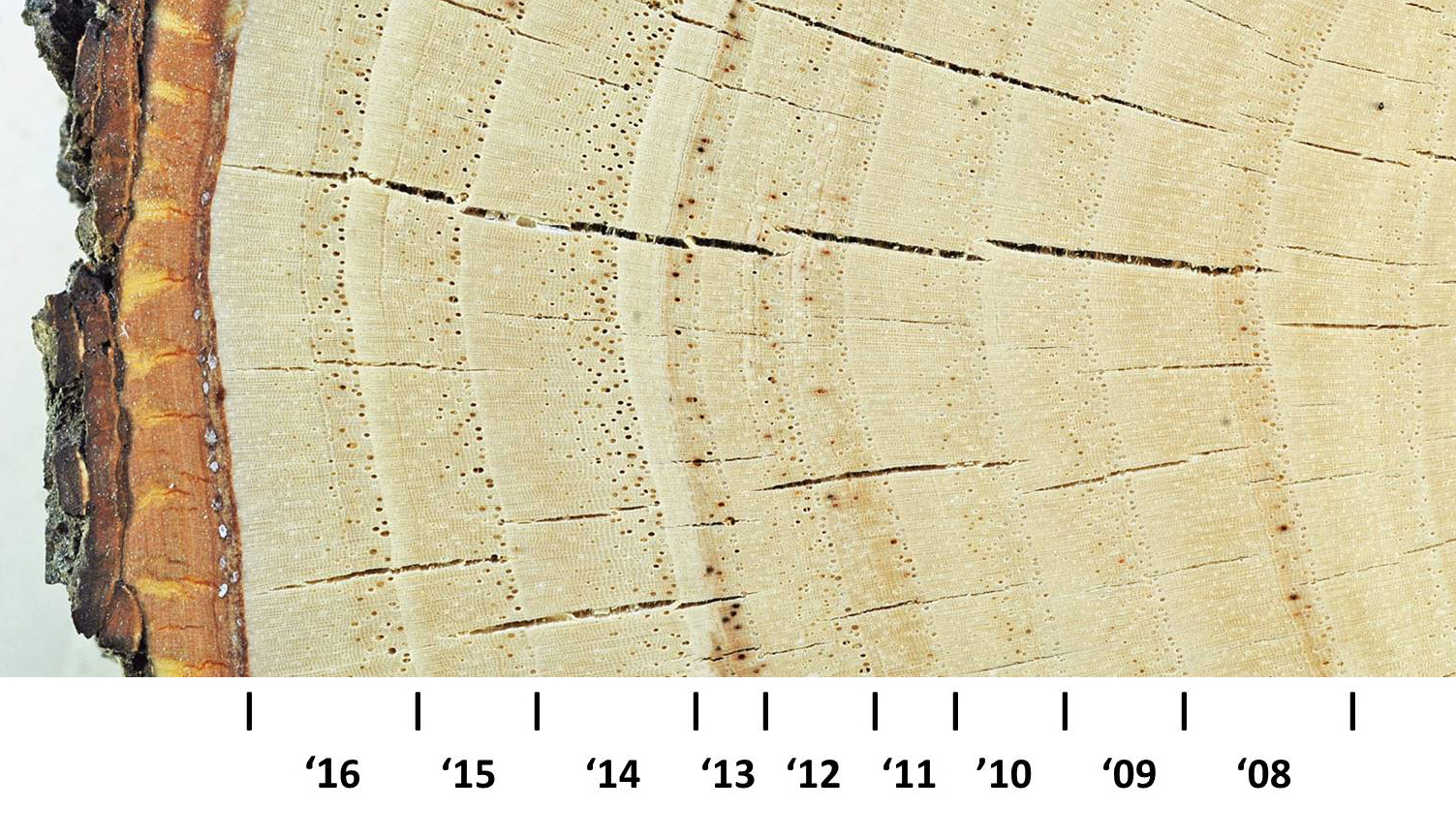
  The annual growth rings within a tree's trunk also offer a historical record of past growing conditions. The wider the growth ring and better that year was for tree diameter growth. The photo above shows the growth rings I found inside a Kanza tree we recently removed during a tree thinning operation. During the years 2014-2016 we experienced excellent weather for pecan tree growth--adequate rainfall and plenty of sunshine. The Kanza tree responded to these good growing conditions by at a creating wide, healthy growth rings.
    But look at the rings laid down during the dry years of 2011-2013. Wood growth during these hot dry seasons was stunted by poor growing conditions. In addition, the number of large vessel cells within these growth rings are severely limited (a response to drought). These large vessel cells are also stained dark brown (especially the 2013 wood). When a pecan tree suffers from drought, the large vessels stop working and the tree plugs up the non-functioning cells to preserve water within the tree.
    Next time you remove a pecan tree, take a little time to read the story left behind in the growth rings. I always seem to learn something new.   

Friday, January 13, 2017

Branch growth pattern: Gauging the potential for native pecan productivity


    Recently, I took a short drive down the gravel roads in the Neosho River bottom to take a look at native pecan trees in mid-winter.  I passed native groves that have had a history of intensive management and then further down the road I came across groves that receive minimal or no inputs during previous growing seasons.  As I studied the canopies of native trees on this cold clear day, I noted striking differences in branch structure between well-managed and un-managed trees (photos below).


    The first tree I stopped at was located in a well manage native grove. What I mean by well managed is that this native stand has received fertilizer applications, both Fall and Spring, for well over 15 years. The grove is also sprayed regularly to control pests and the ground cover is both grazed and mowed. Choosing a tree at random within this grove, I looked upwards and photographed a portion of the tree’s canopy (above right).  Immediately, I noticed the numerous shucks that still hung from the branches. This tree produced a good crop of native nuts in 2016. But, I also noticed a vigorous branching pattern. The twigs within the canopy were long, thick, and light grey in color. This healthy growth pattern can only be appreciated after being compared to the branches of an un-managed native pecan tree.

    Down the road, I came to one of those native pecan groves that suffer from a lack of attention. If the trees in the grove look to be producing a few nuts, the orchard gets mowed and raked just before the harvesters come in to collect a meager crop of nuts. This grove has been starved of soil nutrients but is occasionally sprayed for pecan weevil control.  Again I picked a tree at random and took a photo of the tree’s branch structure (above left).  There was little evidence that this tree produced a nut crop in 2016.  The tree had short, thin branches that appeared dark in color. In comparing the canopies of managed and un-managed trees, it is almost hard to believe they are both the same tree species.


    After taking the photographs of tree branch structure, I used a pole pruner to cut a sample of twig growth from both trees (photo above). In the photo, the two dark twigs to the left of the ruler came from the un-managed grove. To the right of the ruler, I set down a single light-colored twig from the well managed grove. The reason I photographed two twigs from the un-managed grove is to give you some idea how poorly this tree bore nuts. Of the four terminals pictured from the un-managed tree, only one terminal had a pedicel attached indicating the formation of a nut cluster. Based on the size of the nut attachment scars on this one pedicel, I guarantee that all the nuts in this cluster were aborted by mid-season due to scab infection. In comparison, the branch from the well-managed tree displayed prominent pedicels on both terminals.  This twig had borne two nut clusters in 2016.

But the twigs pictured above have an even greater story to tell.  Note the diameter of the shoot growth. Un-managed twigs are thin and spindly. The twig cut from the managed tree has shoots that are longer and thicker. And here’s why this all matters. I can look at the branches of any native tree and predict its future productivity.  Branch growth is a reflection of total tree vigor. Vigorous thick shoots indicate that the tree will have the internal reserves to produce an abundant pistillate flower crop in the Spring.  Short, small-diameter twigs may produce a lot of catkins but female flowers will few in number.

   If you are still grumbling about a poor crop in 2016, take the time to go out and look at your trees this winter. If you don’t see vigorous branch growth, your native grove is not on the path of good annual nut production.  To increase annual nut production your first step should be to apply enough nitrogen fertilizer to stimulate the growth of strong, thick twigs. If the grove has been un-managed for several years, it will take several years of annual fertilizer applications (both Fall and Spring) to see a response from large native trees. Eventually, you’ll see better shoot growth and subsequently much better nut production.

Thursday, April 7, 2016

Why we call it sapwood


   Last week, we removed a couple of large native pecan trees that were shading the growth of some young trees in an adjacent planting. After cutting the trees, we left the stumps in place for a couple of days while we hauled off the brush. One day after cutting the trees down, you could see large amounts of tree sap flowing from the outer growth rings of the trunk (photo above). In every case, the sap flow was limited to the outer 4 to 5 growth rings. The vast majority of the wood in the tree stump remained relatively dry.
    This high flow of sap from the outer-most layers of wood is the origin of the term "sapwood". However, the term sapwood means something entirely different to those that cut pecan trees for lumber. The sapwood refers to the lighter, almost white colored wood on the outer portion of the trunk. The heartwood of pecan trees is found in the center of the tree and is typically brown in color. You can see darker colored heartwood at the far right in the photo above.

     Next time you cut down a pecan tree, look to see if you can identify the different tissues that make up a tree's trunk. In the photo above, I've labeled the important tissues.  Starting on the left you can see several annual rings of wood tissue. This photo was taken just moments after the tree was felled and you can already see wet spots developing around the largest pores in the outer-most growth rings. Botanically, the wood of a pecan tree is xylem tissue which is responsible for conducting water from the roots upwards to the leaves. As wood tissue ages, becoming increasingly buried under new layers of wood (annual growth rings), the pores in the wood becomes clogged with lignin. Lignin blocks water flow but increases wood strength and rot resistance.
    Outside the wood is a narrow band of cells called the cambium (red arrow above). Every spring these cells become active creating new wood cells on one side and new bark cells on the other. The activity of the cambium layer is responsible for the tree's annual increase in diameter.
   On a mature pecan tree, you will find two distinct layers of bark. The inner bark or phloem functions to transport carbohydrates from the leaves downward to all other portions of the tree (branches, trunk, roots). The outer bark provides protection for the living tissues underneath. The outer bark acts as a vapor barrier to prevent moisture loss and as insulation against heat and cold.

Monday, June 15, 2015

Post-pollination nut drop

       Every spring we scout for pecan nut casebearer damage starting shortly after the end of the pollination season. While I'm up in the canopy searching for casebearer, I have noticed that a certain percentage of  flowers simply drop from the tree. I even found what looks like a perfectly normal pistillate flower dropped off and resting on a leaf (photo at left).

      During the the month of May (pollination season in SE Kansas), we experienced several extended periods of rainy weather. Several growers have been concerned that the wet weather inhibited pollination and nuts are dropping due to a lack of proper pollination. The nut clusters pictured above were from the same tree. The photo on the left has two pistillate flowers that are drying up and are ready to drop off. Only one healthy nut remains. In contrast, the nut cluster on the right has five healthy nuts. If rain was a factor in nut drop this year, all pistillate flowers clusters on a single tree would be showing signs of poor pollination. 

   There are actually two types of pollination season nut abortions. The first occurs early, during pollination. A pecan shoot that has insufficient resources can create a entire cluster of small, ill-formed pistillate flowers. These flowers often fall off right in the middle of pollination season. Later, the dried up peduncle will also fall off (photo above left). The second period of nut loss occurs after pollination has been completed.  In this case, what looks like healthy flowers drop from the tree sometimes leaving the entire peduncle bare (photo above right).
 

   One of the most common types of nut abortion I have seen is the dropping off of terminal flowers in the cluster (photo at right). As a tree creates a new pistillate flower cluster, nutlets are formed from base of the peduncle to the terminal. As pistillate flowers are formed, a flowering shoot can simply "run out of gas" and create small or ill-formed flowers at the cluster's terminal.  What ends up looking like a lack of pollination, is actually nut abortion caused by a weak female flower. Although weak female flowers usually occur at the terminal of a cluster, poorly formed flowers can occur anywhere in the cluster (photo above right)  

    We've recorded post-pollination nut drop for a period of several years and noticed some definite trends. In the graph at right, I've plotted the number of nuts per cluster over time (the month of June). Notice that during odd-numbered years, cluster counts start off high but dropped off sharply. During even-numbered years, trees produced fewer
nuts/cluster but suffered less nut drop. Switching over to yield data for those same 6 years (table at right), we find that odd-numbered years were high crop load years while even-number year produced lesser crops.
    Taken together, these two data sets tell me that pecan trees may have a way of regulating crop load that has nothing to do with pollination. If a tree produces an excess of pistillate flowers ("on" years) post-pollination nut drop will appear severe. In contrast, trees during "off" years seem to want to hang on to every flower they can. 
    This year, our groves are experiencing an "on" year. That might be why we are noticing more post-pollination nut drop. 

Friday, May 1, 2015

Nature's grafting technique

    It has been a great week for grafting pecan trees. I've be grafting at the Pecan Experiment Field, grafting trees on my home farm, or showing folks how to graft during grafting schools. The other day I was grafting at my farm when I stopped for a minute to watch all the cars and trucks wiz by on US Hwy 166. Just think, all those people rushing back and forth--not one of them having the time or inclination to carefully carve out a scion and attach it to a sapling pecan tree. To me, grafting offers me the chance to slow down, enjoy the outdoors, and create a tree that will bear nuts every year for the next century (photo at right). I can't think of a better endeavor.
    During this week's grafting schools I visited several pecan farms. During one farm tour, I spotted a natural graft union that formed in a tree that had lost much of its canopy several years ago in an ice storm (photo at left). Once limbs were broken off by ice, the tree sprouted new shoots from remaining live branches with all new shoots growing straight up towards sunlight. As a result of this rapid regrowth, one limb crossed over another. At first, these two limbs just rubbed together in the wind, wearing a bare spot where the limbs touched. As the limbs grew in diameter the pressure against each other increased and the two limbs eventually formed a natural graft union.
   These kinds of natural graft unions are not that common in mature pecan tree canopies. But under the ground, the roots of adjacent trees frequently overlap each other and form natural graft unions. Root grafts are the main reason we do not recommend using tree killing herbicides to treat the stumps of pecan tree removed during a tree thinning operation. The herbicide might control the formation of stump sprouts from the removed tree but the herbicide might be transferred to an adjacent tree via a root graft causing unwanted tree injury.

Sunday, February 1, 2015

The pecan tree's backup plan

    Look carefully at the buds on a one-year-old pecan shoot. Above each leaf scar (the heart-shaped scar on a dormant stem) is a row of buds that range in size from the largest at the top to the smallest nestled tightly against the leaf scar (photo at left).
    The primary bud is the most prominent in the group and will be the bud that breaks opens and grows during the spring flush of growth. Inside the bud is a vegetative shoot flanked on each side by a set of catkins (male flowers). If all goes well, the primary bud grows and the smaller buds below it will remain dormant.
    However, the tree creates secondary, tertiary and quaternary buds just in case something happens to injury or destroy the primary bud's new growth. A late spring frost, a freak hail storm, or even an outbreak of sawflies can destroy the tree's first attempts at new spring growth. That's when the secondary bud comes into play. The secondary bud will start growth in response to the lost of the primary bud. We saw this happen just last year in response to a late spring freeze.
     Back in 2007, I was really glad that pecan trees have a built in back-up plan for restarting growth following the loss of new growing points. We established a new orchard using container grown trees in the fall of 2006. On Easter weekend of 2007, we experienced bone chilling cold that froze all the emerging green tissues off the young trees. A couple of weeks later, secondary buds broke and the trees resumed building new shoots and leaves. Later that summer, the Neosho river spilled over its banks and we experienced the second highest flood on record. The flood waters were so deep that they completely covered the newly established trees and killed all green tissues. Once the flood receded, tertiary and quaternary buds broke and young trees struggled back to life.
   

Thursday, June 5, 2014

Juvenile vs. mature pecan leaves

    Last night I was out in my pecan grove checking grafts when I came across the tree pictured at right. Wow! What a colorful display. All the shoots and leaves sprouting from the rootstock were crimson red. The shoots sprouting from the scion were green.
    What you are actually looking at is the difference between juvenile pecan leaves (the red ones) and sexually mature leaves (the green ones). If you look carefully, you can see that catkins were produced by the the sexually mature scion.
   Seedling pecans must grow through an extended juvenile stage before they become capable of producing catkins and pistillate flowers. This juvenile stage usually lasts between 15 and 20 years. Juvenile pecan trees produce leaves and rachises with a noticeable red tinge. Leaves of juvenile trees also tend to be more pubescent (hairy) than leaves of mature trees.
   When grafting a tree, we place a sexually mature twig (the scion) on a juvenile rootstock. Because the scion is sexually mature, the shoots growing from that scion will be sexually mature. This simple fact is the reason grafted trees start bearing pecans at such an early age as compared to seedling (not grafted) trees.
   After taking this photo, I pruned all the trunks sprouts (red leaves) off this tree to focus all the tree's energy into the scion. I also attached a bamboo stake to the trunk, pruned the scion to one shoot, and tied that new shoot to the stake. I've got more grafts to trim tonight but so far the 2014 grafting season looks to be a 100% success year.