Showing posts with label water stress. Show all posts

Thursday, July 2, 2020

Bearing pecan trees compete with ground-cover for water

    The weather this year has been wild. During the month of May, over 9.5 inches of rain fell on my pecan grove. When June arrived, Nature's spigot seems to turn off completely. We've recorded only 0.37 inches of rain during the entire month. Things have gotten very dry, very quickly.

    This morning, I noticed a ring of wilted grass around each of my young Kanza trees. It almost looks like I sprayed herbicide around the tree but that's not the case. I haven't been able to do any chemical weed control so far this year because of spring floods and muddy soil conditions during the months of March through May. When the ground started to dry up in early June, I was finally able to mow the grove for the first time this season.
   The circle of wilted vegetation that rings each tree represents that area of soil where pecan roots are out-competing grass and weeds for soil moisture. Fortunately, pecan trees are pretty good at handling dry soil conditions. However, the trees are now entering the nut enlargement phase of pecan development. During the month of July and into early August, pecans grow rapidly in size. If dry conditions persist, nut enlargement will be stunted and we'll be harvesting a lot of small pecans this fall.
  

Monday, March 27, 2017

Counting pecan wood rings

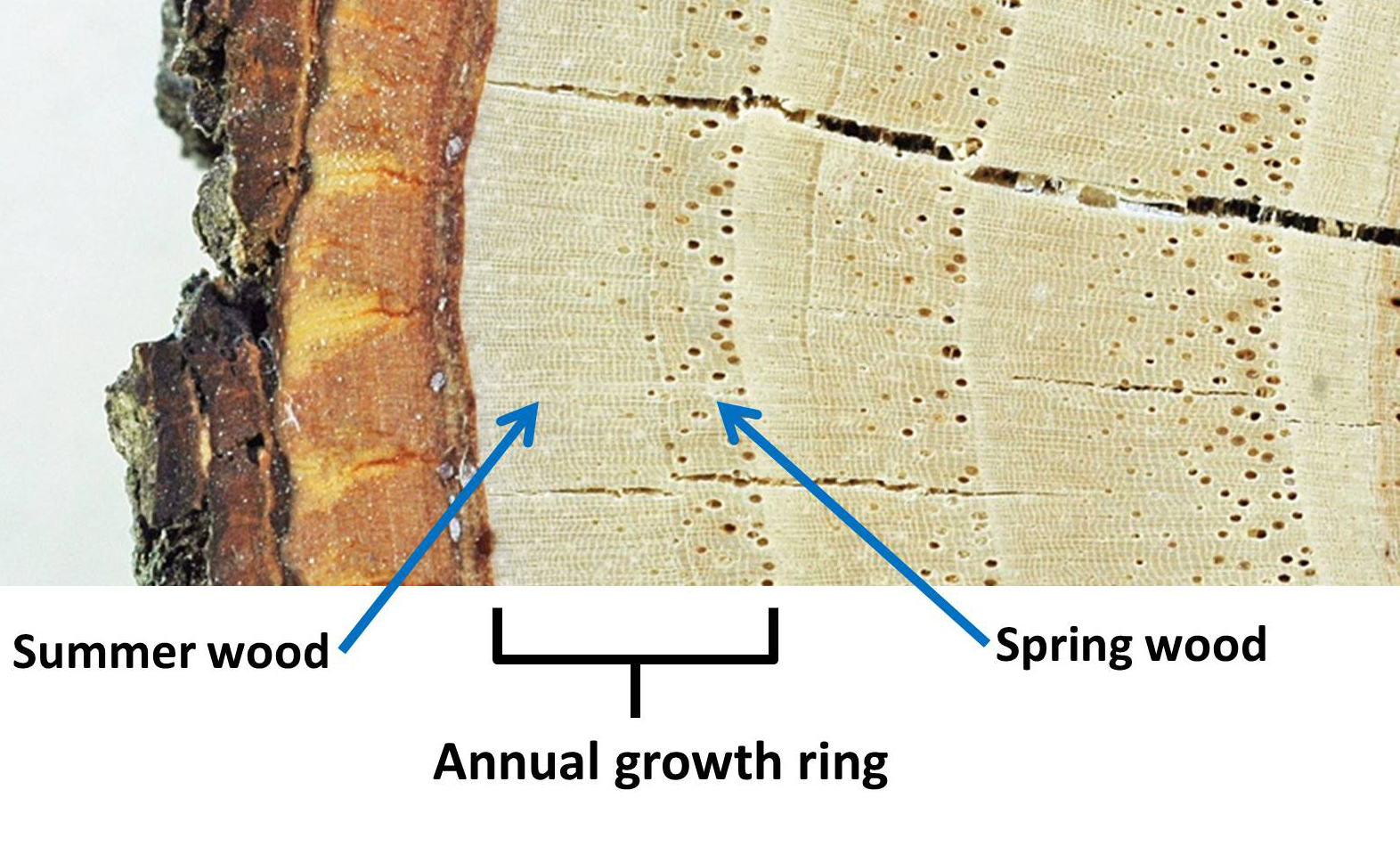
    Whenever we remove trees during an orchard thinning process, I like to stop for a minute and look at the rings in the wood. Each year pecan trees lay down a new and unique layer of wood tissue. Take a closer look at the rings of a tree and you'll discover a little bit more about how a tree grows. During the spring flush of growth, new wood tissue is created with numerous large vessel cells (large pores in the spring wood pictured above). These large vessels are needed to transport the massive amounts of water and nutrients required to build the spring flush of leaves and new shoots. As shoot growth ceases by early summer, demand for water and nutrients slows and the tree creates wood tissue with only small vessels (summer wood pictured above). Small wood vessel cells may not be able to conduct large volumes of water but their small diameter makes it easier to move water up the trunk during the dry summer months.  


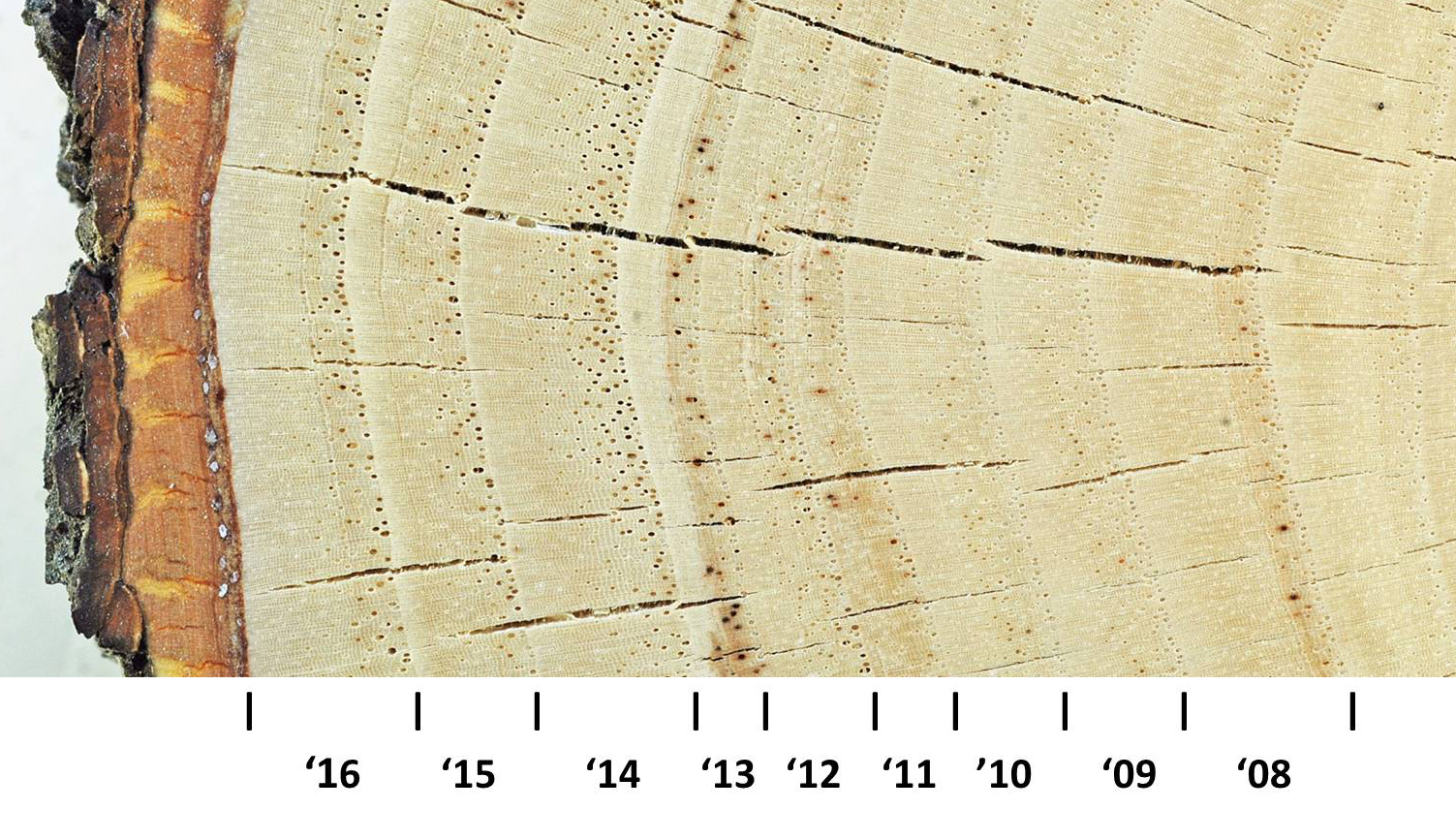
  The annual growth rings within a tree's trunk also offer a historical record of past growing conditions. The wider the growth ring and better that year was for tree diameter growth. The photo above shows the growth rings I found inside a Kanza tree we recently removed during a tree thinning operation. During the years 2014-2016 we experienced excellent weather for pecan tree growth--adequate rainfall and plenty of sunshine. The Kanza tree responded to these good growing conditions by at a creating wide, healthy growth rings.
    But look at the rings laid down during the dry years of 2011-2013. Wood growth during these hot dry seasons was stunted by poor growing conditions. In addition, the number of large vessel cells within these growth rings are severely limited (a response to drought). These large vessel cells are also stained dark brown (especially the 2013 wood). When a pecan tree suffers from drought, the large vessels stop working and the tree plugs up the non-functioning cells to preserve water within the tree.
    Next time you remove a pecan tree, take a little time to read the story left behind in the growth rings. I always seem to learn something new.   

Friday, September 5, 2014

Water makes pecan kernels fill

   After an extended period of dry and hot weather in August, we received 5 inches of rain at the Pecan Experiment Field on September 1st. Up until that big rain storm, the dry weather had inhibited kernel fill and it was looking like kernel quality would ultimately suffer. I was curious to see how our pecans would react to the sudden resupply of soil moisture, so I decided to collect some nut samples.


   On the day following the rain (Sept. 2) and for the next two days, I harvested some Kanza nuts from trees growing at the research station. I then stored the nuts in the refrigerator until all samples were collected, then cut open nuts just before taking the photo above.
   From the three nut samples pictured above, we can learn a lot about how pecans fill kernel and which portions of the kernels are most affected by drought stress. In a previous post, I described how pecan kernel forms inside the nut--kernel tissue is first deposited just inside the seed coat then grows inward to eventually fill the inside of the shell. However, close inspection of the nut collected on Sept. 2 you will note recently formed translucent kernel material on each kernel half closest to the inner wall partition (red arrows). The rain had already stimulated new kernel deposition in an area that had suffered from drought stress. If the weather had remained dry, the under side of each kernel half would have remained undeveloped and the kernels at harvest would have appeared to have a "hollow back" side.
   Two days after the rain, solid kernel had developed all the way around the inside of each kernel half. By Sept. 4, the kernel inside the Kanza nut had expanded to the point of almost eliminating all air spaces inside the shell. It is truly amazing how quickly a pecan can fill its kernel when given a plentiful supply of water. It will be interesting to see how Kanza turns out this year in terms of percent kernel. 

Wednesday, August 7, 2013

Rain changes everything

Soil Crack, summer 2011
   The summer's of 2011 and 2012 were hot and dry. It wasn't that long ago that I was taking photos of massive cracks in our river bottom soil (photo at right). Our trees suffered through those dry years producing a crop each year, but a crop with much smaller nuts. Earlier this year it looked like we were headed for another dry summer with little or no rain falling in June and early July. We were missing every 30% chance of rain and I was preparing myself for a third year of drought. Suddenly everything changed.


    It started to rain in late July and it has continued to rain frequently ever since. We've had over 12 inches of rain during the past 2 weeks and the Neosho River has flooded over its banks twice. The ground cover under the trees is growing like its springtime and we have water everywhere (photo below).


    All this moisture and humidity has led to weevils emerging and pecan scab spreading. Unfortunately, with showers falling nearly everyday and super saturated soil conditions it has been impossible to spray for these key pecan pests. But as soon as we get the opportunity, we will be applying an insecticide for weevil and stink bug control and a fungicide for scab control.
    Today, the Neosho River is starting to fall back into it banks but more rain is forecast for tonight. Another Flood? We'll have to wait and see.

Monday, July 8, 2013

Poor tree growth and the appearance of stump strouts


        The past couple of summers have been hard on young pecan trees growing in the Midwest. The heat and drought have been brutal. This spring I have seen several young trees produce only a smattering of new leaves on upper branches while sending up vigorous stump sprouts from below the soil surface (photo at right).  The stump sprouts on this tree first developed in 2012 and have continued to grow this year. 

   This year's new shoots are only one-inch in length on the upper portion of the tree (photo at left). The leaves are small and have several missing leaflets. The tree just looks sick!


      At the base of the tree, the bark on the main stem is sloughing off (photo at right). To me, this indicates that the conductive tissues (xylem and phloem) in the stem have been damaged, interrupting the normal flow of water and nutrients.  Its no wonder the top growth on this tree is so anemic.
   The growth of stump sprouts is the tree's way of replacing the damaged portion of the tree with healthy stems that support large, healthy leaves.

    One way to deal with this situation is to coppice the tree (photo at left). It was obvious to me that I was going to lose the original portion of this tree. The growth I found on the upper branches was just too sparse to keep the tree going. On the other hand, one of the stump sprouts had already grown 5 feet tall in two years time.  I simply used my chainsaw to cut down the original trunk and the smaller stump sprouts at ground level.  My tree might have a much smaller top after coppicing but the potential for new growth is much better.
    This tree is a seedling growing in our pecan breeding plots and will remain a seedling in the future. If you need to coppice a grafted tree, plan to re-graft the tree in a year or two.  

    The stump sprout I saved had three equally vigorous shoots growing near the top of the tree. To shape this tree into the central leader form, I tipped back the two side shoots to outward growing buds and left the central shoot free to grow into a strong leader (photos at right). I'll need to watch this tree carefully this summer. There is a lot of root energy pushing the new top growth and that will require plenty of return visits for additional summer pruning.   

Saturday, January 19, 2013

Pecan size determined by soil and available water


     Last summer's drought and high temperatures effected agriculture across the Midwest, including pecan groves. In previous posts, I discussed how drought can effect nut size, influence nut shape, retard kernel filling, and prevent proper shuck opening. Today we were evaluating nut samples collected from several locations and soil types. The differences we found  among four Pawnee samples were astounding and I just had to share our observations (photo below).

 
    Its almost hard to believe that all four samples were produced by trees of the same cultivar. The largest Pawnee nut was produced in Illinois, growing in a deep silt loam soil and irrigated during the mid-summer drought. The combination of great soil and ample water provides ideal conditions for nut growth and kernel fill.
    The second largest nut was produced in Kansas at the Pecan Field. Last summer we were fortunate to have a flood in May that saturated our heavy clay soils. Our Pawnee trees ended up mining that water later in the summer to produce a smaller but well filled nut. However, last summer's heat and drought did cause some kernel defects on our Pawnee nuts. 
    The two samples from Missouri were collected from trees growing at the Horticulture and Agroforestry Research Center in New Franklin. Central Missouri was hard hit by the 2012 drought, decreasing nut size significantly. These samples provide a great example of how site and soil type can effect nut production. The tree growing in the silt loam soil is actually located in a very fertile and moist creek bottom. Trees in this planting have grown exceptionally well with many reaching 12 inches in trunk diameter in just 15 years. Planted at the same time and just 1/4 mile away, the trees growing in the silty clay soil have grown much slower reaching only 8 inches in diameter. Although the silty clay soil is located within the greater Missouri River flood plain, this land is cut off from minor flooding events by a levy.  In the end, the nut size difference between the two Missouri samples can be attributed to a difference in both available water (the silty clay had less) and tree size. If you remember, tree size has a enormous effect on a pecan tree's ability to capture soil water, impacting both leaf and nut size.

Friday, December 14, 2012

Testing pecan cultivars: Soil and water effects


    In testing new pecan cultivars, its important to evaluate each clone over several years and at several locations. This year provided some good examples of how location can effect cultivar performance.
    We are currently testing two early ripening clones developed by the USDA pecan breeding project at several locations. The photo at right shows nut samples of USDA 75-8-5 collected from two locations--Chetopa, KS and New Madrid, MO.  At the Chetopa site the trees are growing in a heavy clay soil without irrigation while in New Madrid the trees are growing in an irrigated sandy soil. Both locations suffered extremely hot and dry summers but you can definitely see the benefits of irrigation on nut size and shape.

   In the photo at left, you can see that USDA 75-8-9 behaved just like its sibling clone; The nuts produced under irrigation were larger and plumper that the nuts produced without irrigation water.
   Last summer, soil moisture availability had an  overwhelming impact of nut size and shape. However, during years of normal rainfall we would still see differences in nut size between these two locations. Trees growing in heavy clay soils tend to produce smaller pecans than trees of the very same cultivar grown in loamy or sandy loam soil.  But, there is one advantage of growing pecans in a heavy clay soil--Clay soils have a greater soil moisture holding capacity. During drought years, quality kernels can be produced without irrigation in a clay soil while kernels produced by trees growing on sandier, non-irrigated soils will be shriveled.   

Thursday, October 11, 2012

Site selection, water, and pecan performance


    This morning I cut nut clusters from two trees (photo above). Both clusters were cut from 'Faith' pecan trees, and both were taken from trees that have grown to about 5 inches in trunk diameter. The cluster on the left has been shuck split for quite some time and the nuts have decent size. In contrast, the cluster on the right is only now starting to split open and the nuts are tiny, about the size of a small native pecan. What caused this difference in tree performance? Location, location, location.
    The cluster on the left was collected from a tree growing in the Neosho River flood plain growing in Osage silty clay soil. The cluster on the right was collected from a tree growing in Cherokee silt loam soil which is a "second bottom" soil found adjacent to the Neosho River flood plain.
    Small nut size and a delay in maturity is caused by an extreme shortage of water.  Both Osage and Cherokee soils are deep, heavy, and poorly drained. Although Cherokee silt loam has a somewhat lighter texture than Osage silty clay and primary difference between these two soil types in terms of pecan performance in 2012 was position in the landscape. When the Neosho River runs over its banks Osage soils are flooded. Cherokee soils haven't been under water since the melting of the glaciers at the end of the last ice age.
    This past spring we had a flood on the Neosho River which covered all the pecan groves growing in Osage soil. That flood recharged the subsoil moisture lost during the 2011 drought and provided valuable moisture for the 2012 crop. The tree growing in the upland position (Cherokee soil) was not flooded and did not receive enough rainfall during the season to recharge the soil's moisture reserves. As a consequence the tree growing on the upland suffered greatly during our second dry summer in a row.
   When it comes to pecan tree performance,  the importance of good site selection can never be over-emphasized.

Tuesday, August 14, 2012

The fight for water

   We planted soybeans in our double-row intercrop study again this year. And for the first time, I've noticed that our young trees (11 years old) are starting to dominate over the intercrop. In the photo at left, you can see the perfect outline of the pecan tree root system's  area of influence. Soybeans were planted in the area that is now mostly bare soil (note the 7.5 inch planter rows) but the pecan tree out-competed the beans for water during this drought stricken growing season and the germinated soybeans died from a lack of water.
    I walked up the area in the bean field where the pecan tree's roots had their greatest impact and learned one more interesting thing. A huge soil crack has developed at the boundary between the pecan tree's root system and normal sized bean plants. This says to me that pecan roots are so efficient at extracting water from the soil that the soil has shrunk causing a crack in the soil.   
    This interaction between pecan trees and soybeans has got me thinking. Are the trees getting big enough for me to start thinking about seeding the entire field to a harvester-friendly covercrop?  Soybeans are bringing $16 per bushel: Can I pass up the economic opportunity of an intercrop while the trees are still producing less that 200 lbs. pecans/acre? All I know for certain is that the year to make the switch from intercrop to covercrop is coming soon. I just don't know if it will be 2013 or 2014. Most likely, a flood by the Neosho River will probably make that decision for me.

Wednesday, November 23, 2011

Cracked pecan shells at harvest

    If you have been following this blog over the last several months you might remember that a heavy rain in September saved our drought stricken pecan crop this year by promoting kernel fill. At that time, I warned that we might find that the pressure of an expanding kernel might actually crack the shell on nuts that had sized during the drought. By late September, I found one early maturing cultivar that was split open by the kernel. Now that we are in the middle of harvest and are cleaning pecans, we have noticed several cracked shells crossing the inspection table (photo at right).
    The cracks we've observed in the shell have appeared both along the suture (middle nut above right) and 90 degrees to the suture (top nut above right). We even found a pecan cracked both ways (bottom nut above right). All of these cracks were created by a sudden expansion of kernel following the September down pour.
    So far, we have seen significant shell cracking on the cultivars Colby, Hirschi, and Henning. In looking at kernels inside these cracked nuts it seems that, if a nut cracked along the suture, the kernel became discolored where tissues seem to pop out of the shell (middle nut above). When the shell is cracked 90 degrees to the suture, the kernel remained fully inside the shell and developed no discoloration (photo at left).
    Cracks in the shell allow pathogens and insects easy access to pecan kernel. When we see these nuts on the cleaning table we discard them in order to maintain top quality in our final product.

Tuesday, October 18, 2011

Drought effects pecan nut shape

    Its interesting how our different cultivars react to drought stress in terms of nut shape. To document these changes in nut shape, I've collected nuts from several cultivars then arranged them in order of increasing drought stress.
  As drought stress increases, all pecan cultivars produce smaller nuts. However, there can be other changes as well. Note that the base of Giles and Maramec nuts get narrow as compared apex of the pecan. A nut with a strongly tapered base means that the kernels inside will also be strongly tapered. In comparison,  Kanza and Major nuts just seem to  shrink, turning into smaller, rounder pecans.  
     Kanza looses its distinctive "tear drop" shape as the prominent nut apex disappears in nuts made smaller by drought. In contrast, the "pinched" apex of Lakota can be recognized regardless of nut size or shape. Interestingly, I found Lakota nuts that had narrow bases and nuts that turned shorter and rounder all on the same tree.
    Because Major is a small nut to start with, this year's drought seems to have caused minimal changes in nut shape. Maramec, on the other hand, is a large pecan that suffers greatly from water stress. It is easy to see that Maramec nut size and shape are greatly impacted by lack of  soil moisture.


Tuesday, September 27, 2011

Pecan kernel cracks open shell

   The rain we received in mid September has saved this year's pecan crop from drought-induced, total disaster. Last week, I wrote that the September showers promoted kernel filling and the prospects for quality pecan kernels look so much better. But, I also warned that a sudden rainfall after a prolonged dry period can lead to shell splitting (photo at left).
   At this point, I haven't seen a lot of shell splitting. I actually had to search a while to find this Henning nut (at left). What happened to this nut is exactly what it look likes. The kernel expanded so much following the rain that the shell burst open. Note that the shell split, not only along the suture, but also laterally near the base of the nut.
    Nut splitting can lead to serious kernel quality problems. Notice the black spot (with white center) on the kernel near the tip of the nut. A kernel rotting fungus has already attacked the exposed kernel.  As this nut dries before harvest, the kernel will shrink and the shell will close up, hiding the kernel rot.  Only after cracking a sample of our 2011 crop,  will we discover the amount of damage caused by nut splitting and kernel rot. Oh, how I hate surprises at the grading table.

Wednesday, September 21, 2011

'Giles' pecan kernel fill

     Historically, the cultivar Giles has been a heavy producer of pecans. So heavy, that kernel fill often suffers during "on" years. This year, our Giles trees have a good to heavy crop  and with all the dry weather we've experienced this year, I was afraid most of our Giles nuts would end up on the cleaning pile (ei. poorly filled, light nuts). The photo at right is a cross section of a Giles nut cut last week (14 Sept. 2011, before the rain). You can see lots of air spaces and poor kernel development.
    A week later (photo at right), Giles' kernel development is much improved thanks to 3.5 inches of rain over last weekend. Although you can still see a line running down the middle of each kernel half, it looks like we will have no trouble marketing our Giles crop this Fall.
     There are a couple more things you can notice in the photos about kernel filling . Look carefully at the shell packing material between the two kernel halves. As the kernel has expanded, the partition between halves has become compressed and appears more woody. Also compacted by kernel deposition is the packing material that fills the dorsal groves. Note the color change from orange to tan.


    Part of the reason our pecans are filling so well is because the dry weather started early in the nut sizing period (July). This means that nut expansion was inhibited by lack of rain and our trees produced smaller nuts than in previous seasons.  The photo at left shows a cross section of this year's Giles nut compared to a Giles nut grown in the past. Look at the shape of the shell of both nuts. This year's Giles is shorter and more tapered at the base than the "normal" Giles nut. The good news is that a smaller nut is easier to fill with kernel (less kernel to make) and buyers always like to see plump kernels when they are paying top dollar for northern pecans.

Monday, September 19, 2011

September rain fills kernels

    Over the weekend, 3.5 inches of rain fell in the Chetopa, KS area. Its been so long since I've heard the sound of raindrops on the roof, I could hardly sleep. It is amazing how drought stressed plants react to a sudden supply of water.  In my wife's apple orchard, the rain was welcomed but has lead to a massive amount of fruit cracking (photo above right). As soon as the roots started pumping water from the water soaked soil into the tree, the fruit started to swell in size. Since the fruit's skin couldn't grow fast enough in response to the rapid fruit growth, pop, the skin cracked open.

Lakota, 14 Sept. 2011
    So this morning, it was time to see how the rain  influenced our pecan crop. At left is the cross section of a Lakota nut that I posted last Wednesday (Sept. 14).  In that post, I mentioned that Lakota was still depositing kernel but if rains didn't fall soon, nut quality would be poor. Well the rains came, but was it enough to make an impact on kernel fill?
Lakota, 19 Sept. 2011


    Here's a cross section of Lakota today, Sept 19, two days after a major rain event. Wow, what a difference. This Lakota nut is now packed with kernel. Notice that all the voids have been filled with nut meat.
     Just like the apple pictured above, pecans can also suffer fruit cracking. Late rains can swell the kernel up so much that it pops open the shell and splits the shuck. This can lead to kernel rot and ultimately crop losses. However, we are so late in the season, I don't expect to see a lot of shuck splitting. I'm just hoping for better kernel fill over the entire grove. 
    

Wednesday, September 14, 2011

Drought effects nut fill

     A hot dry summer has played havoc with this year's pecan crop. The dry weather during the 1st half of the summer decreased nut size dramatically. Back in early August, we received some welcomed rains that seemed to perk up our trees. But unfortunately, the rain turned off again and the 100 degree plus temperatures returned. Hot, dry weather in late August through early September has had a major impact on nut fill.
     This morning, I cut open some nuts to check on the progress of nut filling and made some interesting observations.  The first cultivar I checked was Pawnee.  I had expected Pawnee to have nut filling problems this year because of its large nut size but was pleasantly surprised when I found a fairly well packed kernel. However, our Pawnee nuts will not be perfect. In an earlier post, I mentioned that kernel filling starts at the seed coat and works inward. Note that the top of each kernel half has grown much thicker than underside of the kernel. This will mean that, at harvest, our Pawnee nuts will have a concave appearance on the bottom of each kernel half.

    Next, I cut open a Osage nut, thinking that a super, early-maturing nut may be better filled. You can see in the photo that kernel deposition was similar on both upper and lower portions of each kernel half. At this point in the season, Osage has already started the process of shuck separation from the shell and kernel deposition is effectively complete. Note that there are still obvious voids in the kernel. This type of drought damage translates into a dry, crumbly kernel at harvest.
     Lakota ripens almost 2 weeks later than Pawnee and you can see that the nut filling process is still underway. If you zoom in on the photo, you can see translucent areas where kernel is still being developed. Amazingly, we are getting some rain today, with more forecast later in the week. Will these rains help Lakota fill out their kernels? Time will tell, but I think most of our cultivars and all of our native pecans will produce nuts with much lower percent kernel than in normal years.

Thursday, September 8, 2011

Dominating the landscape


     Last week, I wrote about tree age and response to drought. When I drove into work this morning, I noticed that our soybean crop provided the perfect example of how pecan trees come to dominate the landscape. In the photo at right, note the large native pecan tree marked with a yellow bar. The roots of this tree have suppressed the growth of the adjacent bean crop (out-competed the beans for water). The red arrow points to a distinctive line in the field of soybeans that marks the extent of the pecan roots domination over the bean crop. Even 60 feet away from the tree,  the beans are struggling for water. Outside the tree's influence the beans maybe drought stressed but the plants are 30 inches tall.  It is important to note that a tree's underground influence on its environment extends far beyond the "drip line" of the tree's canopy.

Wednesday, August 31, 2011

Tree age and drought stress.

    Looking over our pecan grove,  I've noticed that large, older trees handle drought much better that young trees.  To show you what I'm talking about, I photographed leaves and nuts from two trees. The first was 28-years-old and about 12 inches in diameter, while the second was 9-years-old and about 3 1/2 inches in diameter. Both trees had been grafted to Pawnee and both were bearing nuts.
    In the photo above, the leaf on the left is from the older, larger tree while the leaf on the right was pulled from the young tree. Both leaves were taken from the mid portion of this year's growth. The smaller leaves on the younger tree were also lighter green.

    I  then pulled a cluster of nuts off of each tree. The cluster on the left is from the older tree, while the smaller nuts on the right were pulled from the smaller tree. In a previous post, I mentioned that young trees often produce smaller pecans than mature trees. But this year, the effect will be exaggerated by the drought.
    The smaller leaves and nuts found on young trees is an above ground reflection of the fact that the tree has not yet developed a large enough root system to dominate its surroundings.  A tree with a limited root system has a harder time competing for water and nutrients. Less water and nitrogen means smaller, lighter green leaves and much smaller pecans at harvest.
     Have you ever wondered why young trees respond so well to weed control while older trees seem to tolerate ground cover plants growing right up to the trunk?. It all about becoming the dominate plant in the landscape. From my experience, pecan trees become dominate when the reach 10-12 inches in diameter.

Thursday, July 28, 2011

Symptoms of drought

   We haven't had a summer this hot and this dry in SE Kansas since 1980. Talk to some old-timers and they still recall the droughts of the mid-1950's. Before that, it was the dirty '30s and the droughts that created the depression era dust bowls.   
    Pecan trees tolerate heat and dry weather better than many tree species but we are now seeing signs of drought stress especially on young trees. In the photo at left, you will note several dry, brown leaves among healthy, green leaves. This is not the result of some foliar disease but is a perfect example of how pecan trees deal with drought. When the supply of water becomes very limited, pecan trees will conserve water by shedding leaves to reduce the amount of water lost to transpiration. The oldest leaves (at the base of this years new growth) are the first to be shed.
    Watering trees at this point will not "cure" the leaves that have already turned brown but will help trees retain all the green leaves still on the tree.

Wednesday, July 20, 2011

Transplanted trees need water

    It has been 8 weeks since we've had a good rain shower in the Chetopa, KS area. Today I spotted the first casualty of our hot dry weather (photo at right). The tree in the photo was transplanted with a tree spade last winter. You might remember that I photographed the transplanting back in a February post.
   When a tree spade is used to move trees the soil/root ball that moves along with the tree remains disconnected from the surrounding soil. Normal capillary channels that allow water to move upward from deep in the soil profile are severed by the shovels of the tree spade. Once the tree uses up the water held in the soil/root ball, no additional water can move towards the roots. Essentially, during the first few years after transplanting, a spaded tree acts just like a tree growing in a pot. And like container grown trees, you can never let the soil/root ball dry out.
    To ensure transplanted trees survive, I recommend that all vegetation around the spaded trees be killed. I'd use a tractor mounted rototiller to work the soil (shallow cultivation) around each tree making sure the seam between the soil/root ball and the surrounding soil does not split open. And finally, I'd invest in a 2000 gallon water tank and trailer so I could thoroughly water each tree.
   In my experience, it takes at least three years of vigilant care to get spaded trees off to a good start. After several years the soil/root ball becomes reconnected to the surrounding and the transplanted trees starts to grow at a more rapid pace.

Thursday, October 21, 2010

Nuts on young trees

    After successfully grafting a tree, you wait eagerly for that young tree to produce its first cluster of nuts. And when those first nuts split the shuck, you run out to the tree to peel the pecans out of the shucks, not caring that your fingers will soon turn black. The nuts looked so impressive all summer long. But when you peel them out of the shuck, the nuts are often small and often don't even look like the cultivar you thought you had grafted. Fear not! This is normal. Young trees, and I'm talking about trees 2-3 inches in diameter, often produce smaller-than-normal nuts. In the photo above you'll see 2 large, blocky nuts compared to 2 smaller, oval-shaped nuts. They are all samples from the same cultivar (KSU-OF1) but produced by 2 different trees. The large nuts were produced by a tree nearly 12 inches in diameter while the 2 smaller nuts represent the 1st crop produced by a tree 2.5 inches in diameter.
    The explanation for this common occurrence is simple. As a pecan tree grows, it becomes more and more of a dominate force in its environment. Larger trees are just better at competing with the ground cover for water than younger trees. More water means bigger and normally sized nuts. So don't be discouraged by small nuts on young trees, the time will come when a larger tree will be covered with large beautiful nuts.