Tuesday, July 12, 2022

Young tree's growth response to spring time directive pruning

    In previous posts, I've stressed the importance of practicing directive pruning during the spring flush of growth to encourage the development of a strong central leader. The photos at right show the pruning cuts I took back in late May of this year. At first glance, it looks like I'm trying to create a single-stemmed tree with no side shoots.
However, that is not the case at all. These early-season pruning cuts are designed with the single focus of promoting a single central leader. New lateral branches will develop, but later in the season and at much more desirable branch angles. 
 
  In mid June, I returned to the tree that I pruned in May. In the photo at left you can see that I have successfully maintained a single central leader. But you should also notice that there are now numerous lateral shoots sprouting out from the trunk all below the new central leader.
     On closer inspection (photo at right), you will note that the new lateral shoots are growing from secondary buds that are located just below each pruning wound (the pruning cuts I made in May). It is also important to note that these new shoots are growing out at a wide angle from the trunk. These shoots will develop into strong well-anchored branches that resist wind and ice breakage.
    By early July, all of the new lateral limbs are growing nicely (photo at left). It won't be long before I have well bushed out tree all while keeping a single central leader. I'll leave all these lateral branches on the young tree to help promote trunk diameter growth. The increased leaf area on the trunk catches more wind which, in turn, promotes a strengthening and thickening of the trunk. 

    Young, rapidly-growing trees need training throughout the summer months. Pruning cuts made to strengthen the dominance of the central leader usually means that stalked buds will start to form in mid-summer on the central leader near the top of the tree. Left to grow, stalked buds will produce narrow-angled branches that develop a bark inclusion at their base. If all the stalked buds that form on a central leader are allowed to grow, a pecan tree will become top heavy and take on a broom-like appearance (at the top of the tree). I pinch off all stalked buds as soon as I see them to preserve the central leader (photo above).


Thursday, June 16, 2022

Pecan nut casebearer arrives late


    Every year I scout my pecan orchard for pecan nut casebearer damage to young nuts. Damage from this insect is easy to recognize by the pile of insect frass at the base of a nut and the silken threads that connect the damaged nut to the pedicel (photo at right). Left unchecked, a single pecan nut casebearer larvae will destroy 3 to 4 nuts in a cluster. 

    The first evidence of casebearer nut damage this year occurred a week later than normal. However, now that this first summer generation has started, the above average temperatures predicted for the next 10 days will cause the casebearer population to expand rapidly. I found the first damaged cluster on Wednesday June 16th and started spraying early Thursday morning.

    When spraying during a heat wave, I try to start at first light and quit around 11:00 am. Once temperatures start to approach 90 degrees F spray droplets can evaporate before they ever hit the foliage. 

Pollinated flowers vs. Fertilized Nuts

        Long before I found the first casebearer damaged nut, I knew things were running late by watching the developing nuts. When a female flower becomes pollinated the stigma becomes dry and black, however, it takes a little time for the pollen tube to grow down into the nut and become united with the ovule. Once the nut is fertilized, it starts to swell and the sepals (leaf like projections just below the stigma) will point straight up. This year, nuts didn't show the normal signs of fertilization until June 14th. A day after most sepals were pointing up, I found my first casebearer. Over the years, this relationship between nut development and the first sign of casebearer activity has been very consistent.  In fact, I now use observations of nut development as the primary method for timing a pesticide application to control casebearer.

Thursday, May 26, 2022

Directive pruning last year's grafts


      Once I finish up grafting for this year, I turn my attention to pruning last year's successful grafts. The photo at right illustrates the typical appearance of a young grafted tree in its second leaf. Last year, I carefully pruned the graft to ensure a single, strong central leader. But this spring, the tree popped multiple new shoots from the terminal of last year's growth.  If allowed to remain for the rest of this summer, these multiple shoots will create what is commonly known as a crow's foot and I will have lost my central leader. That is why I'm such a strong proponent of directive pruning. By pruning during the period of active shoot grow, I can "direct" the tree's new growth into maintaining a single leader.


   The photos above shows the terminal of my young grafted tree. Three shoots have developed at the very top of the tree. I identify the strongest growing shoot among the three and then prune out the others.


     To help focus the tree's growth energy into my new central leader, I also remove all lateral branches that arise from the main stem within the top 2 feet of the tree (measuring from the top of this year's new shoot growth). (photo above)


     Since I still have the bamboo stake in place from last year, I tied the tree upright to encourage to formation of a straight tree trunk. Later this summer, I'll probably replace the bamboo with a longer (and stronger) tree stake that will help me keep this tree growing the way I want. I allow lateral branches to develop lower down on trunk (but above the graft union). Lateral branches will increase tree leaf area helping to capture more sunlight to produce the carbohydrates needed to sustain rapid tree growth. These lateral limbs also catch more wind which in turn promotes trunk diameter growth.

    The photo at right is another example of a graft in its second leaf. In the past, I've called these trees "lolly-pop" trees because of the ball of new growth at the top of the tree. This tree also needs directive pruning.

     Whenever I go to prune a young tree, I always start at the top and work my way down. In this example, I have three shoots growing at the terminal but it appears I already have a strong central shoot. However, to reinforce the dominance of this new central leader, I'll prune off all competitors. Again, I stick to the 2 foot rule--No lateral branches within the top 2 feet of the central leader.

    Once I finished pruning I noticed that I already had a couple of lateral buds breaking further down on the stem (photo at right). I make sure I leave these in place for now. 

    Many grower make the mistake of pruning all lateral branches off as soon as possible. Their thought is that by removing low limbs the tree will grow taller, faster. However this is not the case.  Removing all laterals only serves to create a tall thin tree that bends over under it own weight, often snapping in a good wind storm. Nut production will also be delayed by over-pruning lateral limbs. 

    On my trees, I leave lateral branches on the tree until the tree has developed a nice full crown. At that point, I start to remove one or two low limbs each year. My goal is to develop a tree with 8 to 10 feet of clear trunk. However, it usually takes 12 to 15 years to get to that point.


Wednesday, May 18, 2022

Notes on pecan pollination


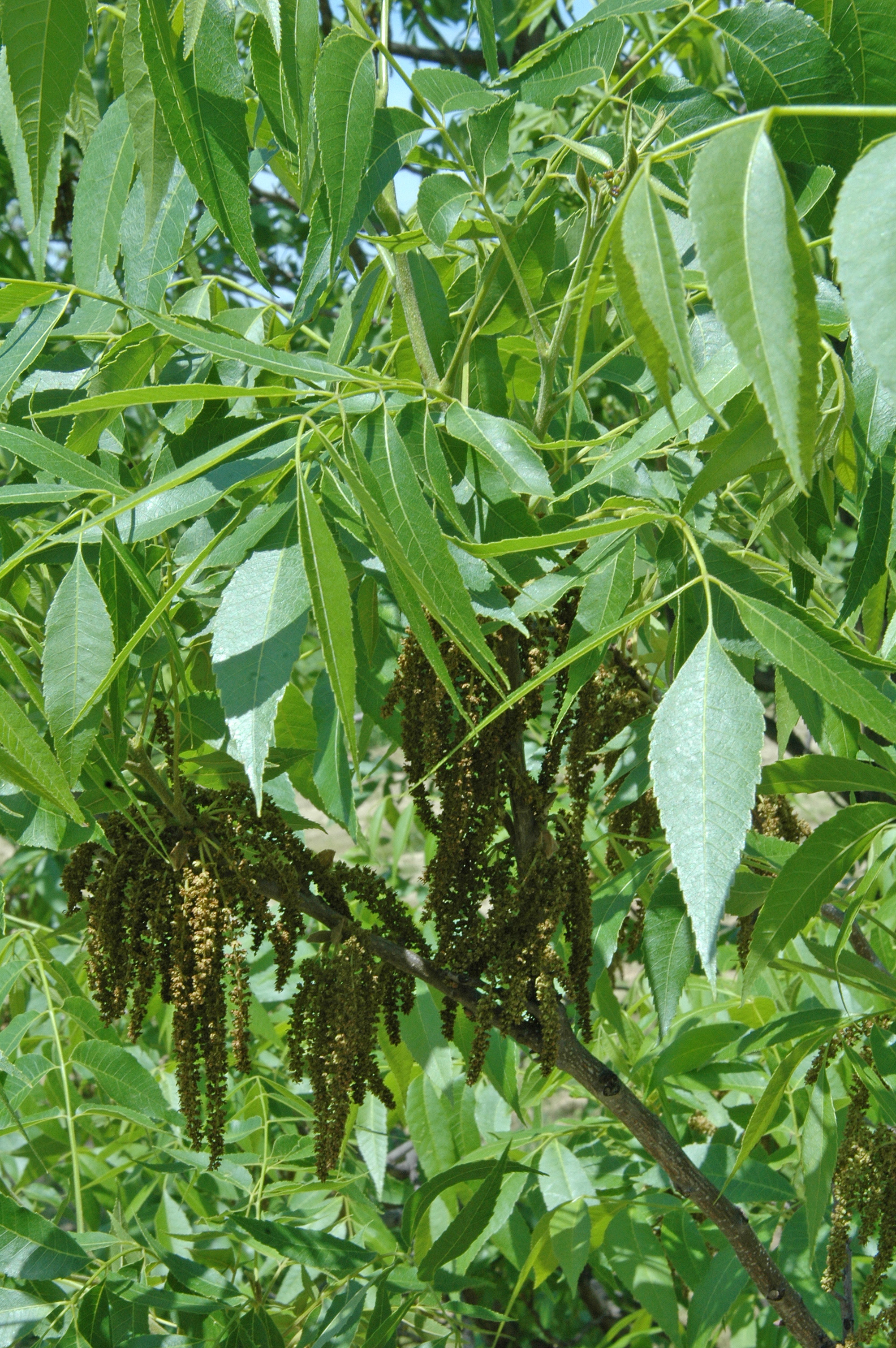
     Last weekend I took advantage of calm winds and sunny skies to photograph pecan flowering and pollination. I also like to scout my orchard at this time of year to get a feel for this year's nut crop. During the month of May, my trees are always covered with catkins--the long worm-like structures that hang down from last year's shoot growth. Male flowers (pollen sacs) cover each catkin and eventually split open to release millions of yellow pollen grains into the air to hopefully find their way to a receptive female bloom.

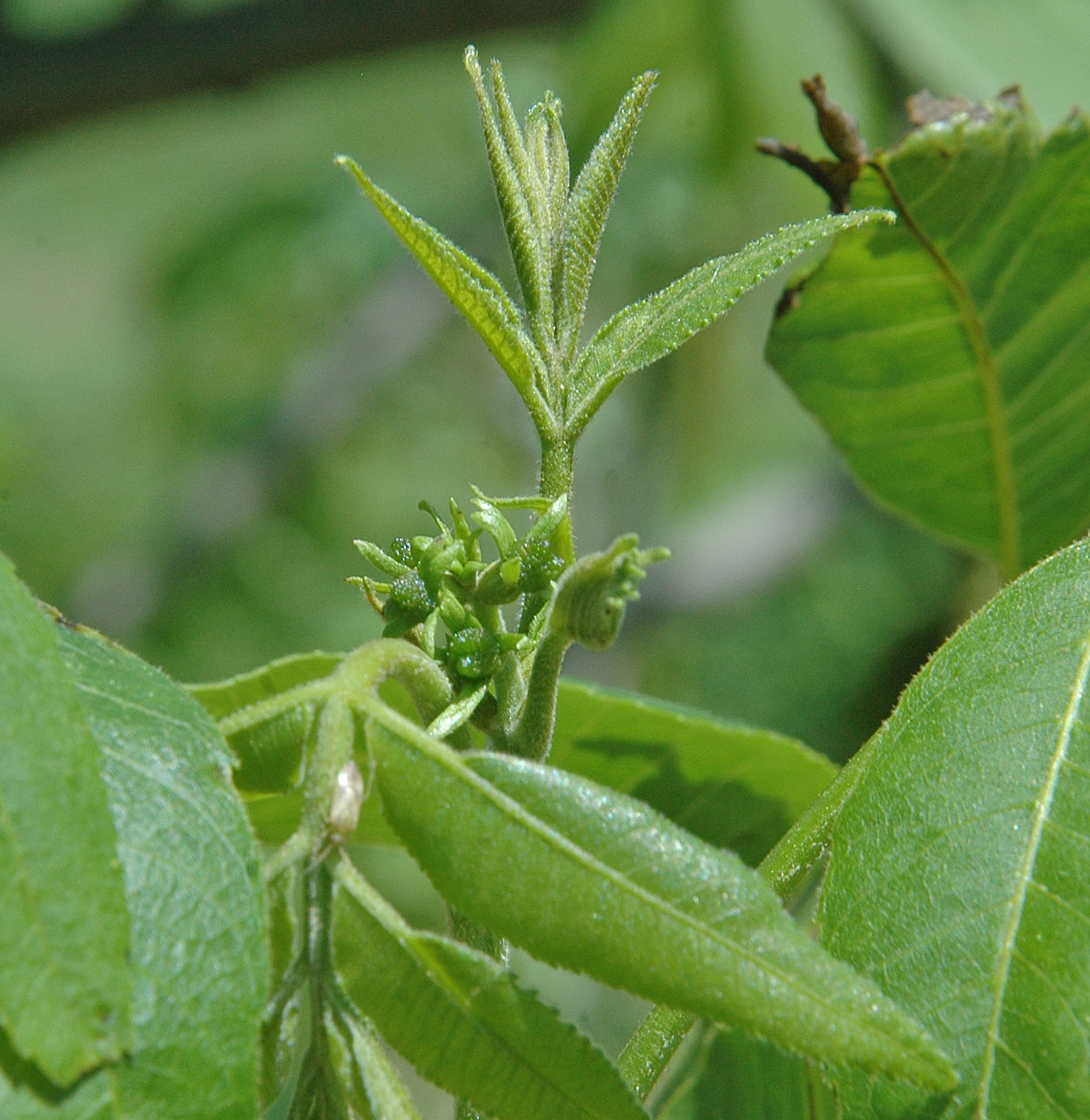
    Pecan female blooms are not very showy (photo at right) and can be found at the terminal new spring shoot growth. Look carefully at the flower cluster in the photo and you will note that the ends of each flower (the stigmatal surface) has started to turn dark brown-black indicating these flowers have been pollinated. The flower cluster pictured here is from a Kanza tree. Kanza is a protogynous cultivar meaning the female flowers on the tree become receptive early in the pollination season while Kanza pollen is released late.

     When scouting my orchard for yield potential, I concentrate on counting the number of terminals on a tree that have developed female flower clusters. The good news for my orchard is that the 2022 crop looks very promising at this point.

On my trip around the orchard, I decided to concentrate recording the flowering habits of the pecan cultivars originating from my breeding project. I took 2 photos of each cultivar. The first shows the entire fruiting shoot. The second is a close-up of a female flower cluster. All photos were taken on May 14th. I've noted the flowering habit of each cultivar.

CANEY - PROTANDROUS


Caney was actively shedding pollen at the time this photo was taken.


Caney pistillate flowers were still growing and not yet receptive. The stigmas will be bright red at receptivity.


 EARLTON - PROTOGYNOUS

Earlton has long slender catkins typical of protogynous cultivars.


A Earlton flower cluster shows signs of already being pollinated.


LABETTE - PROTOGYNOUS

Look carefully. See if you can spot the female flower cluster held at the end of the new Labette shoot.


Labette female flowers look ready to receive pollen.


LIBERTY - PROTANDROUS

Liberty was shedding pollen and should make a good pollinator for Kanza.


Liberty female flowers were still growing in size. Stigmas will be red in color.


PLEASANTON - PROTOGYNOUS

Pleasanton catkins are starting to turn yellow in color. It won't be long before pollen sacs start to open and release their pollen grains.


Pleasanton female flowers have started to turn brown indicating pollination has occurred.


ST. PAUL - PROTANDROUS

St. Paul catkins were shedding pollen. So much pollen that I had to clean off my camera lens.


St. Paul female flowers were still not fully formed. These females will have green stigmas.


THAYER - PROTANDROUS

Thayer catkins have shed most of their pollen and have turned brown in color.


Thayer female flowers are still growing. The stigmas will be bright red when receptive to pollen