Every year I seem to spot just a few leaves distorted by the pecan leaf roll mite (Aceria caryae). Generally, the amount of damage is minor and we can simply ignore this pest. However, this year I have noted several trees in my orchard that are heavily infested with leaf roll mites (photo at right). In the photo, you'll note that the older leaves have thin leaflets but the newest leaves on the end of the shoot appear normal.
Looking closer at the mite-damaged leaves you will note that the edges of each leaflet are curled upwards and a roll of gall tissue has formed along the outside edge (photo at left). Leaf roll mites are in the eriophyid mite family: a family known for causing galls on plants.
I can not find any information on the life cycle of this pest but I don't expect the problem to become more prevalent in my orchard next year. Currently, there are no chemical control measures recommended for this pest but I may try applying a dormant oil spray on infested trees before bud break next spring. For the most part naturally occurring predatory mites keep the population of the leaf roll mites in check. Hopefully, nature's balance of predators and prey will be restored in the Spring of 2020.
Showing posts with label minor insects. Show all posts
Friday, July 5, 2019
Thursday, August 10, 2017
Pecan leafminers
Have you every noticed a brown spot on the upper side of a pecan leaflet (photo at right)? What looks like a foliar disease is actually the home of a small caterpillar. The upper-surface blotch leafminer (Cameraria caryaefoliella) feeds on leaf cells just under the epidermis of the leaf and creates an irregular shaped brown blotch. Look carefully at the blotch and you'll see that under the papery thin epidermis you'll find a pile of black frass left by the caterpillar.
I carefully pealed back the upper layer of the blotch to see if I could locate the caterpillar underneath (photo at left). I found the worm and moved him out to the leaf surface. The larva was black in color and very sluggish. The color and behavior of this caterpillar indicated that this poor fellow has been parasitized by a miniature wasp. That's one leafminer that won't be metamorphosing into a adult moth.
Less common in my orchard is the pecan serpentine leafminer, Stigmella junglandofoliella (photo at right). This leafminer also feeds on leaf tissue just under the epidermis of pecan leaves but creates a meandering tunnel. As the larvae grows in size, the tunnel becomes wider making it look like a small snake is sitting in the surface of the leaf. Eventually the larvae in the tunnel will pupate and a small moth will emerge for the widest portion of the tunnel.
Leaf miners are typically a non-economic pest. I commonly find them on young trees that receive little or no insecticide treatments. Once trees start bearing nuts and are regularly treated for major nut feeding pests, leaf miners largely disappear from the orchard.
I carefully pealed back the upper layer of the blotch to see if I could locate the caterpillar underneath (photo at left). I found the worm and moved him out to the leaf surface. The larva was black in color and very sluggish. The color and behavior of this caterpillar indicated that this poor fellow has been parasitized by a miniature wasp. That's one leafminer that won't be metamorphosing into a adult moth.
Less common in my orchard is the pecan serpentine leafminer, Stigmella junglandofoliella (photo at right). This leafminer also feeds on leaf tissue just under the epidermis of pecan leaves but creates a meandering tunnel. As the larvae grows in size, the tunnel becomes wider making it look like a small snake is sitting in the surface of the leaf. Eventually the larvae in the tunnel will pupate and a small moth will emerge for the widest portion of the tunnel.
Leaf miners are typically a non-economic pest. I commonly find them on young trees that receive little or no insecticide treatments. Once trees start bearing nuts and are regularly treated for major nut feeding pests, leaf miners largely disappear from the orchard.
Labels:
minor insects
Monday, July 10, 2017
Japanese beetles feast on young pecan trees
People living along the east coast of the United States have become all too familiar with voracious Japanese beetles chewing the leaves of trees, shrubs, and garden plants. This introduced pest was first found in Riverton, NJ in 1916 and has slowly spread across the eastern US moving just a few miles each year. This year we've spotted quite a few clusters of Japanese beetles feeding on pecan leaves in Cherokee Co. KS (home of the Pecan Experiment Field).
The Japanese beetle spends most of the year as a C-shaped grub-worm feeding in the soil on the roots of ground cover plants. Adults start emerging in mid-June and aggregate in large numbers on a single plant. The adults feed on over 300 species of plants including pecans. The beetles feed on leaf tissue but only remove tissue between leaf veins. This feeding behavior results in leaves with a skeletonized appearance (photo above).
Adult beetles have bright metallic coloration. The head and thorax are metallic green while the wing covers are copper colored (photo above). Upon emerging from the soil, adults release a strong pheromone that attracts other adults to the same location on the tree. Once aggregated, they feed on leaf tissue then shorty thereafter begin mating. Mated females will then drop to the ground to lay 30-40 eggs in the turf. Adult Japanese beetles are present for about a month's time, starting in mid-June and continuing until early July.
In our pecan orchard we have found Japanese beetles only on trees that did not receive the insecticide treatment we made in mid-June.
Monday, July 11, 2016
Hickory shuckworm, fall webworm and scab: Time to spray again
In scouting our pecan grove, we've seen three insect pests that I would like to keep under control. The first is fall webworm (photo at left). We don't have an overwhelming webworm problem in the orchard but there are just enough first generation colonies that, if left untreated, may lead to a huge second generation problem in August.
We have also collected several dropped nuts damaged by hickory shuckworm You can identify hickory shuckworm damage by finding an ovipostion scar surrounded by a ring of white insect scales (photo at right). With a low to moderate crop this year I want to make sure we hold onto as many nuts as possible. Controlling hickory shuckworm will help maintain the current nut set.
The third insect pest we have found in our pecan grove this week is Japanese beetle. This is a new pest for us and one that is just starting to move into our area. This shiny green beetle with copper-colored wing covers, usually feeds in groups of several beetles. Pecan leaves take on a tattered appearance following beetle feeding.
In spraying for pecan scab today, we included an insecticide in the spray tank to make sure we keep webworm, shuckworm, and Japanese beetle under control.
Friday, May 15, 2015
June beetles cut off new growth
Last week, we experienced several days when early evening hour temperatures remained in the low 70's. That's when I heard the familiar sound of large "June" beetles crashing into the windows of my house starting shortly after sunset. I looked through the window glass and spotted a European chafer crawling on the sill. After spotting this insect, I knew that I could go outside the next morning and find new leaves and shoots chewed off young pecan trees (photo at right). I've written about this pest in an earlier post, but this week I wanted to talk further about the adult beetle behavior and why they only damage young pecan trees.
The European chafer produces one generation per year. Female beetles lay their eggs in the turf and C-shaped grubs that hatch from these eggs spend all year feeding on the roots of grasses. Each spring larvae pupate and become adult beetles. These beetles emerge from the turf during early evening hours and swarm to low lying tree branches or shrubs. By cutting off tender leaves and shoots, the European chafer creates an ideal place for additional beetles to land facilitating the search for a suitable mate.
European chafers are ground dwelling insects so when then fly onto young pecan trees they generally migrate to lower limbs. In the photo at left, you can see that the lowest two limbs of this tree have been attacked by beetles while the upper portion of the tree is untouched. As pecan trees grow larger and lower limbs are pruned off, European chafers will no longer present a problem because these insect can't stand heights.
Spring emergence of adult beetles lasts about 2 weeks. At my location, emergence is trailing off and will be over soon.
The European chafer produces one generation per year. Female beetles lay their eggs in the turf and C-shaped grubs that hatch from these eggs spend all year feeding on the roots of grasses. Each spring larvae pupate and become adult beetles. These beetles emerge from the turf during early evening hours and swarm to low lying tree branches or shrubs. By cutting off tender leaves and shoots, the European chafer creates an ideal place for additional beetles to land facilitating the search for a suitable mate.
European chafers are ground dwelling insects so when then fly onto young pecan trees they generally migrate to lower limbs. In the photo at left, you can see that the lowest two limbs of this tree have been attacked by beetles while the upper portion of the tree is untouched. As pecan trees grow larger and lower limbs are pruned off, European chafers will no longer present a problem because these insect can't stand heights.
Spring emergence of adult beetles lasts about 2 weeks. At my location, emergence is trailing off and will be over soon.
Friday, July 11, 2014
Planthoppers on pecan
While trimming my grafts, I came across a patch of white cottony material on the stem of one of my young trees (photo at right). After looking more closely, I could see a small colony of nymphs hiding within the patch of white fluff. I also spotted a stream of small ants tending the white nymphs.
The nymphs in the photo are the immature form of the citrus flatid planthopper (Metcalfa pruinosa). Adult planthoppers are small, gray, wedge-shaped insects that spring off the stems of trees when disturbed (photo below). Nymphs are wingless and remain clustered in a group until they reach maturity. Both nymphs and adults are sap feeders, piercing the bark of young trees to feed.
The ants in the photo are tending the planthopper nymphs. They collect the sugar-rich honeydew secreted by the planthoppers while protecting the nymphs from predators and parasites.
Planthopper feeding does not pose a serious threat to young pecan trees. Although a large white patch on the stem of a young tree may look bad, an insecticide treatment is not necessary.
The nymphs in the photo are the immature form of the citrus flatid planthopper (Metcalfa pruinosa). Adult planthoppers are small, gray, wedge-shaped insects that spring off the stems of trees when disturbed (photo below). Nymphs are wingless and remain clustered in a group until they reach maturity. Both nymphs and adults are sap feeders, piercing the bark of young trees to feed.
The ants in the photo are tending the planthopper nymphs. They collect the sugar-rich honeydew secreted by the planthoppers while protecting the nymphs from predators and parasites.
Planthopper feeding does not pose a serious threat to young pecan trees. Although a large white patch on the stem of a young tree may look bad, an insecticide treatment is not necessary.
| Adult citrus flatid planthopper feeding on young pecan tree |
Labels:
minor insects
Wednesday, October 16, 2013
Broken twigs caused by long-horned beetle
This week, I've been back up in pecan tree canopies collecting nut samples from our breeding plot. When I'm up in the hydraulic lift I get to see things I might not notice from ground level. High-up in one tree, I found a branch that looked like it was cleanly broken in two with the leaves above the break dessicated to a crispy brown (photo at right).
Moving in for a closer look, I found that the branch had a clean break--almost like it was partially cut by a pruning tool. This type of clean break is the tell-tale sign that the limb had been attacked by a long-horn beetle called the twig girdler. You can find a photo of an adult twig girdler and the details of this beetle's life history in a post I made previously.
The female beetle lays eggs in the branch above the girdle. These eggs will hatch next spring and larvae will feed on the recently killed twig. If you find neatly broken off limbs on the ground under your pecan trees this harvest season, it is a good idea to pick up those twigs and burn them to destroy next year's crop of twig girdlers.
Moving in for a closer look, I found that the branch had a clean break--almost like it was partially cut by a pruning tool. This type of clean break is the tell-tale sign that the limb had been attacked by a long-horn beetle called the twig girdler. You can find a photo of an adult twig girdler and the details of this beetle's life history in a post I made previously.
The female beetle lays eggs in the branch above the girdle. These eggs will hatch next spring and larvae will feed on the recently killed twig. If you find neatly broken off limbs on the ground under your pecan trees this harvest season, it is a good idea to pick up those twigs and burn them to destroy next year's crop of twig girdlers.
Saturday, September 7, 2013
Flat headed apple tree borers make a mess.
I was mowing the other day when I spotted what looked like a long steak of mold growing on the bark of one of my young pecan trees (photo at right). Oh no! Is this something new I need to worry about? Am I going to lose this beautiful, well-shaped tree? I finished mowing, put up the tractor, then came back for a closer look.
Upon closer inspection, I found several trees with prominent stains on the bark, usually centered around the upper side of a branch connection (photo at left). The stain appeared water soaked (dark brown) on the outer margins and fuzzy light-grey near the center. It definitely looked like I had an actively growing fungus on the surface of the bark.
It all became clear when I looked at the other side of the tree and found a neat pile of insect frass in the crotch of the tree (see red arrow, photo at right). Now I know whats going on here. I don't have a strange new disease on my trees I simply have some actively working flat-headed apple tree borers.
These common wood boring insects are often found in young pecan trees, especially in orchards that have yet to receive regular applications of insecticides aimed at controlling nut feeding pests. However, the staining on the outside of the bark is not normally associated with apple tree borers.
The stains are a result excessive sap flow that occurred in response to the heavy rains we experienced from July 21 to August 12 (> 15 inches). Sap flowed into the wood borer's tunnel then spilled out onto bark surrounding the branch crotch. Since tree sap contains several forms of carbohydrates, the sap-soaked bark combined damp weather conditions provided an excellent environment for the growth of the common grey mold fungus.
Since mid-August, the weather has turned off hot and dry. No new sap is flowing from wood borer tunnels and the grey mold fungus has stopped growing. However, the stains have remained and will remain until winter rains scrub the bark clean.
One final note. Apple tree borers do only slight damage to the tree and rarely require chemical control.
Upon closer inspection, I found several trees with prominent stains on the bark, usually centered around the upper side of a branch connection (photo at left). The stain appeared water soaked (dark brown) on the outer margins and fuzzy light-grey near the center. It definitely looked like I had an actively growing fungus on the surface of the bark.
It all became clear when I looked at the other side of the tree and found a neat pile of insect frass in the crotch of the tree (see red arrow, photo at right). Now I know whats going on here. I don't have a strange new disease on my trees I simply have some actively working flat-headed apple tree borers.
These common wood boring insects are often found in young pecan trees, especially in orchards that have yet to receive regular applications of insecticides aimed at controlling nut feeding pests. However, the staining on the outside of the bark is not normally associated with apple tree borers.
The stains are a result excessive sap flow that occurred in response to the heavy rains we experienced from July 21 to August 12 (> 15 inches). Sap flowed into the wood borer's tunnel then spilled out onto bark surrounding the branch crotch. Since tree sap contains several forms of carbohydrates, the sap-soaked bark combined damp weather conditions provided an excellent environment for the growth of the common grey mold fungus.
Since mid-August, the weather has turned off hot and dry. No new sap is flowing from wood borer tunnels and the grey mold fungus has stopped growing. However, the stains have remained and will remain until winter rains scrub the bark clean.
One final note. Apple tree borers do only slight damage to the tree and rarely require chemical control.
Labels:
bark,
minor insects,
wood borers
Tuesday, May 28, 2013
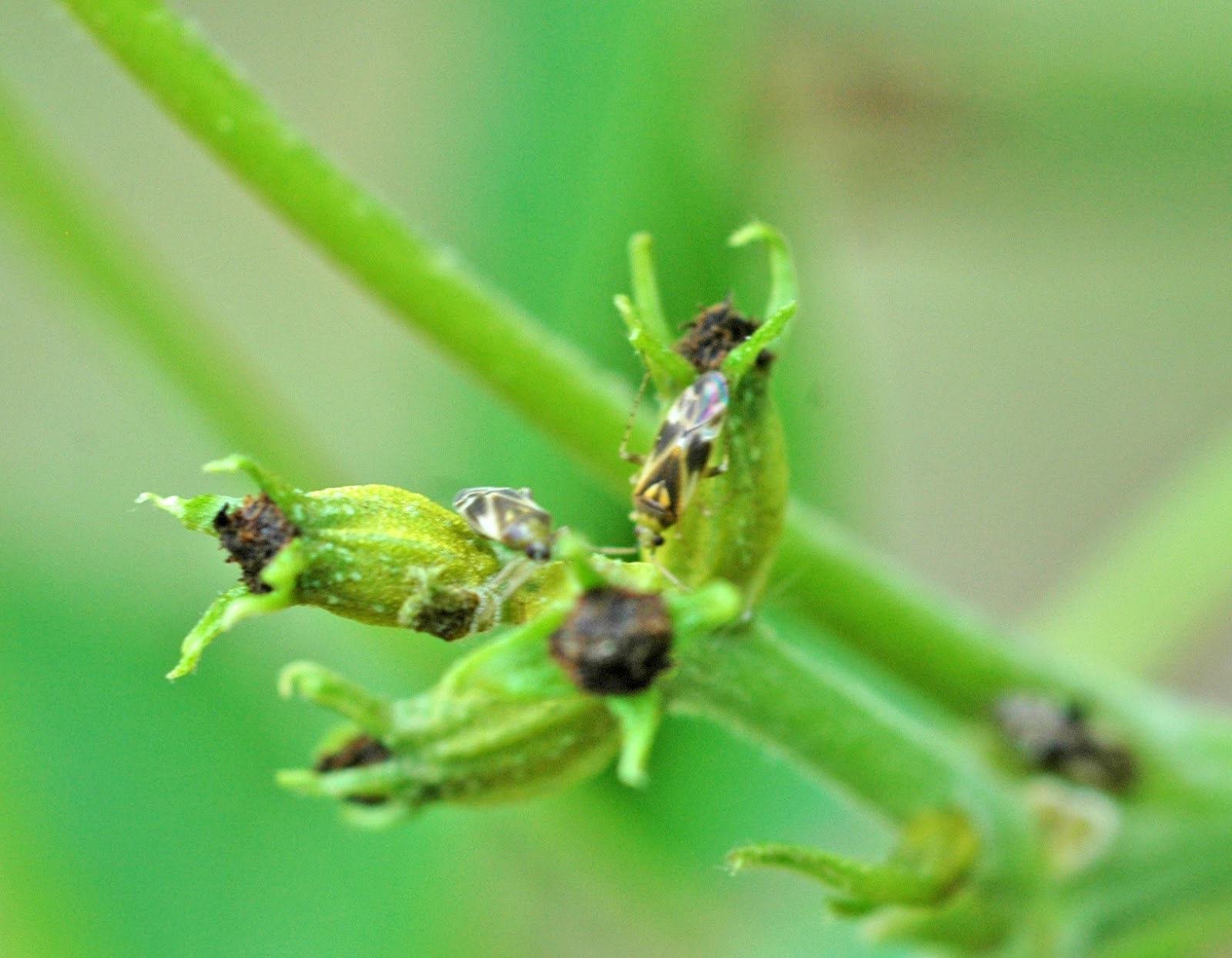
Mirids on flower clusters
At this time of year I like to check on the progress of pecan flowering. While inspecting pistillate flowers, I always spot numerous plant-feeding Mirids crawling around young nutlets. In the photo at right, note the two, mottled-brown insects on the flower cluster. These are examples of the Mirid, Plagiognathus caryae. In the photo, they are using their piercing-sucking mouthparts to feed on plant juices.These insects can also be seen feeding on catkins and expanding leaves. Although they look like they could be damaging, we have found that these insects do not cause significant crop losses.
Labels:
minor insects
Wednesday, June 13, 2012
Insect assassin: The wheel bug
The wheel bug feeds on caterpillars, sawfly larvae, aphids, or any insect not fast enough to get out of the way. This insect has a long, red, tube-like mouth part that is normally held under the head. When a wheel bug attacks another insect, it holds back its head then throws out its tube-like mouth parts like a javelin into the body of its prey. The wheel bug immediately injects a neurotoxin into the body of its victim, paralyzing it. Once the prey is immobilized, the wheel bug secretes its digestive fluids into the insect's body. After the insect becomes pre-digested, the wheel bug sucks all the fluids out through its tube like mouth parts.
The wheel bug is one of our major predators of walnut caterpillar and fall webworm. But be careful around this beneficial insect. If you even get bitten by a wheel bug, the neurotoxin secreted in this insect's bite will leave a painful welt on you that can will last for days.
Thursday, May 24, 2012
Curled-up pecan leaves
Growers are seeing some curled-up leaves in their orchards this year. Over the past week, I have spotted two types of leaf distortions in our pecan grove.
In the photo at right you can see that the 5 leaflets on the end of this leaf are twisted and cupped. This type of damage was caused by the potato leaf hopper during the period of leaf expansion. The holes in the leaflets were caused by sawfly feeding, also earlier this growing season.
If you take a close look at the underside of a curled-up leaflet, you will note brown necrotic areas along the main midrib and all major veins (photo at left). When the leaflet was small and very tender, the potato leaf hopper inserted it mouth parts into the vascular system of the leaflet to feed on nutrient rich plant sap. This feeding behavior causes the vascular system to become clogged, stopping the flow of carbohydrates needed for further leaf expansion. Areas of the leaf that rely on those clogged veins for water and nutrients become yellow (lack of nutrients) or turn brown (lack of water). The leaflets curl because affected areas stop expanding while areas that are adjacent to functioning veins continue to expand.
Potato leaf hoppers migrate through our area every spring. The damage caused by this insect varies from year to year and you will see several trees species affected (including pecan, walnut, ash, & maple). We do not recommend treating for this transitory insect and just let the tree grow additional leaves to replace the damaged ones.
A second type of curled up leaf is caused by the leaf roll mite. In the photo at right, note that the margin of the leaflet is rolled into a tight, hardened gall-like structure. As the mite feeds on the edge of a leaflet during leaf expansion, it causes distorted cell growth, creating the "leaf roll". Leaf roll mites are fairly rare in a native pecan grove and we don't take steps to control what amounts to minimal damage.
In the photo at right you can see that the 5 leaflets on the end of this leaf are twisted and cupped. This type of damage was caused by the potato leaf hopper during the period of leaf expansion. The holes in the leaflets were caused by sawfly feeding, also earlier this growing season.
If you take a close look at the underside of a curled-up leaflet, you will note brown necrotic areas along the main midrib and all major veins (photo at left). When the leaflet was small and very tender, the potato leaf hopper inserted it mouth parts into the vascular system of the leaflet to feed on nutrient rich plant sap. This feeding behavior causes the vascular system to become clogged, stopping the flow of carbohydrates needed for further leaf expansion. Areas of the leaf that rely on those clogged veins for water and nutrients become yellow (lack of nutrients) or turn brown (lack of water). The leaflets curl because affected areas stop expanding while areas that are adjacent to functioning veins continue to expand.
Potato leaf hoppers migrate through our area every spring. The damage caused by this insect varies from year to year and you will see several trees species affected (including pecan, walnut, ash, & maple). We do not recommend treating for this transitory insect and just let the tree grow additional leaves to replace the damaged ones.
A second type of curled up leaf is caused by the leaf roll mite. In the photo at right, note that the margin of the leaflet is rolled into a tight, hardened gall-like structure. As the mite feeds on the edge of a leaflet during leaf expansion, it causes distorted cell growth, creating the "leaf roll". Leaf roll mites are fairly rare in a native pecan grove and we don't take steps to control what amounts to minimal damage.
Thursday, May 10, 2012
Pecan catocala
Hidden in the bark of a native pecan tree, I found the largest caterpillar that feeds on pecan foliage (photo at right). The catocala caterpillar can grow to 3 inches long but it is often difficult to find because its grey mottled appearance is the perfect camouflage for hiding in the bark of pecan trees. The caterpillar remains hidden and motionless during the day and feeds on pecan foliage after dark. The nocturnal behavior and perfect camouflage helps catocala larvae from becoming a tasty meal for hungry birds. Catocala caterpillars chew large angular sections out of pecan leaflets giving the foliage a tattered appearance.
The pecan catocala is a member the Noctuidae family and is commonly known as an underwing moth. I always find one or two caterpillars per year in our pecan grove but populations never grow large enough to cause significant damage to our trees.
(Remember, you can click on the photo to enlarge it. The caterpillar is in the lower center of the photo with its head pointing down.)
The pecan catocala is a member the Noctuidae family and is commonly known as an underwing moth. I always find one or two caterpillars per year in our pecan grove but populations never grow large enough to cause significant damage to our trees.
(Remember, you can click on the photo to enlarge it. The caterpillar is in the lower center of the photo with its head pointing down.)
Monday, May 7, 2012
June beetles cut new pecan shoots
It almost looks like a ten-foot-tall deer has browsed out the tops of a young pecan tree (photo at right). You can look over the entire tree and not find a trace of the offending creature that clipped off this spring's new growth. You can, however, find clipped-off leaves scattered under the tree.
This kind of damage is caused by what is commonly known as June beetles. There are numerous species of June beetles found in Kansas but the one that I've recently noticed crashing into my kitchen window after dark is the European chafer, Rhizotrogus majalis.
The European chafer is a major pest of cool season grasses. This insect's C-shaped larvae (photo at left) live in the soil feeding on grass roots. In late spring, larvae pupate and adult beetles emerge from the soil swarming to small trees or shrubs in search of a mate.
Adults emerge after dark during warm (above 65 degrees) clear nights. It is during this adult swarm that the adult insect feeds on tender shoots, clipping off the foliage of young pecan trees. Adults are active only at night, hiding in the turf's thatch during daylight hours. The adult phase of the European chafer (photo above) lasts only one to two weeks before mated females burrow into the soil to lay eggs. There is only one generation of European chafers per year.
Damage caused by the European chafer (photo at right) can slow down the growth of young trees but they usually recover when new buds break and form new leaves. Control of this insect would require an insecticide treatment of the orchard floor in August to kill larvae in the soil. However, the cost of insecticide treatment is hard to justify considering that most damaged trees have yet to reach the age of commercial nut production.
This kind of damage is caused by what is commonly known as June beetles. There are numerous species of June beetles found in Kansas but the one that I've recently noticed crashing into my kitchen window after dark is the European chafer, Rhizotrogus majalis.
The European chafer is a major pest of cool season grasses. This insect's C-shaped larvae (photo at left) live in the soil feeding on grass roots. In late spring, larvae pupate and adult beetles emerge from the soil swarming to small trees or shrubs in search of a mate.
Adults emerge after dark during warm (above 65 degrees) clear nights. It is during this adult swarm that the adult insect feeds on tender shoots, clipping off the foliage of young pecan trees. Adults are active only at night, hiding in the turf's thatch during daylight hours. The adult phase of the European chafer (photo above) lasts only one to two weeks before mated females burrow into the soil to lay eggs. There is only one generation of European chafers per year.
Damage caused by the European chafer (photo at right) can slow down the growth of young trees but they usually recover when new buds break and form new leaves. Control of this insect would require an insecticide treatment of the orchard floor in August to kill larvae in the soil. However, the cost of insecticide treatment is hard to justify considering that most damaged trees have yet to reach the age of commercial nut production.
Thursday, May 3, 2012
Mirids on pecan flowers
Most pecan growers like to look for pistillate flower clusters during the pollination season. A flower cluster on most every terminal (like this year) is a sure sign of a good nut crop in the Fall. However, when looking for pistillate flowers, you might spot one of the common plant bugs that feed on pistillate flowers (photo above) or on catkins.
Here's a closeup of the insect (photo at right). Plagiognathus albatus is a plant feeding mirid (family Miridae) that I see every year during pollination season feeding on pecan flowers (both male and female). This insect does not cause economic damage to the nut crop and disappears from trees at the conclusion of pollination season. We have plenty of insects to worry about controlling in a pecan grove. This mirid is not one of them.
Labels:
minor insects
Sunday, April 15, 2012
Twig girdler damage on pecan
Between rain showers, I spent most of this weekend grafting pecan trees on my farm. While wading through the water and wet grass, I came across a tree that I grafted last year. At first, the tree looked like it had suffered terminal dieback possibly from last year's drought. But when I took a closer look, I noticed a profusion of new shoots all growing out below a nicely cut grove in the stem (photo at right). This groove was cut late last summer by an insect called a twig girdler.
The twig girdler is a long horn beetle that is 5/8 to 3/4 inch long (photo at left). The most distinguishing feature of this insect are the long antennae that are as long or longer than the entire insect. Female twig girdlers lay eggs in August through September in small pecan branches usually just below the point where a leaf is attached to the stem.
After laying eggs, the female cuts a grove in the stem. The girdling of the stem causes all the carbohydrates manufactured by the leaves above the girdle to become concentrated in the stem rather that being set down to the roots. The eggs she lays in late summer don't hatch until the following spring. But when they do hatch, the larvae feast on the carbohydrate enriched twig.
Twig girdlers are most often a problem in non-bearing pecan groves. Once pecan trees start to bear, insecticides applied in August and September to control pecan weevil also control twig girdler. In young orchards, picking up girdled branches every spring and burning them will help reduce the population of twig girdlers in the future.
The twig girdler is a long horn beetle that is 5/8 to 3/4 inch long (photo at left). The most distinguishing feature of this insect are the long antennae that are as long or longer than the entire insect. Female twig girdlers lay eggs in August through September in small pecan branches usually just below the point where a leaf is attached to the stem.
After laying eggs, the female cuts a grove in the stem. The girdling of the stem causes all the carbohydrates manufactured by the leaves above the girdle to become concentrated in the stem rather that being set down to the roots. The eggs she lays in late summer don't hatch until the following spring. But when they do hatch, the larvae feast on the carbohydrate enriched twig.
Twig girdlers are most often a problem in non-bearing pecan groves. Once pecan trees start to bear, insecticides applied in August and September to control pecan weevil also control twig girdler. In young orchards, picking up girdled branches every spring and burning them will help reduce the population of twig girdlers in the future.
Subscribe to:
Posts (Atom)