Showing posts with label pecan scab. Show all posts

Saturday, July 3, 2021

Weather dictates disease and insect control measures


    During the last 5 days of June it rained every day for a total accumulation of over 5 inches. With all that rain, the Neosho river spilled over its banks and flooded my pecan grove. The excessive moisture provided excellent conditions for the spread of pecan diseases but I was forced to wait until the flood receded before starting up the sprayer. While waiting to spray a fungicide,  I also noticed several colonies of Japanese beetles (photo at left) starting to feed on pecan leaves. 
      Japanese beetle has been a pest in the US for also 100 years and has moved slowly westward across the continent. For SE Kansas, Japanese beetle is a new pest that I first noticed only 5 years ago. This year, the beetle population has grown large enough to present a significant threat to pecan foliage.
 
   The damage on pecan is easily spotted high in the tree's canopy. Beetles feed on foliage in large groups leaving areas of tree canopy with a lace-like appearance (photo at right). This photo was taken a few hours after an insecticide and fungicide application so the beetles are gone but evidence of their activity remains. I just wish I had a way to capture the wild buzzing of beetles around the tree when I hit them with the air-blast sprayer. While driving the sprayer a blistering 1.9 MPH, I was able to get a pretty good feel for the large number of beetles that had been feasting on my trees. 
   During the morning of spraying, I also noticed a single fall webworm colony (photo at left). The insecticide I used to control Japanese beetle will also kill the larvae inside this single web. However, the appearance of this webworm colony serves as a reminder that I will need to stay vigilant with my pecan pest scouting efforts.
    Starting at sunrise this morning (3 July 2021), I sprayed my orchard using Quilt fungicide and Mustang Maxx insecticide.


Monday, June 28, 2021

Scouting for pecan pests

    Every year I have inspected hundreds of pecan nut clusters in early June to determine the date of first significant nut entry by pecan nut casebearer. Casebearer has been a perennial insect pest that can destroy an entire nut clusters shortly after pollination. However, I have searched all month and could not find a single nut damaged by the feeding of a pecan nut casebearer larva (photo above). In fact, my trees look clean of all insect problems at this point (no webworms or walnut caterpillar)

   As part of my regular scouting routine, I always visit some large native pecan trees in a cemetery just across the road from my home. These trees are never sprayed and provide me with an opportunity to see pests develop unchecked during the growing season.


   This past May was cooler and wetter than normal and by the first week in June I found pecan scab infections on native pecan tree leaves (photo at left).   The black spots that dot the leaflets and leaf rachis seem like a minor infection but theses scab lesions will provide provide enough spores to cover young developing nuts with scab lesions. Scab infection early in the nut expansion phase (late June - early July)has the potential to causes serious yield loss.

    Since last Saturday (26 June 2021),  we have entered an extended rainy period that promises to provide ideal conditions for the spread of pecan scab (rain every day for 6-7 days). In my orchard, I gave up waiting for pecan nut casebearer scab and applied a fungicide for disease control back on June 12th. These trees will need a second fungicide spray as soon as I can get in the field and apply it. I'll spray all my trees, even scab resistant cultivars like Kanza. In the past, I have found that the secondary diseases that cause early defoliation usually get their start during mid summer wet periods. By keeping healthy leaves all season long, I canl ensure a good return crop in 2022.    

Wednesday, November 27, 2019

The price for not controlling pecan scab

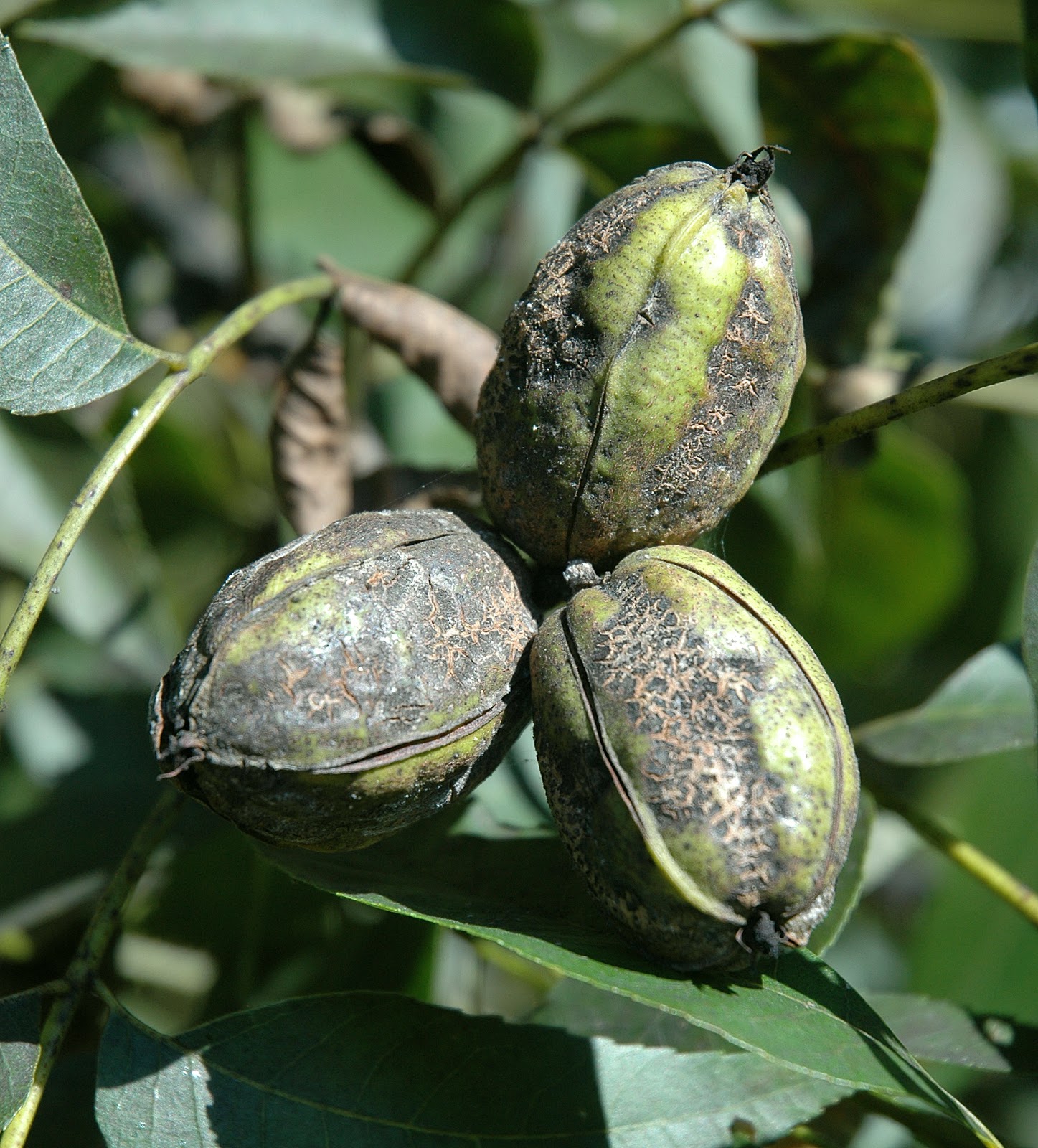
     2019 will be a year remembered in our area for its unusually frequent rain-showers. It rained all summer long and that weather pattern has continued into pecan harvest season. Only a fraction of the native pecan groves that grow along the Neosho river have been harvested. However, with much of the crop still hanging on the trees, I had the opportunity to photograft some of this year's native nuts (photo above,  right).   
    The first thing I noticed was that many of the hulls have not opened up, or if they had, opening was incomplete.
   
  Looking over the nuts on a single tree, I found entire clusters of stick-tights (photo at left). The shucks of these nuts never opened up because they were severely infected by pecan scab during our wet summer months.
   On the same tree, I could find nut clusters that had open shucks. However, even the shucks that had opened showed signs of scab infection (to a lesser extent than stick-tight nuts). To illustrate the impact of scab on native pecan yield, I collected nuts from open shucks and nuts from stick-tights.
     
    The photo above shows the nuts (top) and kernels (bottom) of the pecans I collected from open shucks as compared to stick-tights. On average the nuts peeled out of stick-tights were smaller than those pulled from open shucks. The kernels of open shucked nuts were well filled and plump. Kernels pulled from stick-tight nuts were often shriveled and dark.
   Commercial pecan growers always discard stick-tight nuts during the nut cleaning process. So in effect, scab causes total economic loss from heavily infected pecans. This year, native pecans required a strong fungicide program to prevent major crop losses. Our native trees set a heavy crop in 2019, but with the widespread outbreak of pecan scab, less than 50% of those nuts will be marketable.   

Thursday, July 11, 2019

Making my third disease control spray

    This summer had been wet and humid in SE Kansas. Pop-up thunderstorms have been frequent and those wet spots in the pecan grove never seem to dry up completely. Needless to say, this has been an ideal year for the spread of pecan diseases. Today, I was out looking at some un-managed pecan trees and I found a tree with a terrible case of pecan scab (photo at right). With an infection this bad in early July, I can guarantee you that these nuts will never yield salable pecans in the Fall. Spraying pecans with a well established scab infection like the one pictured will not cure this disease. Fungicides are only effective in preventing disease infection. This is why I've tried to stay ahead of scab this year by making multiple fungicide applications.
    I made my third fungicide application today.


    Insect pressure on our pecan trees in the area has been light. Today, I noticed my first Fall webworm colony (photo at left). The dirty white web located near the bottom of this native tree's canopy contains larvae from the first summer generation of Fall webworm. A second generation usually appears in August at a time we are often spraying for pecan weevil.

Tuesday, June 25, 2019

Making a second scab spray

    Last Sunday we had over 3 inches of rain. 2019 is turning out to be a wetter than normal year for us and it has made great conditions for the spread of pecan scab. Today, I walked over to the cemetery (across the road from my farm) to inspect nuts growing on unsprayed trees. It didn't take too long to spot some black scab lesions forming on a young pecan (photo at right).
    With this year's heavy rain fall pattern I knew it was time to make my second pecan scab spray. Despite the water soaked soil in the pecan grove, I started up the sprayer and sprayed the grove. Many farmers may criticize me for rutting up the field, but waiting for better field conditions may have been too late for keeping me  ahead of pecan diseases (photo at left). For this application, I used Flint fungicide.

Tuesday, June 11, 2019

Spraying pecans to prevent diseases

   I've been scouting pecans for pecan nut casebearer every-other-day but as of June 11, I haven't seen anything. What I have seen, is lots of pecans. Every native pecan tree in our area seems to have a nut cluster on every terminal. In addition, my improved cultivars have a great crop. So this year I've decided to change my pest control priorities and concentrate on preventing pecan diseases.

    The photo at right shows a typical cluster of Gardner pecans. Gardner is a scab susceptible pecan cultivar that produced high quality large pecans. Right now every nut in the cluster is clean; no casebearer and no scab. If all the nuts currently set on this Gardner tree stay perfect until August, I'll need to shake about half the crop off the tree to insure good kernel fill and a decent return bloom.
   A light infestation of casebearer would actually be beneficial in helping thin down the crop. In sharp contrast, there is no way I want to allow scab to get established on this year's nut crop.
   Looking at the weather predictions for the coming week it looks like we can expect several rainy days. With the rain comes high humidity and perfect conditions for scab to spread. So today, I sprayed my trees with a systemic fungicide that will work to prevent scab infection for the next 10 to 14 days.
   I sprayed the fungicide even on scab resistance cultivars such as Kanza, Hark, and Lakota because these cultivars are not resistant to all pecan diseases.  I've found that early season fungicide applications can help prevent pecan anthracnose and downy spot from creating serious late season problems during wet summers.
  I plan on making additional fungicide applications as the season progresses depending on rainfall patterns.  

Friday, July 27, 2018

Low pecan scab pressure this summer

Scab lesions on Peruque, 2018
    Many northern pecan growers have experienced a drier and hotter summer than normal in 2018. The downside of this weather pattern is that I find it hard to work outside in the heat of the afternoon, that is, unless I'm sitting in an air-conditioned tractor cab. The plus side is that we have seen a lot less pecan scab this summer. The other day, I searched my farm for signs of scab and found none. Although you should remember that I applied two fungicide cover sprays to my pecan trees back in June.
     So, I drove down to the old Pecan Experiment Field to see if I could find any scab. I started my search with two of the most scab-susceptible cultivars in our area--Peruque and Hirschi.  The Pecan Field was sprayed only once this year (shortly before I retired) so my chances for finding scab were much better.

Scab lesion on Hirschi, 2018
     I found scab lesions on both Peruque (photo above) and Hirschi (photo at left). Over the past three to four years, I was finding it almost impossible to produce these two cultivars without crop loss from scab. With just the few scab lesions present on these nuts this summer, Peruque and Hirschi should develop full-sized pecans and split their shucks normally. The hot, dry weather (especially in June) has sure helped slow the spread of scab this summer.

Scab on Peruque, 2015
    To remind you how bad scab can get on Peruque, I've reprinted a photo I took in 2015 (photo above). This scab infested nut was smaller than normal and produced far less kernel.

Tuesday, June 26, 2018

Second scab spray

Getting ready to spray the pecan breeding block
    Over the weekend we had several light rain showers followed by brutal heat wave. With ample heat and humidity, pecan scab can spread rapidly so I decided to make my second pecan scab spray of the season. This time I used Quadris Top fungicide for scab and added an insecticide (Bifenthrin) to control shuckworm and Japanese beetle.
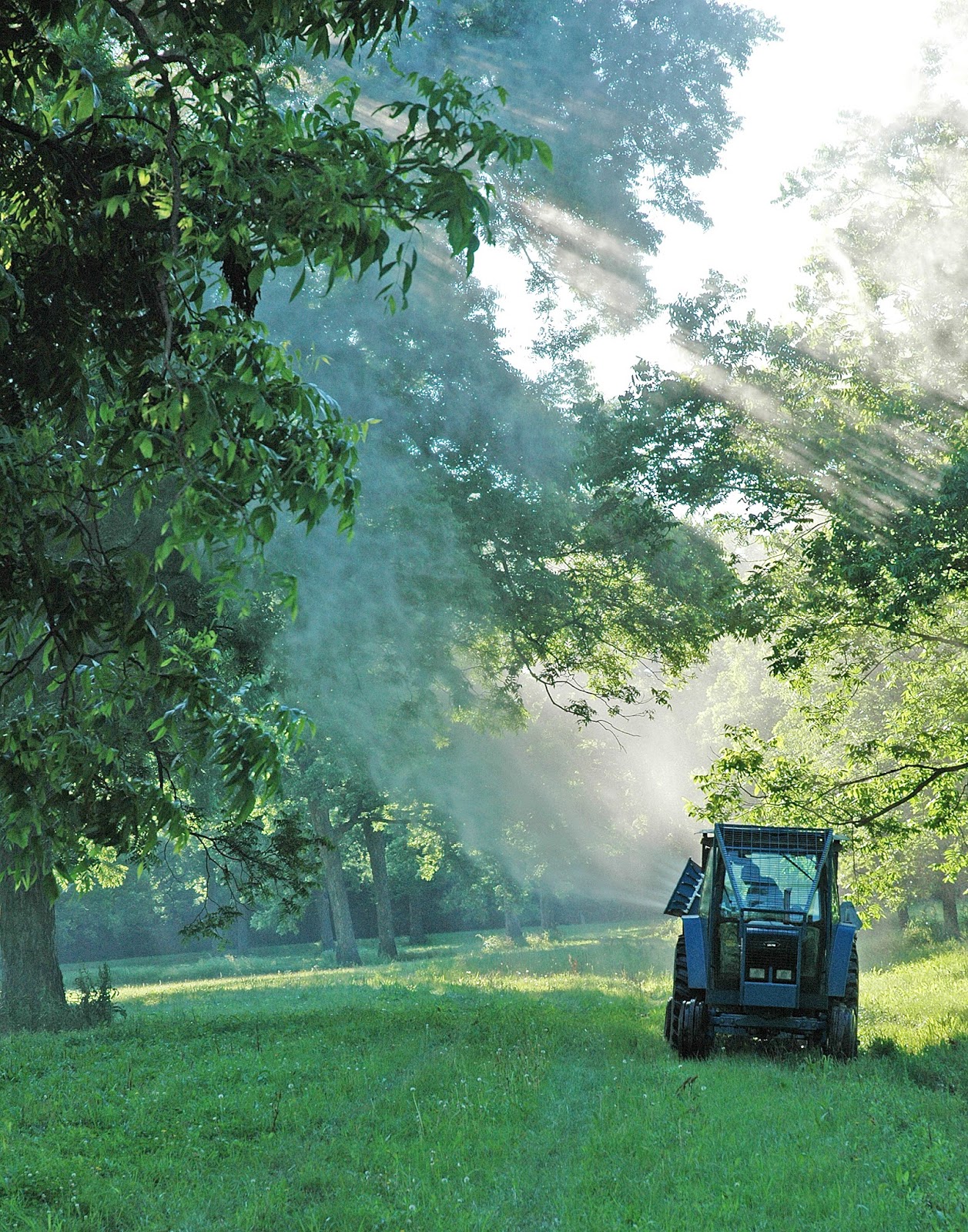
    When spraying at this time of year, I like to get started before dawn and quit before 11:00 am. Airblast sprayers work best when the air has high relative humidity and the spray material fogs up into the canopy of the tree. 

Thursday, November 30, 2017

The cost of scab infection

   We've been working hard at harvesting the 2017 pecan crop and I was struck by the obvious impacts pecan scab infection has had on some of our pecan cultivars. At the research station, we have a block of Giles and Chetopa trees, two scab susceptible cultivars. For each cultivar, I collected nuts from the harvester and arranged them by size for a photograph.


    Each photo  shows 3 normal sized pecans in the top row compared to scab-effected,  smaller nuts in the bottom row.  Although both cultivars showed signs of yield loss (smaller nuts) from scab, Giles looks harder hit.
   Looking back at our pecan scab control program in 2017, I think we made an error in waiting for the appearance of pecan nut casebearer before making our first scab spray. As it turns out, casebearer never developed to a damaging level but pecan scab got a good start on our nut crop in early June. I'm becoming convinced that I need to switch our pest control priorities. Next year, I'll time our June pesticide applications based on scab. If that means applying an insecticide a little early for casebearer, so be it. I'll just have to choose a long residual insecticide like Warrior or Intrepid to handle casebearer.  

Friday, October 27, 2017

Seeing the benefits of pecan disease control

    By mid October, you can really see the difference fungicide applications make towards preserving pecan leaf health. This past year we made three fungicide applications to all of our orchards at the Pecan Experiment Field except for a five acre block of native trees that did not receive any pesticides.


    The photo at above shows our fungicide treated pecan trees in mid-October. The leaves on these trees are still healthy and green. Healthy leaves capture energy from the sun and covert that energy into carbohydrates. Carbohydrates are then used to fill this year's pecan kernels and promote pistillate flower production next Spring. Maintaining healthy foliage throughout the growing season is the best way to reduce a pecan tree's natural tendency for alternate bearing.


    Now look trees that did not receive fungicides during the growing season (photo above). By mid-October, some of the native trees had lost most of their leaves while most had taken on a bronzed appearance. These trees are already shutting down for winter. Lesser amounts of carbohydrates are created by damaged foliage and that limited supply of energy is totally directed towards filling this year's crop of nuts. This leaves little of no energy for pistillate flower formation next year. Unchecked pecan foliar disease ultimately accentuates the alternate bearing pattern.

    Pecan diseases not only impacts leaf health but they can have direct effects on nut yield. The photo at right shows two clusters of Stuart pecans. The cluster on the left is covered with scab. On the right, the nuts still show signs of scab infection but to a much lesser degree. All of these nuts appear to be splitting open but the heavily infected nuts are one half the size. Pecan scab causes yield losses in three ways; early nut abortion, reduction in nut size, and a reduction in percent kernel.
   The primary reason we apply fungicides to pecan trees is to control pecan scab. However, the secondary impacts of disease control on leaf health is equally as important. The introduction of pecan scab resistant pecan cultivars will make disease control easier but does not eliminate the need for fungicide applications.  The control of leaf disease, especially during wet summers, is important for maintaining tree health and productivity.

Wednesday, August 30, 2017

Pecan cultivars: Checking on scab infections


    I  spent some time collecting nut samples from 24 different pecan cultivars to check on pecan scab infection levels. This season we applied 3 fungicide sprays to our pecan orchard. So when you look at the photos keep that in mind. Cultivars with zero scab lesions are either scab resistant or our scab control efforts were able to keep the disease in check. In many cases, the shucks of some pecan cultivar show signs of scab infection but the level of infection is not severe enough to impact nut size, kernel fill, or shuck opening. Peruque is an example of a cultivar that was not protected by our scab spray program and scab has engulfed the entire nut (photo above). Colby is scab susceptible but our scab control program limited the disease to a few small of scab lesions. Norton and Osage are scab resistant--the black spots on these shucks are the result of limb rub.


    Major is a scab resistant cultivar (photo above). Kanza, Lakota, and Hark all have Major as one of their parents and are also scab free. Even though these four cultivars are scab resistant that does not mean that they are immune to all pecan diseases. The fungicides we applied to our grove this year have kept the shucks of Major and her daughters from contracting pecan anthracnose.


     The photo above show four early-ripening northern pecan cultivars. Warren 346 and Lucas were completely clean showing zero scab lesions. In contrast, Mullahy and Goosepond had scab lesions despite our spray program.


    Oswego is a seedling of Greenriver and both cultivars are scab resistant (Photo above). Posey and Surecrop are only slightly susceptible to scab and it appears that our spray program has prevented all disease on the shucks.

  
    Giles is a cultivar selected from a native grove just 2 miles from our research station. Giles shows scab susceptibility despite our efforts to control the disease (photo above).  Jayhawk and SWB617 have Giles parentage but Jayhawk is scab resistant. The scab resistance of Jayhawk must come from its unknown parent.  Chetopa is another local cultivar, originating as a native tree at the Pecan Experiment Field. Chetopa is not scab resistant but three fungicide applications have kept this cultivar clean.

   
   The final photo of cultivars show that Mandan, Pawnee, and Faith are all susceptible to pecan scab. Mohawk was free of the disease.  
   With the exception of Peruque, we have been able to control scab on susceptible cultivars to a point where we will see no economic losses. This year we invested about $60 per acre in disease controlling fungicide sprays. Judging from the crop I see on the trees, we should average over 1200 lbs. of pecans per acre. That more that enough nuts to pay for our spray costs.

Monday, August 7, 2017

Spraying for weevil, stinkbug, and scab

    We had a good rain shower over the weekend which came at a perfect time to promote nut growth and kernel fill. But 1.5 inches rainfall also provided plenty of moisture to softened the soil and allow pecan weevil to start emerging. So today we fired up the sprayer (photo at right).
   Today's pesticide application was aimed at controlling three key pests; Pecan weevil, stinkbugs, and pecan scab.  We generally spray the grove in early August for stinkbug control but the wet weather dictated that we also control weevil and scab. We used Warrior 2 for insect control and Quilt Xcel for disease control.   
    Applying a fungicide this late in the season has proven beneficial during wet summers to control not only pecan scab but also pecan anthracnose and downy spot. Judging from the forecast we are in for a cool wet August.

Monday, July 24, 2017

Monitoring scab

Native pecan infected by scab
     The 2017 growing season started off with ample rainfall and ideal conditions for the spread of pecan scab (photo at right). In response, we have made two fungicide applications this summer (Mid-June and early July). However, the weather in our area has turned off hot and dry and the spread of the disease has slowed dramatically.
     We got a late start in spraying for scab this year because I kept waiting for pecan nut casebearer to appear (it never did) before making a trip through the orchard with my sprayer. As a consequence, we have a light scab infestation on susceptible cultivars.


   In looking at several cultivars, I found that most scab susceptible cultivars have a non-damaging levels of scab on the shucks. The Giles nut cluster pictured at left is a good example of how our less that perfect scab control efforts have held disease spread to a minimum.


    Of course, a scab free cultivar like Kanza looks perfect at this time of year (photo at right). However, it is worth mentioning that Kanza does benefit from receiving fungicide applications. Kanza may be resistant to scab but it is susceptible to pecan anthracnose which can cause fungal leaf scorch and shuck rot.

    I also looked at Mandan to confirm my assertion that this fairly new pecan cultivar is susceptible to scab (photo at left). It appears that Mandan is not super-susceptible to scab but will definitely require a fungicide program to ensure top yields.

Tuesday, June 27, 2017

Early signs of pecan scab infection

    We've had a fairly wet spring this year and along with the damp weather, pecan scab has made its early season appearance.  The photo at right shows a cluster of Giles nuts. Giles is a scab susceptible cultivar that must be protected with fungicide sprays in order to produce a harvestable crop.
   A quick look at the Giles nut cluster reveals just the smallest hint of scab infection, a very small black lesion on the upper left side nut. However, if you look at the leaf below the nut cluster you will numerous scab lesions appearing as black irregularly shaped spots.
   With plenty of scab spores up in the tree (coming from leaf lesions) we'll need a good fungicide program to protect the nut crop. We've sprayed once but additional sprays will be needed.

    On super scab-susceptible cultivars, like Hirschi,  the disease has already progressed to the nut crop. In the photo at left, a Hirschi nut (left nut) is already supporting a large scab lesion. You can also see scab lesions dotting the foliage. Historically we've had trouble controlling scab on Hirschi even with multiple fungicide applications. This year looks no different. Our Hirschi trees will receive the same spray schedule as the rest of the orchard but we'll probably lose most the nut crop from these tree due to scab.
   

Monday, June 19, 2017

Spraying for scab

Spraying pecans (view from the tractor seat)
   With over 3 inches of rain falling over the weekend, it is high time we quit waiting on pecan nut casebearer and start concentrating on controlling pecan scab.  Today we fired up the sprayer and applied some Quilt Xcel fungicide. We sprayed the grove with our air-blast sprayer that applies roughly 100 gallons of water per acre of trees.  That makes figuring out how much chemical to put in the tank pretty easy.
    Read any chemical label and you'll find the rates of application given in amount of product per acre. Our sprayer has a 500 gallon tank or enough water to cover 5 acres. To determine the amount of product to be added to the spray tank, I just simply multiply the per acre rate by 5.  The recommended application rate is for Quilt is 14 oz. per acre. In filling our sprayer, I added 70 oz of Quilt to the spray tank.
   One word of advice abound spraying fungicides. Good disease is only achievable when the fungicide covers all plant surfaces. To get good spray coverage I always spray each tree from both sides. You should not assume that your air-blast sprayer is powerful enough to penetrate the entire canopy from just one side of the tree.

   We did include a insecticide in with our fungicide spray. We added Govern insecticide to the tank to control this summer's first hatch of fall webworm (photo at right). In scouting the orchard, we have found several colonies of first instar larvae. At this point in the webworm's live cycle they have done a minor amount of defoliation or have yet to hatch. Spraying an insecticide now should keep this insect out of our orchard until the second generation arrives in mid-August.   

Friday, June 16, 2017

This is why scouting for pests is so important

   For the past week, I've been expecting to see damage from pecan nut casebearer start to take off.  In fact, I have my sprayer filled with water and ready to go. The problem is, we can't find enough casebearer damage to justify spraying
   Three times per week we scout our orchard for signs of insect damage (photo at right). The results of each of our scouting runs can be found by clicking on the Pecan Nut Casebearer tab (The tab is located just below below this blog's header). We have yet to find more than 1% damage.
   In a normal year, we apply a fungicide to control pecan scab at the same time we apply an insecticide to control casebearer. Its now mid-June and we still haven't applied any pest control chemicals. So starting next Monday (June 19th) we are going to start spraying a fungicide to protect our pecans from scab.  If the casebearer population stays low, we won't be including an insecticide with this spray.
   In late June, we might see fall webworm or walnut caterpillar move into the grove. If these insects appear, we will include an insecticide in the spray tank when we make our second scab spray (around July 1).

Friday, November 11, 2016

Fungicides help reduce alternate bearing of pecans


   The photo above is a perfect illustration of the impact fungicide applications have on pecan leaf retention. This morning, I drove into the Pecan Experiment Field and noticed a stark difference between our trees (left of the lane) and our neighbors trees (right of the lane and across the fence). Our trees still had leaves on them.
    The difference in leaf retention wasn't due a difference between grafted trees and native trees. Trees on both sides of the lane are grafted. On the left are Posey and Pawnee trees while the neighbors trees are primarily grafted to Mohawk. The difference in fall leaf retention pictured above is entirely due to the application of fungicides made last summer to control scab. Our neighbor did not use any fungicides in 2016.
   Even though our primary goal in making fungicide applications was to control nut scab, fungicide sprays have the secondary benefit of keeping leaf diseases under control. It was the cumulative impact of several foliar diseases that caused early leaf drop in our neighbors orchard. 
    Long before the leaves drop from the trees, foliar diseases reduce the tree's ability to capture the sun's energy and convert that energy into carbohydrates. This usually happens in late summer, exactly at the same time pecan trees need the carbohydrates to fill out nut kernels.  The result is an exaggeration of fruiting stress during the current season and a weak return bloom the next.
   Over the many years of managing our pecans at the Experiment Field we have found that preserving leaf health with fungicide applications help reduce the intensity of alternate bearing. But remember, all the fungicides applied were aimed at controlling pecan scab. Improving leaf health and reducing alternate bearing is a welcomed bonus.     

Wednesday, September 28, 2016

Scab masks actual ripening date

    Over the past two weeks I've been trying to make a photographic record of when pecan cultivars ripen at the Pecan Experiment Field. But when it came to determine a shuck-split date for Hirschi, the susceptibility of this cultivar to pecan scab makes it nearly impossible  to tell when the shuck opens normally. In the photo at right a cluster of Hirschi nuts is covered with scab lesions. two of the nuts have tightly held shucks while the third appears to be opening up.

  On the same tree, this cluster of Hirschi nuts has less scab covering the shuck but the shucks have yet to open (photo at left).

    Five days later I went back to look over Hirschi to see if the nuts had opened up and I found at least one nut cluster with normal looking shuck split (photo at right).
    Pecan scab interferes with normal shuck opening. Based on what I've found by watching Hirschi this fall, scab can both delay and inhibit shuck split. From past experience I know that Hirschi ripens early, but this year's true shuck-split date for this cultivar was masked by scab covered shucks.   

Thursday, August 11, 2016

Pecan scab causes nut drop

   Over the past few years, we have set out nut drop cages to monitor the causes of nut abortion over the summer months.  The trees in this trial are not treated with insecticides or fungicides and it's been amazing to discover how many pests can cause nut loss. The tree that has suffered the greatest nut loss this year is a native pecan trees susceptible to pecan scab. The photo at right are just a few of the pecans that fell of the tree in early August. Every nut is covered with scab lesions.

    After finding numerous scab infected nuts in the drop cages, I decided use our hydraulic lift to find out what was going on up in the tree. The photos above show two nut clusters produced by the same native pecan tree. The photos were taken with exactly the same camera settings to allow for direct nut size comparisons. The heavily scab covered nuts (left photo) are much smaller than the still green nuts spotted with scab lesions (right photo). In a previous post, I explained how scab impacts nut grown and kernel fill. But in the photo above I was able to document how scab can cause nut abortion. The orange arrow points to a small scab-infected nut that is just about to fall from the tree. In fact, after taking the photo, the nut fell in a gust of wind.
   By cutting open the nuts that had fallen from the tree, I came to understand that scab causes nuts to abort when the infection starts early during the fruit expansion period. All the nuts I've found on the ground ceased growing before kernels reached the 1/2 water stage. This tells me that the scab infection on these nuts started right after nut fertilization and advanced to full shuck coverage by early July. Nuts that become covered with scab lesions later in the season usually remain attached to the tree and fall during harvest as blackened stick-tight.
      

Monday, July 11, 2016

Hickory shuckworm, fall webworm and scab: Time to spray again

   I've been watching the weather and monitoring our pecan grove trying to keep to top of possible pest problems. I'm really worried about scab get started on our nut crop. Scab infections can spread rapidly on pecan shucks during the period of rapid nut growth that occurs during July. We have received numerous rain showers since the last time we made a fungicide application and the time has come to apply another protective layer on fungicide on the nuts (2 weeks between sprays).

 
    In scouting our pecan grove, we've seen three insect pests that I would like to keep under control. The first is fall webworm (photo at left). We don't have an overwhelming webworm problem in the orchard but there are just enough first generation colonies that, if left untreated,  may lead to a huge second generation problem in August.
  
    We have also collected several dropped nuts damaged by hickory shuckworm  You can identify hickory shuckworm damage by finding an ovipostion scar surrounded by a ring of white insect scales (photo at right). With a low to moderate crop this year I want to make sure we hold onto as many nuts as possible. Controlling hickory shuckworm will help maintain the current nut set.

    The third insect pest we have found in our pecan grove this week is Japanese beetle. This is a new pest for us and one that is just starting to move into our area. This shiny green beetle with copper-colored wing covers, usually feeds in groups of several beetles. Pecan leaves take on a tattered appearance following beetle feeding.
   In spraying for pecan scab today, we included an insecticide in the spray tank to make sure we keep webworm, shuckworm, and Japanese beetle under control.