Showing posts with label tree spacing. Show all posts

Saturday, January 20, 2024

Thinning trees to maximize light penetration and remove problems

     All summer long I take mental notes on tree spacing within my orchard. This past summer, I noticed several areas in my pecan breeding block that were becoming crowded. Limbs of adjacent trees were nearly touching. Sunlight penetration into each and every tree canopy is critical for maximum nut production, so it was time to break out the chainsaw (photo above).  

     As you can see in the photo, I attach a couple of special implements on my tractor during the tree removal operation. On the tractor's front loader, I attach a hydraulic grapple to pick up the downed limbs and trunk. On the tractor's 3-point-hitch I've mounted a large tool box. The bottom of the tool box is lined with paving stones to provide sufficient weight to counter balance the pecan logs I lift with the grapple. Above the stones, I have plenty of room to carry 2 chainsaws, fuel, bar oil and tools for chainsaw maintenance.

    When removing trees of this size (about 12 inches dbh), I always notch the trunk at a comfortable height  so I can control the direction of tree fall. Once the tree is down, I'll cut the trunk off at ground level. Stump grinding comes later with a different implement and a different tractor.

    This winter I also removed one of my problem trees.  Tree number KT772 is a open pollinated seedling of Pawnee. As I young tree, I could forgive the scab susceptibility of this seedling (scabs about the same as Pawnee) because the nuts were large, thin-shelled, and good quality. However, like its Pawnee parent this tree started into alternate bearing at a fairly young age. In 2023, KT772 was the only tree in my orchard to set an excessive crop load. Note in the photo at left, all the limbs are drooping under the weight of nuts. By October, several limbs had snapped and fallen to the ground.

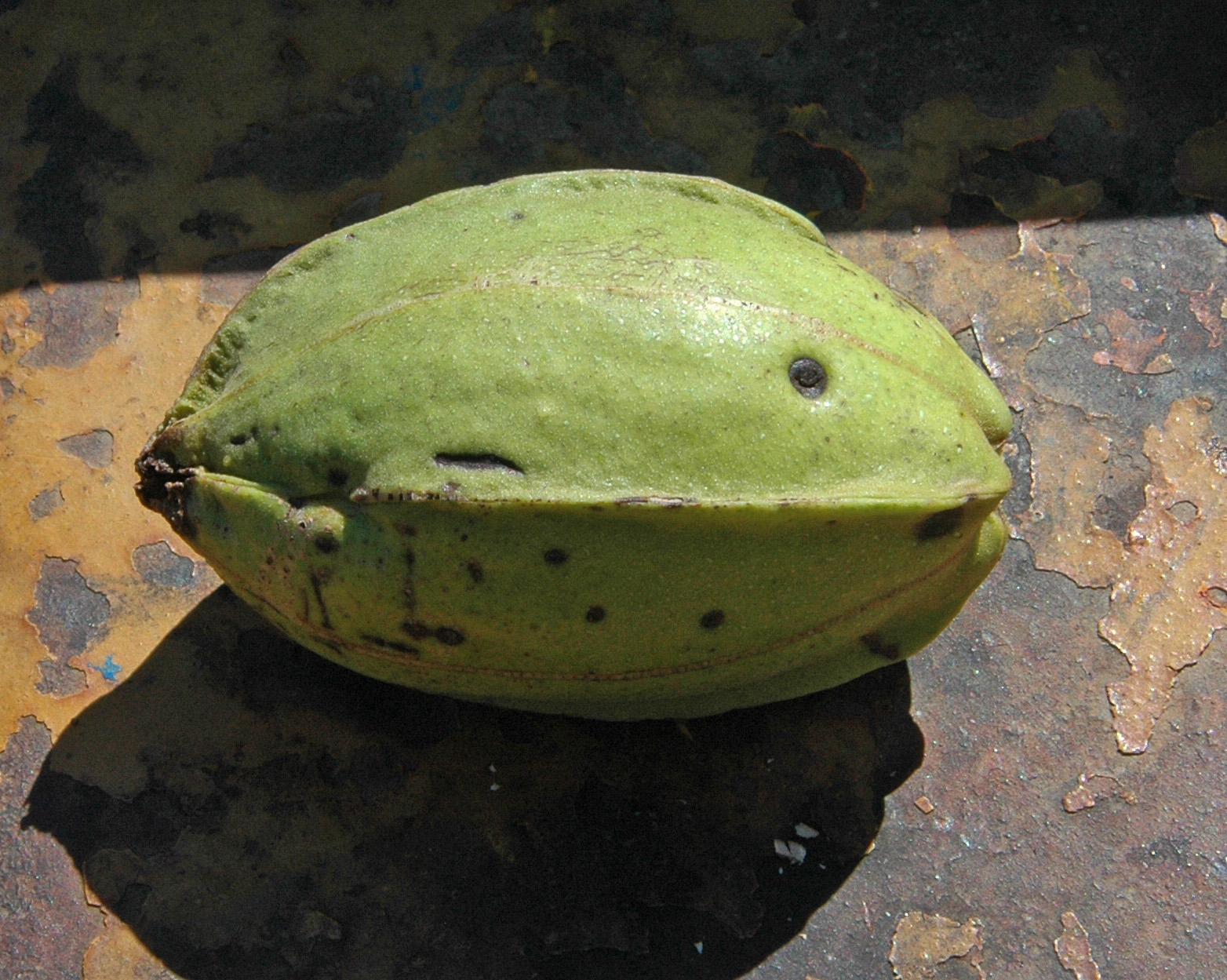
     In previous years, KT772 ripened around October 7. However this year, the shucks on this tree never opened (photo at right) and were frozen tight on the nut shell following the 1st fall freeze.


   Late in the fall I broke open a KT772 nut and found extremely poor kernel filling.  Shuck split in pecan is promoted by plant growth regulators stimulated by fully formed kernels. Without proper kernel development, shuck split is either extremely late (like the drought year of 2022) or it will never happen.


    Just before frost, I found that the shell of KT772 had only partially separated from the husk but the nut shell had developed its normal coloring. By the time I harvested my pecan crop, every KT772 nut was a blackened stick-tight (following 1st Fall freeze) and was totally worthless.  

   I have watched this tree long enough. So this winter KT772 was removed from my pecan breeding block.
 

Thursday, September 29, 2022

Tree spacing influences nut production during drought


    The other day I was scouting my orchard for pecan shuck split when I noticed a dramatic difference in nut size and ripening between a young grafted Caney tree and the mature mother Caney tree located in my pecan breeding block.

    Let's look at the trees in question. The photo at right is a young Caney tree. This tree has a good crop of nuts and the nuts are only slightly smaller than normal. The important thing to notice in this photo is how much open space there is around the tree. In a year of short water supply this Caney tree has very little competition from other trees for water.

    The photo at left shows the original Caney tree growing in my pecan breeding block. This tree is much larger (28 yrs. old) and is crowded by other large trees (note the shade on the ground). Note the yellowing of some of this tree's leaves. This is an indication of extreme water stress caused by the competition for water from neighboring large trees. Although there is a good crop of nuts on the tree, the nuts are tiny.


     The photo above illustrates the differences I observed in the nuts produced by the young, well-spaced Caney tree and the mature, crowded Caney tree.  First there is the obvious size difference. But secondly, note that the nuts produced by the young tree have split shuck while shucks are still firmly attached over the nuts collected from the mature tree. This simple observation leads me to a very important decision; After harvest, I need thin out more trees in the pecan breeding block.

      Caney is one of the scab-resistant cultivars I developed from my pecan breeding project. The photo above gives you a good idea of what Caney nuts look like. Over the years, Caney has produced nuts that are larger than Kanza with nearly 53% kernel. Caney matures a week before Kanza. This cultivar has a protandrous flowering habit making it a good pollen pairing for Kanza. Kernels are straw-colored and  have excellent quality.

Monday, December 30, 2019

Giving pecan trees room to grow


   To maintain good nut production, pecan trees need plenty of room to grow and develop a full canopy. When I established my pecan breeding block, I planted trees far closer than normally recommended to allow for the evaluation and selection of new cultivars. As the trees started to produce nuts, I started to remove trees that produced small nuts or displayed poor resistance to pecan scab disease. This project started with over 800 trees but currently, I've already removed 90% of the original trees.
     This winter, I'm back thinning out more trees (photo at right). At this point in the project, my tree removal objective is to make certain that trees that have the greatest potential to become new cultivars have plenty of room to expand their canopies. The trees in the photo were growing only 20 feet apart within the row (row spacing = 40 feet)  with adjacent canopies shading each other. After tree thinning,  the remaining trees will be spaced 40 feet by 40 feet.


KT334
      The photo at left is an example of the nuts produced by one of my selections that I have made a priority for ensuring adequate tree spacing. In fact, tree KT334 is pictured above as the first tree in the row at the left side of the photo. Now that KT334 has a more normal tree spacing, I'll be able to get a better feel for its production potential.


Wednesday, February 28, 2018

Thinning a Kanza Block:


    Over the course of the last 6 years, I've documented how we have progressively thinned a 3-acre block of Kanza trees (photo at right). In 2012, I drew up a tree thinning plan and have removed trees only within areas of the orchard with tree crowding. Year after year the trees continued to grow. As adjacent branches started to touch, we cut more trees. You can review the history of our thinning plan and the progress we made removing trees over the past 6 year by checking out the links listed below. 
1. 2012, 2013, and 2014 tree thinning 
2. 2015 tree thinning
3. 2016 tree thinning
4. 2017 tree thinning

     Following the 2017 pecan harvest, we measured the diameter of each tree's trunk and plotted that data on the map pictured at left. Each tree in the orchard is designated by a green circle with the size of that circle directly proportional to the diameter of the trunk. As you can see from the map, the bulk of the trees that still need removing are located at the south end of the field. You will also note that the largest trees in this orchard are located in the northeast corner. If you review the history of our progressive thinning plan, you'll find that we started the thinning process in the NE corner of the orchard back in 2012.
   This year we completed the thinning plan by removing 23 tree from the orchard. The black dots on the map at left shows the location of the trees removed this winter.
  When this orchard was established from stratified seed in 1996, we set trees 30 feet apart in a square pattern. In 2000, we grafted all 144 trees to Kanza. Now that we have completed our thinning plan, we have 72 trees remaining spaced 42.4 feet apart. The trees are still arranged in a square pattern but the squares are now tilted 45 degrees from the original north-south orientation.
   It won't be too many more years until this orchard will need another thinning plan as the remaining trees continue to grow at the rate of 1/2 inch in trunk diameter per year. The next thinning plan will remove every other north-south row to carve out an orchard with trees 60 feet apart.

Monday, February 20, 2017

Thinning more Kanza trees


      For the past six years, we have been progressively thinning a three acre block of Kanza trees. This week, we removed trees within the Kanza block in areas where adjacent trees were competing for sunlight and according to our thinning plan (photo above).  During this sixth year of thinning, we cut down 15 trees; the most we've removed in a single year. The original tree planting had 144 Kanza trees. After removing 15 trees this year, we'll be down to 96 trees in the orchard.  The first thinning will be complete when half the trees have been removed and we are down to 72 trees in the 3 acre orchard.  

    The figure at right is a map of the Kanza block as it appeared before we cut any trees this winter. Each tree is depicted by a green circle with a diameter proportional to the tree's trunk diameter. As you can see, tree growth has not been even across this orchard. Tree growth has been fastest in the northern 1/3 of the orchard.  As a result, we've thinned more trees in this area of the orchard. However, trees in the southern half of the orchard continue to grow and will require thinning eventually.


    We removed 15 trees from the Kanza Block this year.  Trees cut down are marked by black circles on the map at right. We thinned trees over the entire planting but most removed trees were located in the middle third of the orchard.
   Up to this point, I've been pleased with this progressive approach to orchard thinning. By taking out trees on an as-needed basis, we have been able to maintain good light penetration into the orchard while preserving high yields

Monday, October 31, 2016

Making plans to thin our Kanza block

    Readers of this blog may recall that we have a block of Kanza trees at the Pecan Experiment Field. In 2012, I drew up a tree thinning plan to remove a portion of the trees in this orchard to allow the remaining trees more room to grow. We took a progressive approach to thinning the orchard. We removed trees gradually, several each year, in areas where trees were beginning to crowd.
    This Fall, when I walked out to the Kanza orchard to check on tree spacing, I noticed that most areas that have not been thinned yet had limbs that were beginning to touch (photo at right).  Following the 2016 harvest season we will be taking out more trees, this time more trees than we had in previous years.

   I also checked areas in the Kanza block that had been thinned in previous years. Here I found the trees to be well spaced with plenty of light penetrating all portions of the canopy (photo at left). Eventually the entire block of Kanza trees will be thinned to this spacing (43 feet by 43 feet).  

Monday, February 22, 2016

Thinning a pecan orchard in a single year.

      When to thin is one of the most difficult decisions a grower must face during the life of a pecan orchard. Over the past several years, I've documented our gradual approach to thinning a block of Kanza trees. But last week, we completed a more typical "once-over" tree thinning operation in a 4 acre cultivar trail (photo at right).
    This cultivar trial was originally planted at a 30 by 30 foot spacing back in 1991. After 24 years of tree growth the limbs of adjacent trees were getting close to touching and very little sunshine penetrated to the orchard floor in mid-summer. In fact, several portions of the orchard were actually past due for tree thinning. 
    Before cutting a single tree, I mapped out the entire orchard recording the locations of weak trees or trees badly injured by wind or ice storms. I knew I would be cutting down 50% of the trees during this once-over thinning operation. However, with map in hand, I could choose a thinning plan that would maximize the removal of "problem" trees.

    In thinning the grove, we removed odd-numbered trees in the first row. Even-numbered trees were removed from row two. In row three, we were back to removing odd-numbered trees. We continued this pattern across the entire block of trees.
    Once all the trees were cut, I could look across the field at a 45 degrees from the tree rows and see an entire diagonal row of trees had been cut (photo at left).
    After removing felled trees from the field, the orchard looked wide open with plenty of space for the remaining trees to grow wide canopies. The remaining trees are now spaced 42.4 feet apart.
   

Friday, February 12, 2016

Thinning trees from a Kanza block

    In keeping with our plan to gradually thin our block of Kanza trees, I cut down nine trees yesterday (photo at right).  We started thinning this block of 144 trees back in 2012, removing 5 to 9 trees each year since that time. So far we have removed a total of 34 trees in 5 years time.

    The map at left shows the position of the trees we removed in 2016. Each green circle represents a tree with the diameter of the circle proportional the the diameter of the tree. The black circles represent trees removed this week.
    So far I've been pleased this this progressive approach to orchard thinning. By removing just a few trees each year we have been able to prevent orchard overcrowding while maintaining total orchard yield. You can review the yield and tree removal history of this block of Kanza trees in this post:

Kanza nut yield for 2015

Tuesday, February 2, 2016

Pecan cultivars and tree size

    In setting out a new pecan cultivar trial, I anxiously wait for the trees to start bearing so I can record nut production data. Nut size, percent kernel, flowering type, maturity date, yield, and disease resistance are all among the key cultivar attributes that can define cultivar success. However, not all cultivar characteristics are revealed within the first decade of nut bearing.
    I was walking through the oldest cultivar trial on the research station when  I noticed obvious cultivar differences in over-all tree size. In the photo above, you can see that Major produced a much larger tree than Dooley. Both cultivars were grafted onto Giles seedling rootstock planted in the field back in 1981. The only difference between these two trees is the scion cultivar. 


    Looking around this 35-year-old trial, I found that trunk diameter was largely a function of cultivar. To create a visual record of cultivar differences in trunk diameter, I photographed the trunks of 6 pecan cultivars placing a one-foot-long ruler across the truck for scale (photo above ). Major and Peruque grew trees so large they seem to dwarf all others in comparision. Colby and Posey grew moderate sized trees while trees grafted to Giles or Dooley seemed small in comparison.
   I would never consider tree size a very important tree characteristic in making cultivar decisions. However, tree growth rate becomes important when planning initial orchard spacing and making subsequent thinning decisions. Large growing trees, like Major or Peruque, should be established at a wider spacing--let say, 40 feet rather than the standard 35 feet. Tree growth rate will also influence tree thinning decisions. The larger a tree grows, the sooner you will need to thin out adjacent trees to make room for future growth.
    It takes at least 30 years of cultivar testing to make accurate tree size determinations. In that time, many cultivars will prove unworthy of future propagation. Of the six cultivars pictured above, I would consider grafting only Major because of its scab resistance and regular nut production. But now, when I graft new Major trees, I'll also be sure to allow more space for these trees to grow.  

Friday, January 29, 2016

Which Kanza trees need thinning this year?

    If you are a long time reader of this blog, you may recall that we have been thinning a block of Kanza trees a little bit each year for the past several years. Today, I took advantage of the warm sunshine to walk through our Kanza block and mark trees for removal this winter.
   In some areas of this 3 acre block of trees the canopies of adjacent trees are beginning to almost touch (photo above, right). In these areas, I flagged some trees for removal.

   But just a couple of tree rows away, trees have not grown as fast and adjacent trees still have plenty of room to grow (photo at left). You might be wondering why, in such a relatively small area (3 acres), are our Kanza trees growing at such different rates. The answers is simple--small changes in soil conditions. All the trees in this block are growing in a soil classified as Osage Silty Clay. However, all soil types contain minor variations that can effect tree growth. The fastest growing trees in this block are growing in areas that are slightly more silty. In contrast, the slowest growing trees are found in soil with more clay.

The initial tree spacing for this orchard was 30 feet by 30 feet. We started thinning this grove in 2012. After thinning, the trees are left at a 42 foot by 42 foot spacing (photo at right). As you can see, the canopies of adjacent trees have ample room intercept sunlight and grow new nut bearing wood.
    After walking the grove today, I marked 9 trees for removal this winter. The blog posts listed below will give you the history of our thinning program in this block of Kanza trees.

2012 Making the decision to thin Trees 
2012 Thinning a Kanza Block
2014 Early spring thinning
2015 Time to think about tree thinning 
2015 Sticking to the plan

Thursday, March 26, 2015

Tree thinning: Sticking to the plan

    Over the past several years we have been thinning a block of Kanza trees. Yesterday we continued that process by removing several more trees (photo at right).
    Four years ago I laid out a tree thinning plan  that maps out which trees will be removed and which will stay.  At that time, only trees in the northeast corner of the block were actually starting to crowd so I decided to starting removing trees on a as-needed basis. Each year we measure tree diameter then use that information to determine which areas within the orchard might need thinning next. We have been removing 5 to 7 trees per year since 2012. Yesterday we cut down 7 trees.
      In the map at right, the diameter of each tree in the orchard is represented by a green ball. The larger the ball, the larger the diameter. Trees marked out by a black dot are the trees we cut down yesterday. This map also gives you a good idea of the progress we've made in thinning the entire orchard. As of this year, we've removed 25 of the 72 trees slated for removal in the original thinning plan.
    Thinning a pecan orchard over a period of several years offers several real advantages over thinning the entire planting at one time.
  • the impact of tree removal on total orchard  yield is minimized.
  • tree removal costs are spread out over time.
  • trees are removed before overcrowding can cause limb loss and yield reduction.

Wednesday, January 7, 2015

Time to think about tree thinning

   Over the past several years, I have outlined our plan for thinning a block of Kanza trees.  Early on, we recognized that the trees in this block were not all growing at the same rate. Portions of the orchard started to crowd faster than other areas as the trees responded to soil variation within this 3 acre tract of land. We devised a total orchard thinning plan but we have been removing trees only when adjacent trees start to crowd.
    Yesterday, as the sun was shinning and the temperatures reached a balmy 32 degrees F, I walked through the Kanza block to get a feel for which areas would require thinning this winter (photo at right).  Just walking through the orchard its sometimes hard to visualize which sections will require thinning next.
    One method I've used to help plan my next thinning cuts is to plot out the trunk diameters of every tree in the orchard (figure at left). In the figure, each tree in the orchard is portrayed by a green circle that graphically represents trunk diameter as measured after leaf drop in 2014.  All the blank spots on the map are the locations where trees were removed previously.
    Using the map as a guide, I go out to the orchard to visually determine which trees actually need to be removed. I'll stand between two adjacent trees and look up. If the branches are close to touching its time to thin. Let me show you what I mean. 
    On the map at left, I have placed a red box around adjacent trees at two locations in the orchard. At each location, I laid down on the ground between the two trees and took a wide-angle photo straight up. Tree 6-10 is 10.3 inches in diameter while tree 7-10 is 11.0 inches. Just a couple of trees to the south, tree 6-12 has a DBH of  9.2 inches and tree 7-12 is 8.3 inches in diameter. From the map it looks like trees 6-10 and 7-10 are almost touching while trees 6-12 and 7-12  still have some room to grow. Now lets look at the photos.

    The photo at right shows how close the canopies of trees 6-10 and 7-10 are to each other.  The dormant stems of each tree are not touching each other yet but add another summer of stem growth and a full load of leaves and you would see a closed canopy during the summer of 2015. I'll be thinning some trees out of this area of the orchard.
    Moving down the row to trees 6-12 and 7-12, the photo reveals that there is still plenty of space between these two trees (photo at right). In this case, I won't need to thin trees in this portion of the orchard for a year or two.
    We have been thinning this orchard a little bit at a time since 2012. In that time, I've come to realize that our Kanza trees start to crowd when trunk diameters of adjacent trees both exceed 10 inches. However, you must remember thinning decisions should be based soley on your particular soil type, initial tree spacing, and cultivar. We started this Kanza block at a close tree spacing of 30 feet x 30 feet. The closer the initial tree spacing, the smaller the  diameter the trees will be when thinning becomes necessary.

Thursday, July 31, 2014

Canopy shape and tree spacing

    Back in 1995 we established a block of seedling trees that we later grafted to Kanza. The original tree spacing was  30 ft. x 30 ft. and  by 2012 the branches of some adjacent trees were starting to touch. In 2012, we developed a tree thinning plan that called for the removal of trees over several years starting in areas of the orchard that were showing signs of overcrowding. You can review this thinning plan and follow the history of tree removal in this orchard by viewing my post from last March.

     Today, I went out to our Kanza block to check on this year's crop load crop.  While walking through the orchard, I was struck by how different the tree canopies  looked between thinned and un-thinned areas. I took a couple of photos that I hope illustrate what I'm talking about.
    The photo at right shows the portion of our Kanza block that has not been thinned. The trees in the photo look really close together because I took the snapshot on the diagonal from the 30 ft. by 30 ft. tree rows. These trees are starting to touch and I'll need to thin trees from this area next winter. But what I really wanted you to see is the shape of each tree's canopy. Trees in the un-thinned area appear tall and columnar. The only pruning we do in this grove of trees is to remove low hanging branches or wind-broken limbs. So ultimately, the distinctive shape of these trees was determined by inter-tree competition for sunlight. To impact tree shape so dramatically, competition  for sunlight had to have started long before the branches of adjacent trees started to touch.

    So what happens when trees are thinned from the grove and sunlight streams down onto the sides of remaining trees.  The photo at right shows the portion of the Kanza block grove that was thinned in February of 2012. This photo was taken in the same diagonal direction as the photo of the un-thinned portion of the block. The trees in this area are now spaced 42 ft. x 42 ft.
    With only three years of new shoot growth, you can see how quickly the sides of these trees have grown out to take advantage of increased sunlight penetration into the orchard. Note how the tree canopies have changed shape to become more rounded. I'm also seeing more nut production on lower limbs in this portion of the orchard as compared to the un-thinned areas.
   This winter we will be cutting more trees out of this orchard according to our tree thinning plan. The number of trees we will remove in February of 2015 is yet to be determined but I keep you posted.

Tuesday, March 11, 2014

Early spring tree thinning

     With warm sunshine overhead, today was a good day to cut some pecan trees down (photo at right). We removed six more trees from our Kanza block according to our pre-determined tree thinning plan.
  The trees in this block are growing at an incredible rate. Just look at the cross section of one of the trees we cut down today. Over the past 4 growing seasons, the annual growth rings of this tree averaged more than 1/2 inch per year (photo at left).  However, not all trees in this block are growing at the same rate. Generally speaking, the trees on north end of this planting are growing faster than the trees farther south.  This variation in tree growth rate is largely due to a gradual change in soil conditions.
   Every winter I walk through the planting to measure trunk diameter and look up at tree canopies to see if they are starting to get too close. Looking up is the best way I know of determining when to thin out trees.
    Here's a series of maps that tells the story of our the thinning efforts over the past three years. In looking at these maps, each green circle represents a tree and the relative diameter of each tree is depicted by the size of the circle. The red lines cut through all the trees that will be removed once the entire field is thinned. I placed a black circle over the trees that are to be removed during each particular thinning year. As you look at the maps, you'll note that the trees slated for removal one year disappear off the map of the next year's tree removal plan.
     Thinning an orchard over several years has many advantages over thinning the entire block at one time.
     1. Trees are removed in time to prevent sections of the block from becoming overcrowded.
     2. The number of trees removed per year is minimized allowing yield for the entire block to remain at a high level.
     3. The work of thinning a block of trees is spread out over several years.
        When established in 1995,  there were 144 seedling trees planted in this block. These trees were then grafted to Kanza during 1998-2000. Starting at tree age 17, we began our planned tree thinning operation. We removed 7 trees in 2012, 5 in 2013, and 6 in 2014. At this point, we have removed only one-quarter of the trees that will eventually be cut to complete the thinning plan. I'm sure more trees will need thinning a year from now.   

Wednesday, August 22, 2012

Pecan tree spacing and drought stress

    Last winter I wrote about  thinning a block of Kanza trees. If you recall, we thinned only a portion of a Kanza block last winter with additional tree removals planned for this coming winter. In any case, this left the planting with Kanza trees at two different tree spacings. The original planting was made at 30 ft. by 30 ft. (9.1 m x 9.1 m). After we thinned the trees on the diagonal, trees in the thinned portion of the orchard were spaced 42 ft. by 42 ft. (12.9 m x 12.9 m). Well, this summer's drought has got me thinking about tree spacing and its impact on tree water uptake. So this morning, I went out to collect some nut samples.

    In theory, trees spaced wider apart should have more water available to them than trees spaced closer together. With more water available during a drought year (and no irrigation), wider spaced trees should have bigger and better filled pecans.  To test this theory, I collected nuts from two trees of equal trunk diameter but one sample came from a tree in the thinned portion of the orchard while the other came from an unthinned area (photo above). If I stare at the photo long enough, it looks like the nuts from the thinned portion of the grove are slightly larger than the unthinned area.

     Now, lets look at kernel fill (photo at right). Again, the differences between trees is slight with the unthinned kernel having a fraction more air space within the kernel.
     My theory that wider spaced trees will produce larger and better filled nuts during a drought year may be true but the nut samples I collected today only gave us a hint in that direction. Could it be that the full effect of wider tree spacing hasn't kicked in yet? The orchard was only thinned last winter and the root systems of the remaining trees have yet to take full advantage of the greater soil resources now available to them.
    Hopefully, we'll get some rain and all my worries about water and kernel filling will disappear.     

Wednesday, February 22, 2012

Thinning a Kanza block

In a previous post, I talked about making the decision to thin trees in a block of Kanza pecan trees. To help make the decision on which trees to remove, I spent some time plotting out a tree size map using the diameter of every trunk in our Kanza block. Since crown size is proportional to trunk diameter for open grown trees, I can create a visual representation of the orchard using plotting features in Microsoft Excel (plot at right).
Looking over the map, you can see that the orchard has begun to crowd in the northeast corner (upper right). See how the tree circles on the graph are touching each other in that portion of the field.  This is exactly what we see in the field--limbs starting to touch only in a small section of the orchard. You will also note that we have a few small trees scattered through the orchard that seem to be lagging behind the others.

Using this visual information, I decided on the best pattern for thinning the entire orchard. For the first thinning, we will remove trees on the diagonal. The map at left shows the diagonal tree rows that will be removed (red lines). With this thinning plan I will remove all but one of the runty trees.
The entire orchard does not need to be thinned at this time. We will remove trees only in areas where the trees are beginning to crowd. For this first year of thinning, we plan to remove just 7 trees. These trees are marked on the map by black dots.
Thinning this orchard will take several years, but we’ve got a plan in place. As trees in other portions of the orchard start to crowd more trees will be removed until eventually the entire orchard has been thinned.
We cut down the 7 trees marked in our thinning plan today (photo at right). Once the trees are on the ground, we pull the entire tree top out of the orchard using a tractor and log chain. These trees will eventually be cut up for firewood.

Cutting down trees gave me the opportunity to see the growth rate of trees in this block of Kanza trees. In the photo at left, you can see  annual growth rings of 1/4 to 3/8 of an inch per year every year. This tree was growing fast! It no wonder we needed to start the thinning process in this portion of the orchard.