Tuesday, July 16, 2013

Pecan seedlings: from simple to compond leaves

  
    As you might recall, I am growing a bunch of pecan seedlings in containers this summer. As my seedlings germinated, the first leaves produced by the new trees had a single blade; very different than the normal compound leaves we see growing on pecan. Now my seedling trees have grown taller they are starting to produce compound leaves (photo at right). The first compound leaf has a large terminal leaflet with only two small leaflets below. Above that, another compound leaf is starting to grow and expand. This leaf will have five leaflets.
    In just a few weeks time, my nursery of container-grown seedling will actually look like a forest of small pecan trees. Before long, every tree should be producing compound leaves.

Monday, July 8, 2013

Poor tree growth and the appearance of stump strouts


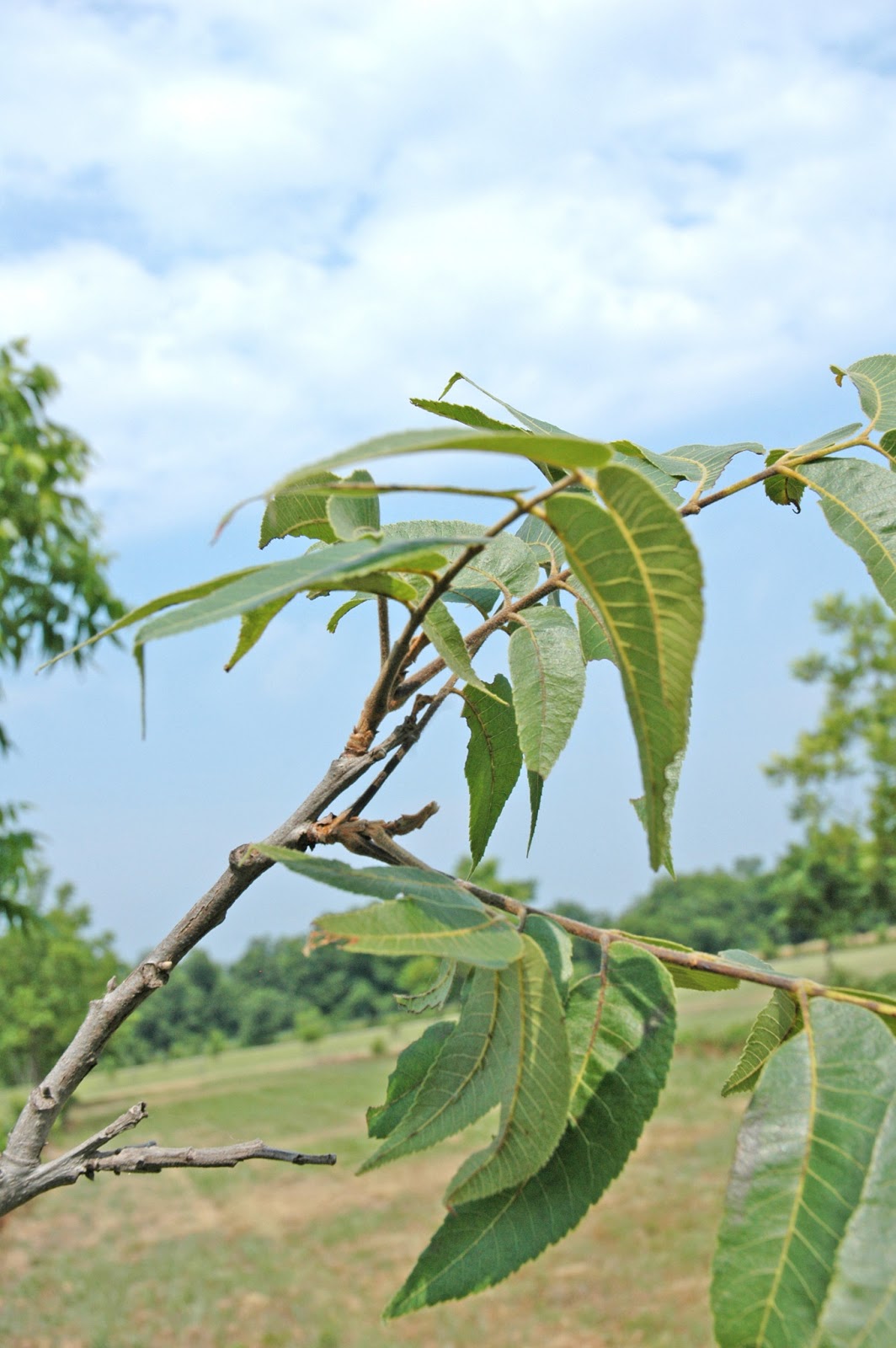
        The past couple of summers have been hard on young pecan trees growing in the Midwest. The heat and drought have been brutal. This spring I have seen several young trees produce only a smattering of new leaves on upper branches while sending up vigorous stump sprouts from below the soil surface (photo at right).  The stump sprouts on this tree first developed in 2012 and have continued to grow this year. 

   This year's new shoots are only one-inch in length on the upper portion of the tree (photo at left). The leaves are small and have several missing leaflets. The tree just looks sick!


      At the base of the tree, the bark on the main stem is sloughing off (photo at right). To me, this indicates that the conductive tissues (xylem and phloem) in the stem have been damaged, interrupting the normal flow of water and nutrients.  Its no wonder the top growth on this tree is so anemic.
   The growth of stump sprouts is the tree's way of replacing the damaged portion of the tree with healthy stems that support large, healthy leaves.

    One way to deal with this situation is to coppice the tree (photo at left). It was obvious to me that I was going to lose the original portion of this tree. The growth I found on the upper branches was just too sparse to keep the tree going. On the other hand, one of the stump sprouts had already grown 5 feet tall in two years time.  I simply used my chainsaw to cut down the original trunk and the smaller stump sprouts at ground level.  My tree might have a much smaller top after coppicing but the potential for new growth is much better.
    This tree is a seedling growing in our pecan breeding plots and will remain a seedling in the future. If you need to coppice a grafted tree, plan to re-graft the tree in a year or two.  

    The stump sprout I saved had three equally vigorous shoots growing near the top of the tree. To shape this tree into the central leader form, I tipped back the two side shoots to outward growing buds and left the central shoot free to grow into a strong leader (photos at right). I'll need to watch this tree carefully this summer. There is a lot of root energy pushing the new top growth and that will require plenty of return visits for additional summer pruning.   

Friday, July 5, 2013

Time for new graft training

  
    Now is a good time to start training your successful grafts. Today, I worked on a couple of bark grafts including the tree pictured at right. After removing the deer cage, I cut off all sprouts growing from the trunk below the graft union. I next turned my attention to the shoots growing from the scion. I had left 2 buds on the scion when I grafted this tree and both buds had sprouted and were growing vigorously.
    
    In the photo at left, you can see that both scion shoots are about the same size in diameter.  I could choose to keep either one of these shoots to be my new central leader, but the straighter growth of the shoot on the right gives it a slight edge.  I then cut out the shoot on the left.
    With just one cut, I have established a new central leader for this tree (photo at right). Now all of the tree's energy will be focused into growing the scion's single remaining shoot.
    Like all vigorously growing pecan shoots, the shoot that I kept to become my new central leader was already producing stalked buds (photo at left). To prevent these stalked buds from growing into branches that form serious bark inclusions, I broke off every one of them. Breaking off stalked buds will also help preserve the dominance of the new central leader.
    My next step was to cut off the grafting tape that holds the plastic bag tightly around the scion. The scion on this bark graft should grow rapidly in diameter this summer and I don't want the tape to girdle the scion. After cutting and removing this small piece of tape, I will leave the rest of the graft wrappings in place for now.
    Next, I replaced the bird perch on the graft with a much longer bamboo stalk. I used electrical tape to attach the bamboo to the trunk of the stock, then used flagging tape to tie the new growth to the stake (photo at left). Bark grafts are easily damaged in the wind, so tying the new growth to a stake is a critical part of the graft training process. My final step, was to place the deer cage back over the tree. (No browsing deer is going to ruin this graft!)

Wednesday, July 3, 2013

Flooding and new grafts: 2013 results

   Back on June 1, I posted a photo of a newly grafted tree surrounded by flood water (reprinted at right). Unfortunately, the water was still rising when I snapped this photo. Later that night, the graft union on this tree became completely submerged. In my previous post, I stated that a new graft will be lost if flood waters cover the union before the tree has a chance to callus in the scion. Today, I returned to this field to see what actually happened.
    At first glance , the photo at left might look like a successful graft, but all the new growth is coming from shoots that originate below the graft union. Hidden amongst the leaves is a very dead scion. This tree was completely submerged during the flood, giving my grafting effort a 0% chance of success.
   
      A hundred feet away, I grafted a tree a little higher on the stem (photo at right). This tree was also located on a little higher ground (we're talking 1-2 inches at most). Although this tree was also surrounded by flood water,  the graft union remained above the high water mark.  By escaping the flood, the graft placed on this tree remained viable and is now growing rapidly.
     I grafted about a dozen trees in this field in 2013. In every case, graft unions that became submerged in the flood failed. On the other hand, I've had great grafting success on trees with graft unions placed above the flood's peak. 
    I'll let the trees with failed grafts grow out for a couple of years, encouraging them to grow tall and straight. With a larger tree, I can graft higher on the stem and hopefully avoid future problems with floods.