Friday, January 28, 2011

Cutting scions

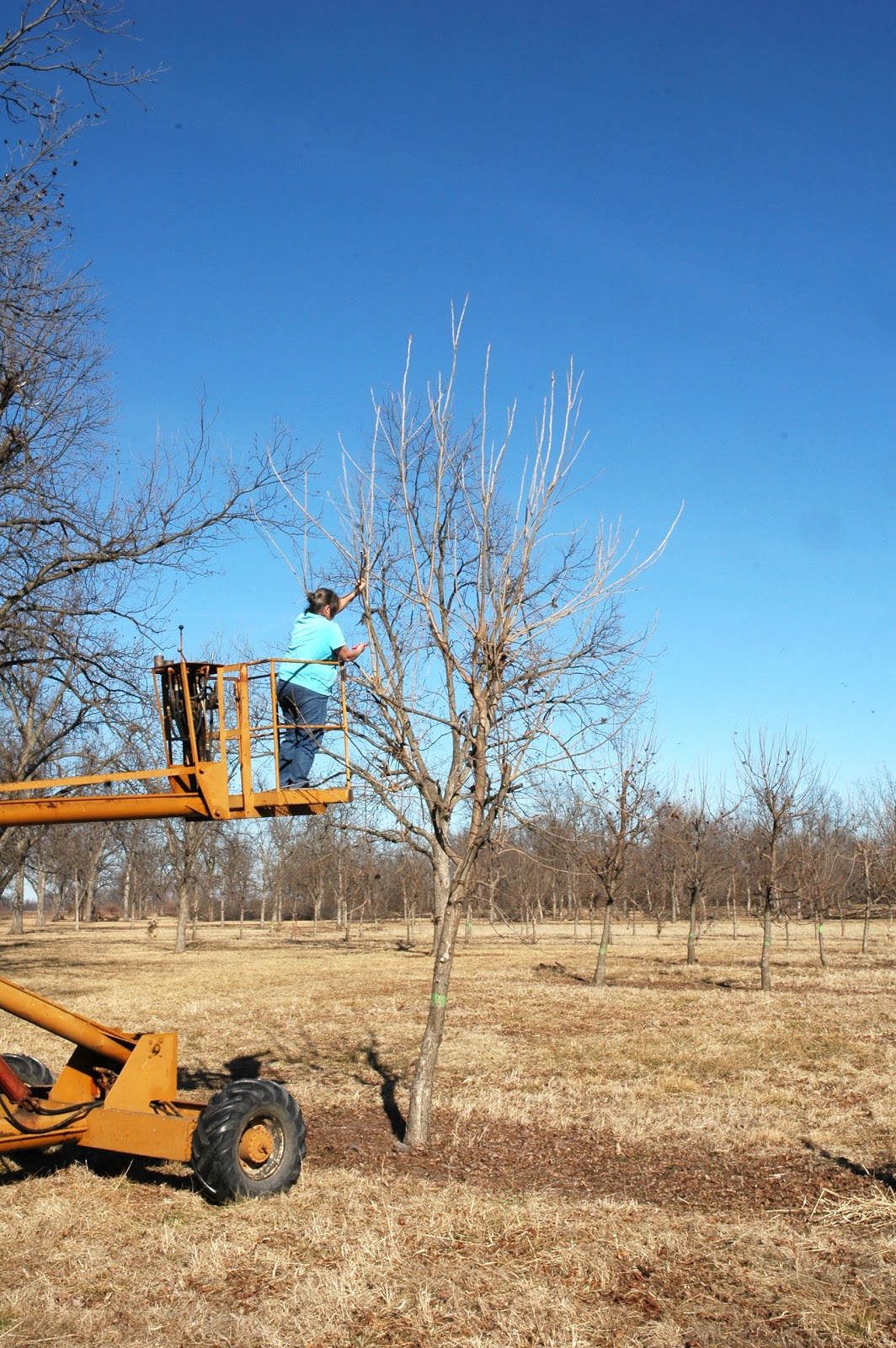
Our annual January thaw came around this week, so we took advantage of some beautiful weather to cut pecan scion wood. One of the best ideas we've had when it comes to growing high quality propagation wood is to develop a scion wood orchard. In the photo at left, long, one-year-old shoots are cut from specially grown scion wood trees. Its nice to have a hydraulic lift for this type of work but most of the scions could be reached with a pole pruner.
     In the photo at right, you can see one of our a scion wood trees with all the scions removed. Note that we leave lots of stubby branches on the trees to provide ample places for the tree to sprout new vigorous shoots next summer.
    Even when these trees are butchered annually they still produce a few nut clusters (note shucks on still on the tree). We collect the first nuts produced by each tree in our scion wood orchard and verify that the cultivar is true to type. We then  paint the green ring on the trunk (green=good to go) to indicate that the tree is ready for scion wood production. The trees in the scion wood block are planted 15 feet apart in rows 30 feet apart.

 
 Once we collect the scion wood branches, we cut the wood into ~8 inch long bud sticks and place them in plastic boxes (photo at left).  Inside the boxes we also place some dampened paper towels to ensure high humidity inside the box during storage.  We store the wood at 35 degrees F until it time to ship out the wood in early April.

What's wrong with my pecans?

   I often receive pecan samples from home owners that have a pecan tree or two in their yard with a note simply saying--"Whats wrong with these pecans?". So I thought it might be a good idea to describe how I determine the problems associated with these type of samples. The sample pictured above came from a gentleman from the Wichita, KS area. The note that came with the sample stated that the pecans produced by his tree rarely fill well and some nuts have an "off" flavor.
    The first step to determine the cause of poor pecan performance is to determine if the nut comes from a grafted tree. These nuts were smaller than most cultivars and the thick shell confirmed the nut to be a seedling. Before cracking the nut open, I noticed that the shell markings that are normally dark black on a pecan were lighter and reddish on the submitted sample. This told me this pecan did not receive a long enough growing season to complete normal nut development. I cracked open the nut and found more evidence that this pecan is not adapted to the Kansas growing season.  Three kernel defects were present--hollow kernels, kernels that don't extend the full length of the shell, and brown fuzz adhering to the kernels. All 3 of these defects indicate that this tree ran out of time (length of growing season) to fill the kernel properly.
   The "off" flavor of some kernels were caused by stinkbug feeding. This problem shows up as darkened areas on the kernels. A full explanation of this malady can be found in a previous post call "black spots on kernels".
  So now its time to make recommendations. There are no remedies for poor genetics. The tree that produced the pecan pictured above likely originated from a seedling tree (or nut) collected in Texas and moved to the Wichita area. During years when we experience a longer-than-normal growing season the nuts will fill better. Stink bugs can be controlled in the commercial pecan orchard setting but the chemicals used are not compatible with application  within suburban neighborhoods.
   This nut sample provides yet another example of why proper cultivar selection is critical for successful pecan production in the North.
Friday, January 21, 2011

Natives bounce back


   I will always remember the devastation our native groves suffered following the 2007 ice storm. Broken tree limbs were everywhere. It took nearly six months to clean up the mess. While watching the huge piles of debris burn,  I kept wondering if the native pecan yields we had worked so hard to achieve would ever return. In the graph above, you can see that our yields, like our trees, are regrowing. Let me recap some history. The 2007 yield was record low because we lost most of our spring flush of terminal growth to the Easter Freeze in April. We had just finished our meager harvest in Dec of 2007 when we were hit by the ice storm. The crop in 2008 was slightly better that 2007 even with more that 1/2 the limbs gone because 2008 should have been an  "on" year (a result of the spring freeze in 2007). Yields dropped in 2009 as the trees seemed to put all their energy into growing new branches. In 2010, we were back "on" but this time some of those new limbs produced a few nuts. I'll predict the 2011 crop to decline slightly and then in 2012 we'll be back to the 1500 lb average we harvested during the years prior to 2007. 

Pecan Breeding Project

This past fall we collected the first pecans from our pecan breeding block. Pictured at left is a seedling that produced a clean beautiful kernel. It really stood out among all the samples we collected. This medium sized nut had 57% kernel. The pecan pictured below was 52% kernel, about the same size as Kanza and is scab resistant. At this point in our evaluation, I'm looking for kernel quality and scab resistance for any clone that will move into advanced testing. Nut size can change as the trees get larger (see Nuts on young trees). So, I will wait a while before deciding if a seedling is too small to be considered for release.
     One thing I have noticed so far is that our heavy use of Pawnee as a parent has meant that many of the seedlings are producing nuts with that fine black speckling on the surface of the kernel that is so characteristic of Pawnee. These black speckles give the kernels a grayish caste that you can see on the nuts pictured above right.
    If I find a high quality and scab free pollinizer (type 1) for Kanza (type 2) in our breedling block, all that hand pollination and tree planting will be worth it.