Showing posts with label lakota. Show all posts

Tuesday, December 24, 2013

What happens when Lakota over-produces?

    As a pecan cultivar, Lakota has a lot of great attributes. Lakota produces large pecans with high quality kernels. The tree is precocious, high yielding, and scab resistant. However, Lakota is not the perfect cultivar. As the tree ages, Lakota can over-produce and slip into alternate bearing.   
    Our Lakota trees are now close to 30 years old and this past summer the trees were loaded up with pecans (photo at right). Lakota can produce large nut clusters often with six to seven nuts to a cluster. Although large cluster size looks impressive in mid summer, too many nuts in a cluster usually creates problems with kernel fill.


    In the photo above, the four kernels on the right side are examples of the excellent quality nuts  usually associated with Lakota pecans. The four kernel halves on the left side also came from Lakota nuts but illustrate the common kernel defects associated with crop over-production.  If you look carefully you will spot three indicators of poor kernel fill. 
    First, note that the kernels on the  left do not appear as plump as the kernels on the right. In addition, the poorly filled kernels have a light coat of fuzz on the surface of the kernel especially towards the apex. Turn the kernel over and you see that the underside looks hollow or depressed. All three of these symptoms are indications that the tree did not have enough available energy to fill every nut on the tree to maximum quality.
    The biggest problem with over-producing Lakota trees is the fact that a single tree produces both high quality and lesser quality nuts. This can create a marketing nightmare especially when selling directly to the consumer. Ultimately, over-production can be managed by thinning the nut crop in mid-summer using a trunk shaker. Shaking over-loaded trees during the water stage of nut development will reduce both the number of nuts per cluster and the number of nut clusters per tree. By reducing the crop load, the remaining nuts will fill to perfection and the tree will set a better crop the following season.      


Wednesday, March 27, 2013

Lakota and Mandan


     Every time a new cultivar is released it generates a lot of interest among pecan growers. Lakota and Mandan are the current hot topics among northern pecan growers. We've had Lakota under test a long time but our exprience with Mandan has been limited to just the past 2 cropping seasons.
    Let me start with Lakota (photo above). Lakota was developed by the USDA and field tested at the Pecan Experiment Field. This cultivar originated from a hand pollinated cross of Major and Mahan and was originally tested as USDA 64-6-502. Productivity, precocity, and scab resistance were three cultivar characteristics that made this clone stand out among several other clones we have under evaluation (recent yield and nut quality data in this post).
    Lakota has a protogynous flowering habit and matures its nut about two weeks after Pawnee. Nuts have had an average weight of 7.26 g and 56.85% kernel in our field trials. Lakota produces excellent quality kernels. The kernels are smooth, even colored, and fall free from the shell when cracked. Unlike many older cultivars, the kernel quality of Lakota remains high even under heavy crop loads.
     Lakota will over-produce as trees mature, which can lead to severe alternate bearing. However, alternate bearing can be minimized by using mid-summer shaking to reduce crop load during years of excessive nut set.  In terms of over-production and alternate bearing, Lakota seems to be a scab-free version of Pawnee. I am grafting more Lakota in my orchard.
    
    Mandan was also developed by the USDA from a cross of  'BW-1' and Osage and released in 2009 (photo at left).  We received scions of Mandan in 2009 and grafted this clone into fairly large trees to encourage early fruiting. We produced nuts in 2011 and 2012.
   Because our grafts are so young, I can not comment of the bearing potential of this cultivar. However, here's what I noticed so far. Mandan has a protandrous flowering habit and has ripened its nuts the same time as Pawnee. We have seen scab develop on Mandan but have yet to have a normally humid spring to determine the severity of scab infection (both 2011 and 2012 were extremely dry seasons).
   Mandan nuts are large, averaging 8.34 g in weight. Our Mandan pecans have produced 60.62% kernel indicating that this cultivar has an extremely thin shell. At this point in our evaluation of Mandan, I'm most concerned about kernel quality. Mandan kernels seem to darken quickly, in the same way Posey and Witte darken to an unattractive kernel color just a few weeks after harvest. Kernels of Mandan are also krinkled and have a tendency to exhibit dark viens, two kernel characterists that make for ugly pecan meats. At this point, I'm not convinced Mandan is a good cultivar choice for the long run. 

Tuesday, October 30, 2012

Productive and scab free: Kanza, Lakota and Oswego

Kanza nuts ready to shake
  
    Testing pecan cultivars has always been a big part of the my work. Choice of cultivar is critical for the long term success of a pecan planting. In recent years, I've emphasized the importance of grafting scab resisitant pecan cultivars to help reduce management costs. Three scab-free cultivars that have done exceptionally well at our location are Kanza, Lakota, and Oswego.

Kanza crop load


   With most of the leaves now fallen from the trees, I was able to get a good look at the nut crops produced by these three cultivars this year. While not limb breaking, Kanza, Lakota, and Oswego all held good crop loads (photos at left and below).  Nut size for the three cultivars was below normal (because of the 2012 drought) but all nuts showed good kernel fill.

Lakota crop load


Oswego crop load

Wednesday, February 1, 2012

Pawnee vs. Lakota

    I have been a fan of the Lakota pecan cultivar for a long time now and have often described it as a scab free version of the Pawnee cultivar.  These two pecan cultivars share a lot of traits. Both Pawnee and Lakota are precocious, productive, and fall into alternate bearing if not carefully managed. The nuts of both cultivars are large, thin shelled, and have good oil content.
    There are some major differences between Lakota and Pawnee. Lakota is resistant to pecan scab and ice storm breakage, while Pawnee is susceptible to both.  Pawnee ripens more than 2 weeks earlier than Lakota.
   Looking at Pawnee and Lakota nuts side by side you can see obvious differences in nut shape (photo above). Pawnee nuts are a little bit flattened while Lakota nuts are nearly round in cross section. Both nuts have a distinctive yet different apex shape while Lakota tends to have a tapered base.


    I cracked out some nuts to show how each cultivar and their nut shape influences kernels appearance and quality (photo above).  Note that kernel shape mimics the shape of the shell. Pawnee kernels are broad and blocky,  while Lakota are more narrow and tapered.  When it comes to kernel appearance, note that Pawnee has some problems. Pawnee kernels always seem to be covered fine black speckles that can give the kernel a grayish cast.  And in some years (like this year), the kernels can even have large brown blotches. In contrast, Lakota always seems to produce smooth, golden kernels. I guess that's one more reason to like Lakota.

Monday, November 7, 2011

Major's daughters

    Over 100 years ago, a seedling pecan tree growing near the confluence of the Green and Ohio Rivers (in Kentucky) was discovered that would become the foundation of this century's most important northern pecan cultivars. Introduced in 1908, 'Major' quickly became known as a disease resistant pecan cultivar that produces quality kernels every year.  Today, 'Major' is one of  the old standards of the northern pecan industry.

     In the years to come, the importance of 'Major' to northern pecan growers may change. 'Major' may become better know as the disease resistant  parent of two important cultivars--Kanza and Lakota. Kanza resulted from a controlled cross of Major and Shoshoni, while Lakota has Mahan and Major parentage. Looking at all 3 nuts,  you might not suspect Major as being a parent of both Kanza and Lakota. However, Major has transferred excellent pecan scab resistance to both progeny.

 
    The other day I spent some time to inspect the crops held by many of the cultivars we have under test. As usual, our large 'Major' trees (30 yrs-old) had a decent crop of nuts. Just like the old timers say, you can always rely on 'Major' to produce nuts. 
      I then went on to inspect the crops set by Major's daughters--Kanza and Lakota.  After a tremendous crop last year, Kanza has set a fair crop this year (photo at right). Kanza had us fooled most of the year because we didn't see many nuts in the lower portion of the canopy. Once the leaves started to fall, we spotted a good crop of Kanza nuts up in the tree tops. (This is the first indication we might need to thin our Kanza block).
    Lakota (photo at left) also set a good crop of nuts in 2011. In fact, Lakota may have produced too many nuts for this drought-stricken, growing season. However, Lakota is like its Major parent. If water becomes limiting, the nuts become smaller but they still produce a quality kernel.
    Over the next 10 to 15 years we will learn if the daughters of Major (Kanza & Lakota) become the reliable standards in which northern pecan growers can count on.

Monday, March 7, 2011

Lakota takes the cold

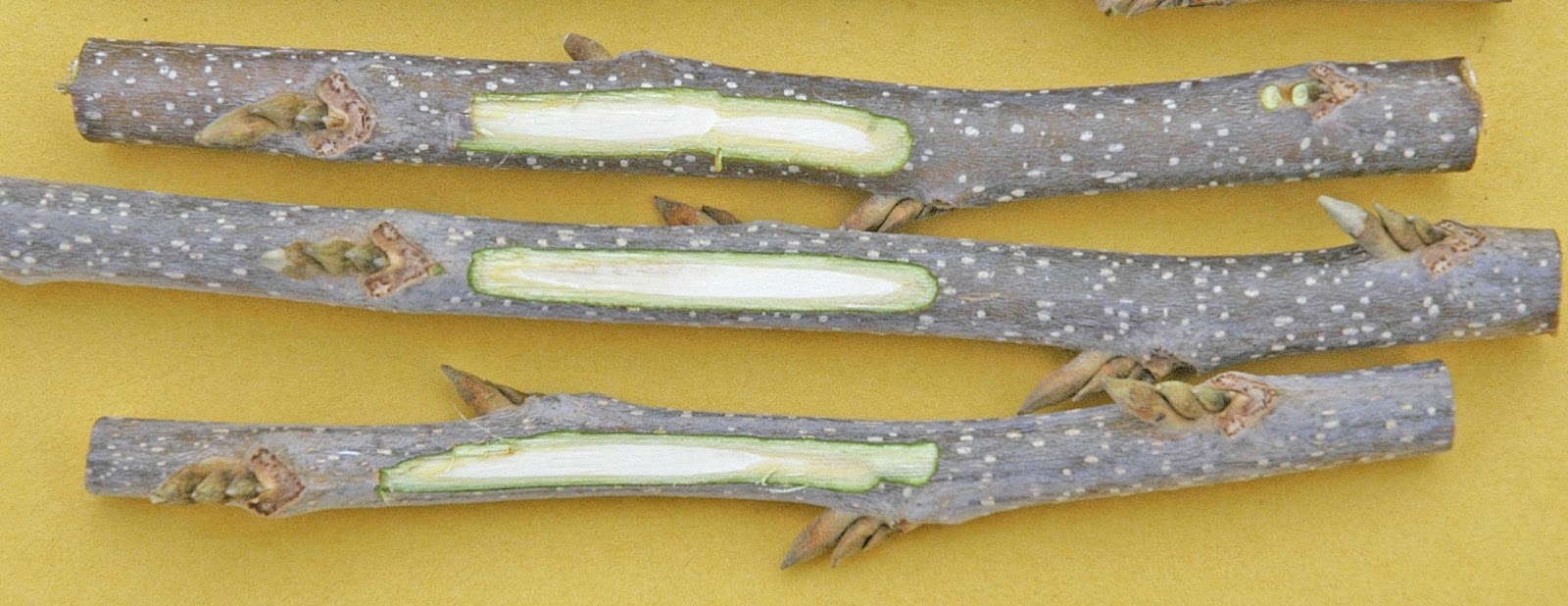
   We spent most of today cutting Lakota pecan scionwood. With a quick slice of the knife we found that Lakota did not exhibit the the same kind of internal browning we saw on our Pawnee wood (see previous post). I was kind of surprised by this because both Pawnee and Lakota represent hybrids of southern and northern cultivars. Pawnee is the results of Mohawk X  Starking Hardy Giant cross, while Lakota is a Mahan X Major cross. Could it be that having a female parent of Major make a clone more cold hardy? Remember that Kanza is a Shoshoni X Major cross and we've seen only green healthy bark this year on our Kanza scions.