Wednesday, June 5, 2013

Phomopsis trunk galls on pecan

   
     Every once in a while, I come across a native pecan tree with a baseball-sized, woody gall growing on the side of the trunk (photo at right). Look carefully and it doesn't even look like the gall is firmly attached to the tree. In fact, a sharp blow with your hand or hammer will usually pop the gall right off the tree.
    This gall is caused by a slow growing fungus in the genus, Phomopsis. The woody gall is formed by the tree's natural wound response to fungal attack. To prevent wood decay, pecan trees try to grow over and seal out invading fungi. However, in the case of a Phompsis gall, neither tree nor fungus seem to gain the upper hand in the wood decay battle. As a consequence the gall just grows larger.


   I knocked this gall off the tree with just the palm of my hand (photo at left). This was a fairly unique gall in that it represented the fusion of two infections into one elongated gall. Phomopsis infections usually start at a single point, most often at the site of a small broken off limb. In the photo, the yellow arrows point to the infection points of this double gall.
   Looking at the underside of the gall, (held in my hand) you can see that the woody gall is composed of a jumbled up mix of bark, wood, and fungus tissues. You can also see that this gall  actually started off as two round galls that later fused together when they began to touch.
    Phomopsis galls are not that hard to find in native pecan groves and they seem to have zero impact on nut production. 

Tuesday, June 4, 2013

Sprouts from a drought-injured pecan tree

   Last summer's heat and drought was hard on a lot of plants including young pecan trees. This morning, I photographed a tree that I had grafted two years ago (photo at right). I was so disappointed; I lost almost the entire top of the tree to drought-induced die-back. This tree had been growing great, with over 4 feet of new top growth added just last year.  But if you look at the tree now, all you will see is a few new sprouts growing from the base of the tree.
     The photo below is a close-up of the sprouts that are now growing from the tree's base. Notice that the sprouts seem to come in one of two different colors. The sprouts with a reddish tinged leaves are growing from the rootstock portion of the tree (below the graft). Red pigmentation of expanding new leaves is a juvenile characteristic of a seedling pecan tree.
   

    The bright green sprouts have developed above the graft union. The all-green color is indicative of sexually mature tissue and tells me that these sprouts originated from the Kanza scion. 
    Now, the tree training process must start all over again, but this time with a twist.  First, I removed all the sprouts with red colored leaves. Next, I pruned off all but one of the green "Kanza" sprouts in an effort to restart a central leader. For the time being, I left the dead portion of the old trunk in place to act as a training stake for the new shoot. To keep this tender shoot from being broken off by a wind storm, I used grafting tape to tie the shoot to the old trunk.
    I'll cut the dead portion of the old trunk out in mid-summer once the new shoot has developed a woody stem of its own.  However, this tree will still need staking. Until the pruning wound is completely healed over, this tree will be prone to wind breakage at the point of connection between new central leader and older trunk.  Once I remove the dead stem, I'll use an eight foot long piece of steel conduit (3/4 inch tubing) as a stake for tying  at the new leader.
    After pruning I installed a deer cage around this tree. In the photo above, you can see that a deer had already sampled the succulent new growth sprouting from this tree.  With all the root energy pushing my new central central, I should see at least 5 feet of new growth this summer. If the deer, were allowed free access to this tree, I'd end up with a 2 foot tall pecan bush.


Monday, June 3, 2013

Natural crop load regulation during bloom

   
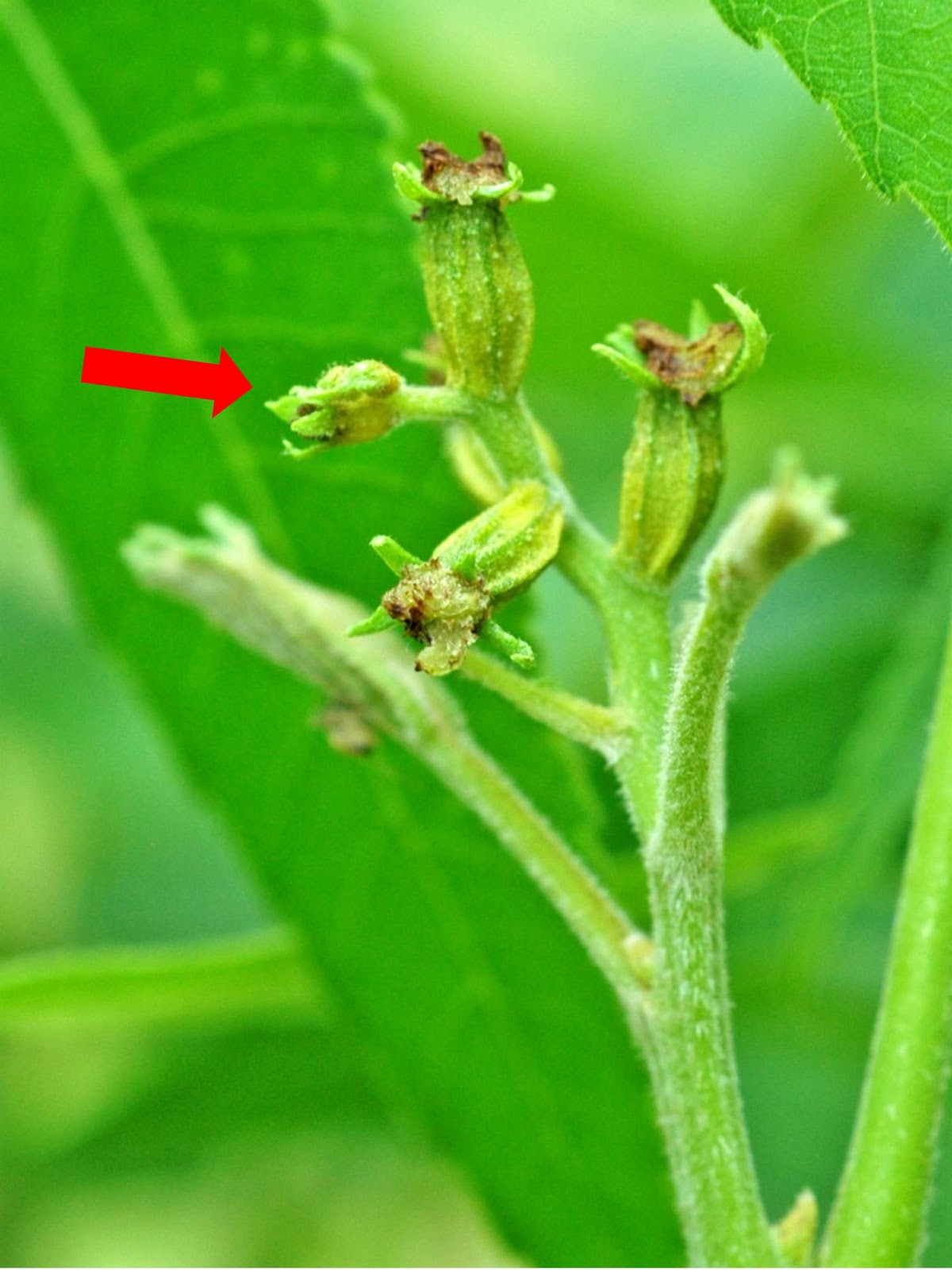
    Many pecan growers like to blame poor weather conditions during the pecan pollination season for a poor nut set. This happens whenever they see a developing nut cluster that has one or two flowers shriveled up and ready to drop off (red arrow points to 2 aborted flowers in the photo at right). Got to be poor pollination right? Wrong--its more often the case that the flowers aborting at this time of year were weak or poorly formed way back when the flower cluster was first created. Even if pollen lands and germinates on the stigma of a poorly formed pistillate flower, that flower is not strong enough to complete the fertilization process and will drop from the tree.
   
    In the photo at right, the red arrow points to a small, misshaped pistillate flower. This flower will never form a pecan and will eventually abort at the end of the pollination season. Note that this weak flower is located at the very terminal of the flower cluster. When a pecan tree develops pistillate flowers in the spring, the first flowers formed are found at the base of the flowering stalk (also known as the peduncle). As the flower cluster continues to grow, more pistillate flowers are formed along the peduncle. Eventually, the tree runs out of reproductive steam often resulting in the formation of small, weak flowers at the terminal of the flower cluster.
   The reproductive energy needed to create female flowers each spring is determined by the previous season's nut set and the tree's overall vigor. An excessive crop load one year is often followed by a year of weak pistillate flower formation (hence pecan's tendency towards alternate bearing). Drought, excessive flooding, lack of soil nutrients, insects and diseases can all put stress on a tree and reduce the strength of flower formation the following spring.
   So next time you start blaming poor pollination weather on your lack of pecan crop, think back to what happened last year. Did you do everything possible to ensure healthy tree growth?  

Saturday, June 1, 2013

Flooding and new grafts

  
    Flood water  from the Neosho River has backed up over the county road and covered a portion of my young pecan grove. Two weeks ago, I grafted several young trees in that field and I was curious to see how much of each tree was submerged in the flood. In the photo at right, you can see one of my bark grafts with all the wraps poking up through the water.  Its a good thing this graft union was not submerged in flood water. Over the years, we've learned that if a graft union is covered by flood water before the scion has callused into the stock, flood water will kill the graft. If the graft has healed and new growth had emerged from the scion, a new graft can often survive flooding (the sprouted primary bud often dies if submerged but secondary buds break on the scion once the flood recedes).
   This picture was taken during the river level's predicted high point. Hopefully, this graft will survive and sprout new growth shortly. The good news is that all the other grafts I made this year were even higher out of the water than the one in the photo. And I've learned a valuable lesson during this flood, my tree's deer cage will also serve to keep pesky beavers at bay.