Yesterday, I spent some time out in my pecan grove inspecting emerging leaves and catkins. Its much too early to see the kind of nut crop we are going to have in 2019, but by looking carefully at catkins I can determine a pecan tree's flowering habit.
Pecan cultivars that shed pollen before their pistillate blooms are receptive are said to have a protandrous flowering habit. Cultivars that produce receptive female flowers before shedding their pollen have a protogynous flowering habit. Nature has designed pecan trees with two flowering habits to ensure that every nut produced by a tree has the hybrid vigor that results from cross pollination.
In the photo above, Oswego is an example of a protogynous cultivar while Yates 68 is protandrous. Now look at the emerging catkins. The Yates 68 catkins are already quite large, seemingly developing faster that the new leaves. In contrast, the catkins on Oswego are just emerging while several new leaves are expanding on the new shoot.
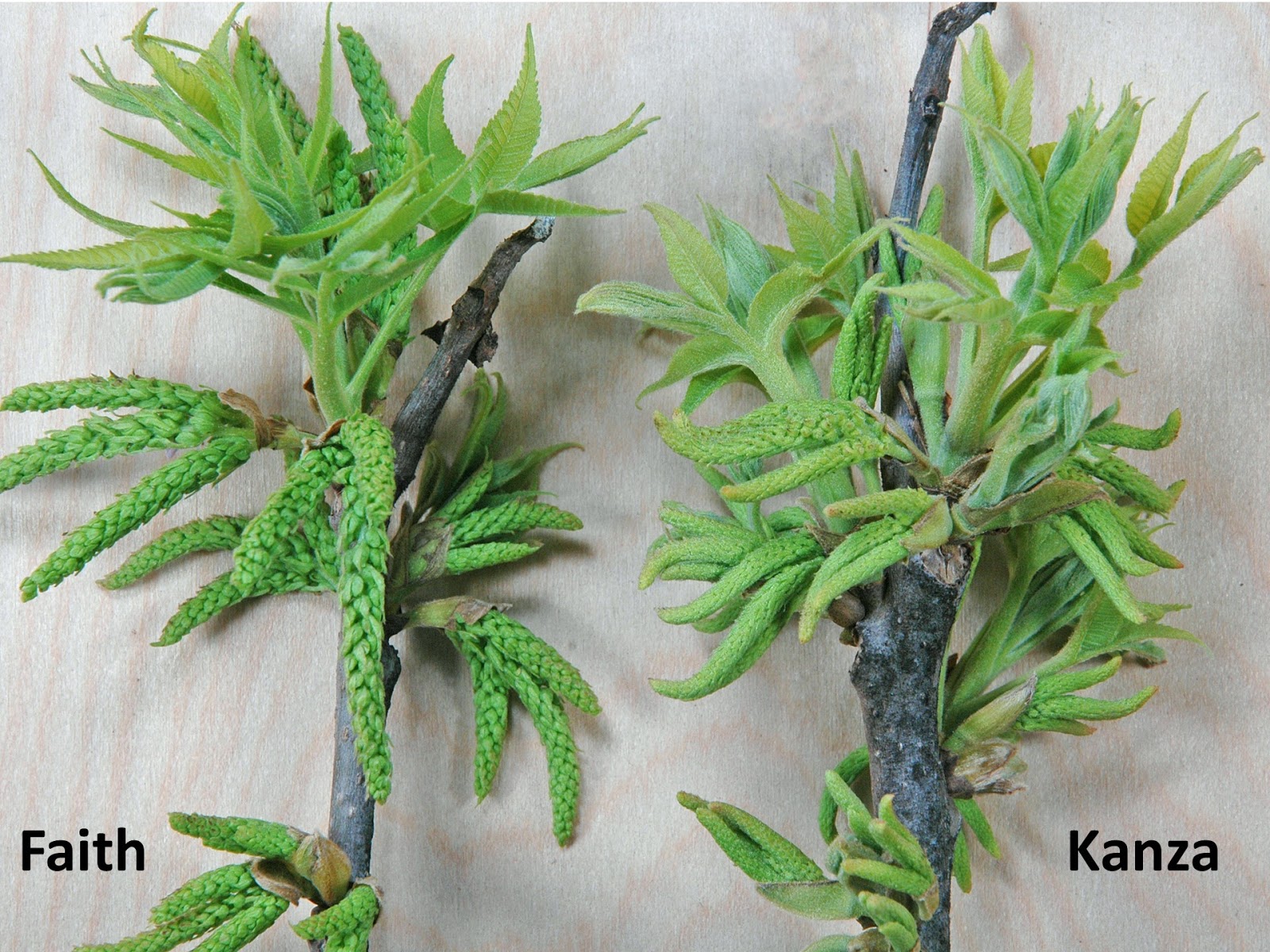
This distinctive difference in catkin appearance can been seen as spring growth continues.. The photo at left shows the protandrous Faith cultivar in comparison to protogynous Kanza. As a general rule the catkins of protandrous cultivars are short and fat while catkins of protogynous cultivars are long and thin.
While inspecting my trees, I collected shoots from three protandrous cultivar and three protogynous cultivars. Since the time of bud break differs among cultivars, these photographs offer a glimpse at early shoot development.
The first set of shoots were collected from protandrous cultivars (photo at right). Starting with Hark, note that the catkins of protandrous cultivars emerge before the leaves start to unfurl. As bud break continues, catkins continue developing at a fast rate becoming quite large early in the season.
The photo of protogynous cultivars (at left) illustrates that shoot growth starts of quickly while catkin development is delayed. Remember that pistillate flowers are produced on the terminals of new shoots. So, early shoot growth is just a precursor of early female flower receptivity. Catkin emergence on protogynous cultivars seems much slower than new shoot growth.
Thursday, April 18, 2019
Tuesday, April 16, 2019
Grafting this Spring
| A successful apple graft |
I know that several people are disappointed that my recent retirement means that I won't be traveling around Kansas, Missouri and Oklahoma to hold grafting classes. However, I will be doing plenty of pecan grafting on my own farm and would happy to demonstrate the techniques to anyone willing to drive to my place. As of today, it looks like I'll start grafting around April 27th. I do most of my grafting in the mornings and it should take me about 2 weeks to work all trees that are ready for grafting. So, if your interested, pick a pretty day and come see me in the morning. Our farm is located 4.5 miles east of Chetopa, KS on US Hwy 166 then south onto 95th Street. A sign for "Brenda's Berries" (our fruit business) marks the turn off the highway. As you drive south on 95th street, our pecan orchard is on the east side of the road. You should be able to see me in the pecan orchard grafting trees.
In addition, I've been invited by the Indiana Nut Growers to hold a grafting class in southern IN. Hopefully, folks from IL, IN, KY and OH will find this grafting workshop worth the drive. Information about this meeting, to be held on May 18th, can be found by pressing the Events Tab above.
One more thing. Several years ago I created a slide show showing the grafting techniques I use for grafting apples, pears and pecans. I have placed this slide show on a new page that you can access by pressing the Tab just below the mast head. You will note that I use some different methods for apples and pears I haven't presented in this blog for use on pecans. These fruit tree grafting methods are some of the oldest methods of grafting known to man but I don't recommend the splice graft and cleft graft for field grafting pecan trees.
Labels:
grafting
Wednesday, April 10, 2019
Controlling weeds in the pecan orchard
Over the past week, I've been working on getting the weeds and grass controlled around my pecan trees (photo at right). It is widely accepted that total vegetative control around young trees is one of the key factors in promoting rapid tree growth and greater nut production. There are several ways to achieve weed control around pecan trees including tillage, herbicides, and hardwood chip mulch. But in my orchard, I've opted for spraying herbicides.
When I first started working with pecans back in the early 1980's, glyphosate (Roundup) was the easy choice for total vegetation control. All you needed to do was to make sure you didn't hit pecan leaves or green bark with the spray. However, once roundup ready crops were developed, the widespread use of glyphosate has led to the proliferation of roundup resistant weeds.
This year, I have used a combination of herbicides around my trees. I used Gramoxone (a plant desiccant) to control existing winter annual weeds, and Simazine (a pre-emergent herbicide) to control germinating weeds and grasses. Later this summer, I'll come back with a broad spectrum contract herbicide to address any additional weed problems. I'll rotate between glufosinate ammonium (Rely) and glyphosate (Roundup) to help avoid resistance issues.
In my orchard, most of my trees started out as volunteer seedlings. So for these trees I drive a utility vehicle from tree to tree carrying a 25 gallon sprayer in the back (photo at left). I try to create a 6 to 7 foot weed-free zone around each tree. I do not try to drive and spray at the same time. At each tree, I stop and get out so I can spray around each tree being very careful not to get any spray drift on the tree.
Minimizing spray drift is very important when spraying around young trees. Last fall, I planted some one-year-old seedlings in some of the gaps in my volunteer orchard. I caged these trees to ward off the deer and carefully sprayed around the seedling (photo at right). When spraying near the small tree, I always ease up on the water pressure coming out of the nozzle. This dramatically cuts down the creation of a fine spray mist that can drift onto the green bark of the seedling.
Vegetation control is not so critical for the performance of mature pecan trees. The oldest trees on my farm are in the pecan breeding block which is planted in rows. Here, I spray a herbicide strip down the row using a simple one-nozzle boom sprayer mounted on my tractor. The herbicide strip has two functions. First, it serves to control climbing weeds such as poison ivy, trumpet vine, and wild grape. And second, it makes mowing the ground cover much easier. I can mow in one direction without having to try to weave in and out of the trees. In the volunteer orchard, I mow in two directions to get all the ground cover mowed. This means I'm covering the same ground twice every time I mow.
When I first started working with pecans back in the early 1980's, glyphosate (Roundup) was the easy choice for total vegetation control. All you needed to do was to make sure you didn't hit pecan leaves or green bark with the spray. However, once roundup ready crops were developed, the widespread use of glyphosate has led to the proliferation of roundup resistant weeds.
This year, I have used a combination of herbicides around my trees. I used Gramoxone (a plant desiccant) to control existing winter annual weeds, and Simazine (a pre-emergent herbicide) to control germinating weeds and grasses. Later this summer, I'll come back with a broad spectrum contract herbicide to address any additional weed problems. I'll rotate between glufosinate ammonium (Rely) and glyphosate (Roundup) to help avoid resistance issues.
In my orchard, most of my trees started out as volunteer seedlings. So for these trees I drive a utility vehicle from tree to tree carrying a 25 gallon sprayer in the back (photo at left). I try to create a 6 to 7 foot weed-free zone around each tree. I do not try to drive and spray at the same time. At each tree, I stop and get out so I can spray around each tree being very careful not to get any spray drift on the tree.
Minimizing spray drift is very important when spraying around young trees. Last fall, I planted some one-year-old seedlings in some of the gaps in my volunteer orchard. I caged these trees to ward off the deer and carefully sprayed around the seedling (photo at right). When spraying near the small tree, I always ease up on the water pressure coming out of the nozzle. This dramatically cuts down the creation of a fine spray mist that can drift onto the green bark of the seedling.
Vegetation control is not so critical for the performance of mature pecan trees. The oldest trees on my farm are in the pecan breeding block which is planted in rows. Here, I spray a herbicide strip down the row using a simple one-nozzle boom sprayer mounted on my tractor. The herbicide strip has two functions. First, it serves to control climbing weeds such as poison ivy, trumpet vine, and wild grape. And second, it makes mowing the ground cover much easier. I can mow in one direction without having to try to weave in and out of the trees. In the volunteer orchard, I mow in two directions to get all the ground cover mowed. This means I'm covering the same ground twice every time I mow.
Labels:
weed control
Wednesday, April 3, 2019
Spring fertilizer application in the pecan grove
With pecan buds swelling and the soil dry enough, today was a good day to spread some fertilizer on my pecan orchard (photo at right).
Earlier this year I took a soil sample to test for phosphorus, potassium and soil pH. As I suspected and based on my soil type, the results showed I was low in P, K and lime. So today, I started by applying a complete fertilizer mix to my orchard. I spread 64 lbs/acre N, 46 lbs/acre P, and 45 lbs/acre K.
You might recall, that I started this complete fertilizer regimen last fall and will continue until I build up the P and K levels in the soil until they reach sufficient levels according to soil tests.
I also plan on getting some lime applied to the soil in the grove. My soil has dropped down to below pH 6 and I need to add lime to sweeten the soil back up to around 6.5. Once I contract a liming service, I plan on using a pasture harrow to rake the surface applied lime into the soil. I'll show that operation within the pages of this blog once I get the lime applied.
Earlier this year I took a soil sample to test for phosphorus, potassium and soil pH. As I suspected and based on my soil type, the results showed I was low in P, K and lime. So today, I started by applying a complete fertilizer mix to my orchard. I spread 64 lbs/acre N, 46 lbs/acre P, and 45 lbs/acre K.
You might recall, that I started this complete fertilizer regimen last fall and will continue until I build up the P and K levels in the soil until they reach sufficient levels according to soil tests.
I also plan on getting some lime applied to the soil in the grove. My soil has dropped down to below pH 6 and I need to add lime to sweeten the soil back up to around 6.5. Once I contract a liming service, I plan on using a pasture harrow to rake the surface applied lime into the soil. I'll show that operation within the pages of this blog once I get the lime applied.
Subscribe to:
Posts (Atom)