Tuesday, April 4, 2017

Cleaning up a bark graft

   Whenever I graft a tree, I usually return to the new graft every 3-4 weeks throughout the summer to prune off trunk sprouts and root suckers. I also like to start training the new scion to grow a strong central leader. The photo at right is an example of a successful bark graft that I made last year but totally overlooked the all summer training. You'll even note that the graft union is still wrapped in aluminum foil and plastic. To get this tree back into shape, I needed a chainsaw, pruning saw, and hand shears.  
   The first step in cleaning up the this young grafted tree was to cut off all the root suckers with a chainsaw and use the hand pruning saw to remove the trunk sprouts. With just these few cuts I've already reclaiming my grafted tree (photo at left). 

    When I grafted this tree last year, I placed a single scion under the bark of the stock tree. At that time, the stock was about 3 inches in diameter  (photo at right, grafting knife set on trunk for scale). Once the graft took, the scion grew vigorously sprouting numerous new shoots. Unfortunately, none of the shoots from scion produced a strongly dominate central leader. This  scion needed pruning desperately to carve out a single tree trunk.

    In pruning the scion, my first step was to trim the stock at an angle to encourage rapid wound closure. To make the cut, I used a small chainsaw to cut the stock tree at a angle of between 30 and 45 degrees (photos above). Not only does this angled cut enhance  healing,  it also encourages water to run off the wound, promoting rapid wood drying and helping to inhibit wood rot.

  Next, I used my pruning saw and clippers to prune the scion into a single shoot (photo at left). Later this summer, I'll need to train this one remaining stem to grow into a strong central leader tree. By removing all of  root suckers, stump sprouts, and more than one half of the scion's shoot growth, this tree will have a lot of pent up energy to sprout new growth come this spring. I will definitely need to revisit this tree with my pruning shears on a regular basis (every 3 weeks) to direct all new growth in the right directions. I'm positive that new trunk sprouts and root suckers will try to grow this summer. But this time,  I'll be quick to prune them as soon as they develop.

   The photo above gives you an idea of what the tree looked like before pruning and then after I had carved out a central leader. At this point it looks like I've pruned the tree into a telephone pole. However, I assure you, that with proper directive pruning, lateral branches will form and the tree will begin to fill out.


Wednesday, March 29, 2017

Sapsuckers have arrived

  Every spring, yellow-bellied sapsuckers stop to visit our pecan trees on their flight northwards. Long before the buds of pecan trees start to break, these members of the woodpecker family will drill a series of holes in the trunks of pecan trees (photo at right).  The holes are dug deep enough to allow rising sap within the tree' trunk to leak out. The sap provides nourishment for the birds as well as attracting insects to the sugar rich sap. When the sapsucker returns to it's freshly dug holes, the bird will dine on both sap and insects.
   Looking at the photo at right, you can see a row of freshly drilled holes in the bark. But six inches above that row is a row of old sapsucker holes that have been closed over by growing bark tissue.
   Sapsuckers holes may look bad but they do not damage nut production.

Monday, March 27, 2017

Counting pecan wood rings

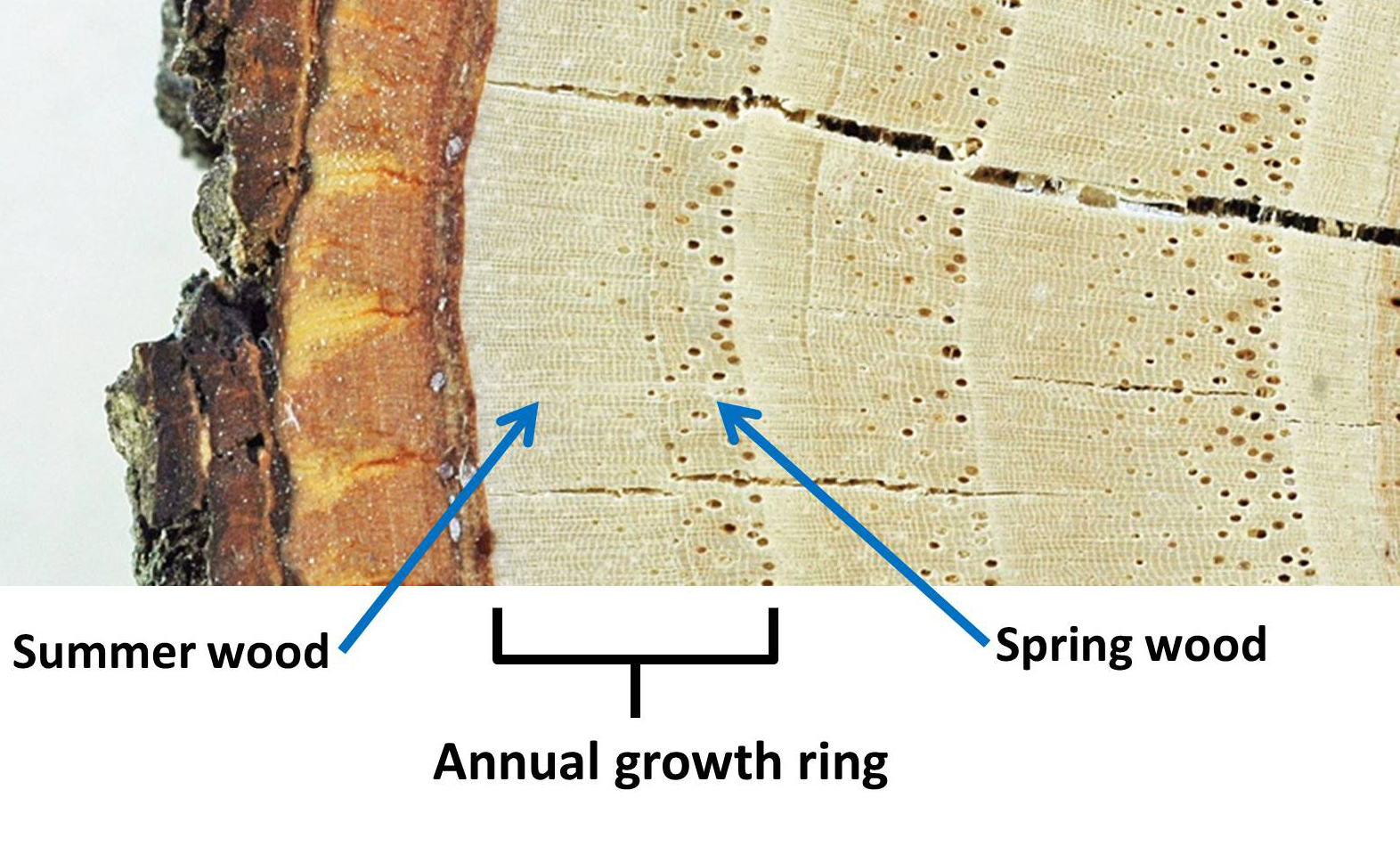
    Whenever we remove trees during an orchard thinning process, I like to stop for a minute and look at the rings in the wood. Each year pecan trees lay down a new and unique layer of wood tissue. Take a closer look at the rings of a tree and you'll discover a little bit more about how a tree grows. During the spring flush of growth, new wood tissue is created with numerous large vessel cells (large pores in the spring wood pictured above). These large vessels are needed to transport the massive amounts of water and nutrients required to build the spring flush of leaves and new shoots. As shoot growth ceases by early summer, demand for water and nutrients slows and the tree creates wood tissue with only small vessels (summer wood pictured above). Small wood vessel cells may not be able to conduct large volumes of water but their small diameter makes it easier to move water up the trunk during the dry summer months.  


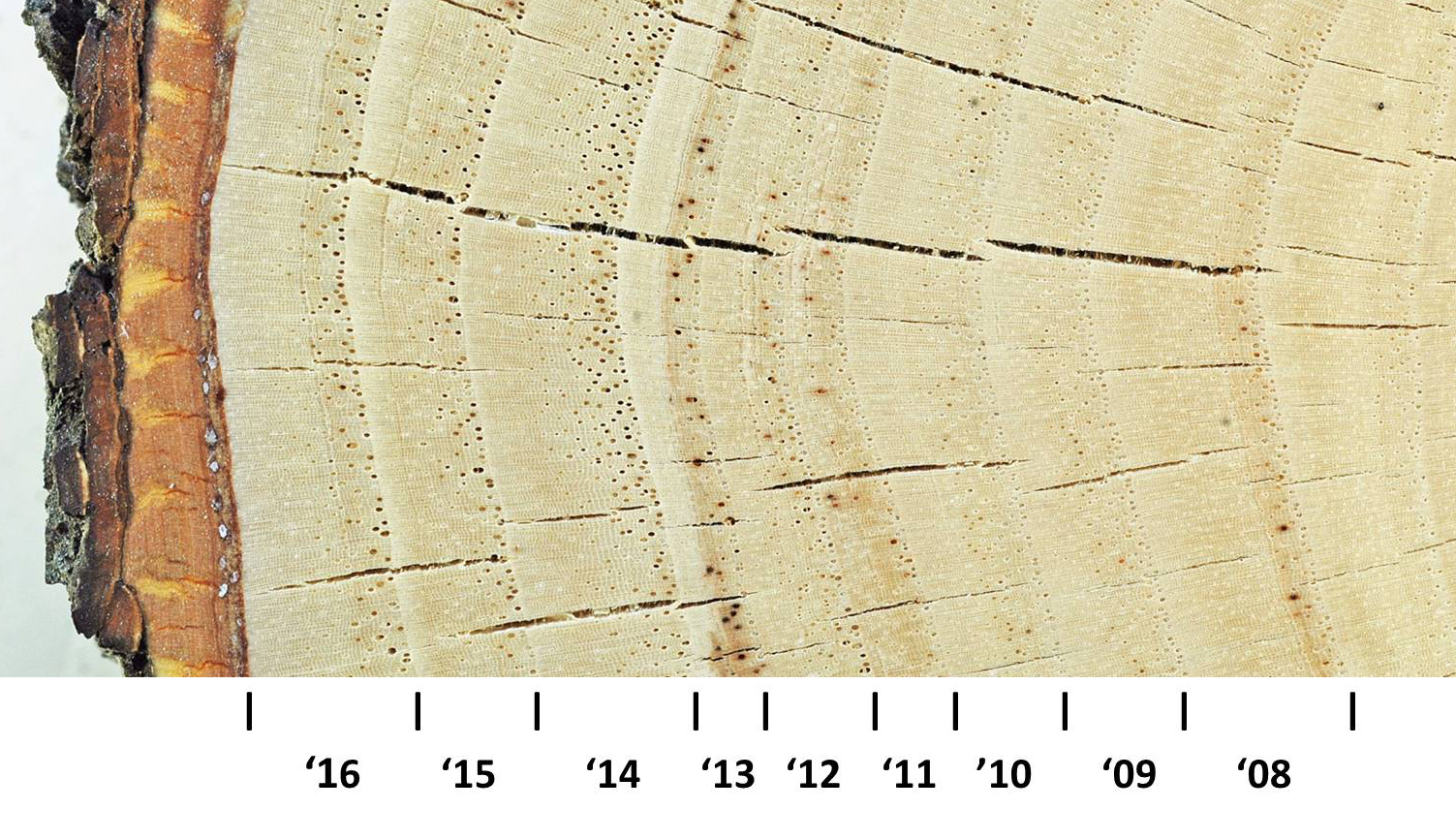
  The annual growth rings within a tree's trunk also offer a historical record of past growing conditions. The wider the growth ring and better that year was for tree diameter growth. The photo above shows the growth rings I found inside a Kanza tree we recently removed during a tree thinning operation. During the years 2014-2016 we experienced excellent weather for pecan tree growth--adequate rainfall and plenty of sunshine. The Kanza tree responded to these good growing conditions by at a creating wide, healthy growth rings.
    But look at the rings laid down during the dry years of 2011-2013. Wood growth during these hot dry seasons was stunted by poor growing conditions. In addition, the number of large vessel cells within these growth rings are severely limited (a response to drought). These large vessel cells are also stained dark brown (especially the 2013 wood). When a pecan tree suffers from drought, the large vessels stop working and the tree plugs up the non-functioning cells to preserve water within the tree.
    Next time you remove a pecan tree, take a little time to read the story left behind in the growth rings. I always seem to learn something new.   

Wednesday, March 22, 2017

Pecan trees still waiting for Spring

    With temperatures hitting the 80's (>27 C) a few days ago, everyone is talking about Spring arriving early this year. So today, I went out to the pecan grove to see if I could find any signs of bud growth on our trees. The vast majority of pecan cultivars I inspected were still fully dormant. The Pawnee and Posey twigs pictured above are just two examples of cultivars with dormant buds. On the other hand, Mohawk buds have started to split open the outer bud scale (crack in the scale marked by red arrow). To get a closer look at the Mohawk bud click on the photo for a full screen photo.
   Outer scale split is the very first indication of pecan bud swell. It also marks the time when pecan roots start their spring flush of new growth. In just a couple of weeks we should see all pecan cultivars start bud expansion. In five weeks time, I'll be grafting trees.