Tuesday, May 30, 2017

Pistillate flower strength and pecan nut set

  I was checking on the development of the 2017 pecan crop last week and made some interesting observations about pecan flowering and nut set.  Whenever I look at pistillate flower clusters that are fully receptive and ready to be pollinated, I become extremely optimistic about the current season's nut crop. A cluster of five nutlets with bright red stigmas just looks so impressive (photo above, right).

   However, rarely do all the pistillate flowers in a cluster turn into harvestable pecans. When a pecan tree creates an pistillate flower cluster, the flowers at the end of the pedicel are often smaller or ill-formed (photo at left). Its like the tree just runs out of gas at the end of the flowering stalk.  
     Weak or poorly formed flowers may capture pollen but these flowers don't have the strength to produce a fertilized nut. This is why you might find that terminal flowers turn brown and eventually fall off the tree (photo at right). What the casual observer might blame on poor pollination, is actually weakly formed pistillate flowers being shed by the tree. 

    Pecan tree will only hold on to nuts that have become fertilized. The developing seed produces a plant hormone that sends a signal to the rest of the plant that basically says-- "hold me and feed me". The photo at left illustrates how a pecan tree shed unwanted unfertilized pistillate flowers. At first the weak flower turns brown (labeled A). The tree responds by forming an abscission layer between the flower and the pedicel. The location marked B once held a pistillate flower that has since aborted. If the pedicel does not contain a single fertilized nut, the entire pedicel will be removed from the tree. You can see an abscission layer forming at the base of the pedicel (marked C). 
     Without an actively growing nut cluster, you will note that the buds just below the pedicel are starting to swell. A second flush of vegetative growth  will soon appear on this branch terminal.


Friday, May 19, 2017

Checking on pecan pollination

    Yesterday, I wandered through our pecan cultivar trials to check on the progress of pecan pollination.  At this point, we are half way through pollination. All of the protogynous cultivars are releasing pollen and the protandrous cultivars have receptive pistillate flowers. Pawnee is a protandrous cultivar that is now displaying large, red stigmas on the ends of pistillate flowers (photo above).  The catkins on Pawnee shed their pollen a while back and have now dropped to the ground.

     The pistillate flowers of Kanza are fully pollinated (photo at left). Stigmas of female flowers dry up and turn black once they become pollinated.
    Kanza, being a protogynous cultivar, has late pollen release. Yesterday, Kanza catkins were releasing millions of pollen grains into the warm springtime winds.

    One thing I noticed about pecan flowers is that pistillate flowers of protogynous cultivars are smaller than pistillate flowers of protandrous cultivars.  In the photo above, you can see this size difference. Posey is protogynous while Pawnee is protandrous. By the end of the growing season the nuts of these two cultivars will be roughly the same size.


    While inspecting pecan flowers, I was also reminded that the color of receptive stigmas can vary from green, to orange, to bright red. The photo above illustrates some of this color variation. Both Major and Waccamaw had fully receptive pistillate flowers yesterday. Major displayed green stigmas while the Waccamaw stigmas are bright red. Since pecan trees are wind pollinated, stigma color has zero impact on pollination success. However, stigma color can sometimes be used to help identify certain cultivars. 

Wednesday, May 17, 2017

Finishing up the grafting season

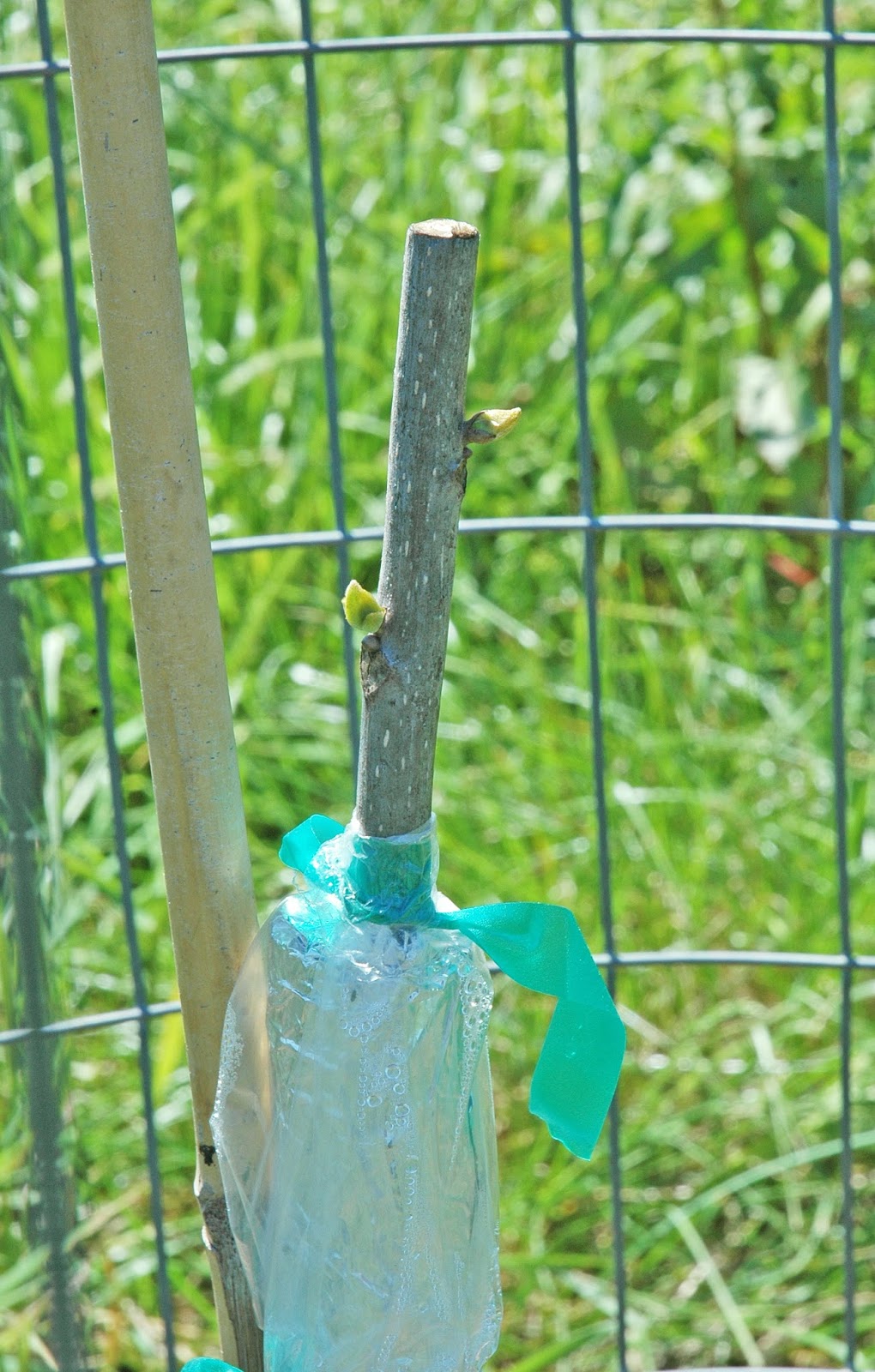
   Last weekend, I finally finished grafting pecan trees in my orchard. After the flood receded, it seemed like I spent a week in rubber boots wading in the mud to finish up making bark, arrowhead, and 3-flap grafts. I've been grafting pecan tree since late April this year and those first grafts I made are starting to break bud (photo at right). Now it was time to finish up.
   Not every tree is cooperative with the grafting process and the last tree that I needed to graft this year turned out to be a graft failure from 2016 (photo at left).  Its a good thing that I had strong trunk sprouts grow up last summer to provide a perfect spot for grafting this Spring. My first step was to remove the failed graft and trim the tree down to a single trunk.
    I choose to keep the larger of the two sprouts for my new central leader. I trimmed off the old failed graft and the smaller trunk sprout with one cut using a chainsaw. I made the cut at about a 45 degree angle to aid in rapid wound healing.
    I cut the remaining portion of the tree at about 2 feet above ground level. At this point, the tree was about one inch in diameter--somewhat small for a bark graft. I selected a small diameter scion from my cooler and held it up to the stock. This is how I search for a flat spot on the stock wide enough to suit my scion (photo above right).

   In choosing a flat spot to insert the scion, I also took into account the locations of buds on the stock. Each bud has a bud trace or small branch of wood that grows up into the bud. If you try to insert a scion right under a bud on the stock, the scion might get hung up on the bud trace. I found two buds on the stock tree that I needed to avoid. In the photo above, the red arrow points to a bud at the very top of the stock. This location looks like a nice flat spot, but the bud trace could create a problem for inserting the scion.  I found a second bud in the grafting zone (yellow arrow) and I chose to avoid this bud also. Ultimately, I decided to place the graft in location of clear bark that seemed just wide enough for the scion (the scion in the photo hovers above that location).
  
    The way I carve my scion for a bark graft means that I always place the scion on the left side of the split in the stock's bark. Keeping that in mind, I made the downward slice in the stock's bark on the very right side of the area I had identified for scion placement. I proceeded to carve the scion and staple it in place (photo at left).

    This year's grafting season for me ended up the same way as always--covering a graft with aluminum foil and plastic bag, then attaching a bird perch. For me the end of the grafting season means the beginning of the directive pruning season, especially on trees grafted in 2016.

Monday, May 15, 2017

Cages protect young pecan trees from deer browse


    A picture may be worth a thousand words but the two photos above teach a valuable lesson. The photo on the left shows an unprotected seedling pecan trees that has been heavily browsed by deer. The tree on the right is enclosed by a cage constructed of welded wire fencing. This tree has a full canopy of leaves and has already made over ten inches of new shoot growth.

    Although browsing doesn't kill the tree, the removal of new growth ultimately stunts the growth of the tree.  The photo at right shows the terminal of the tree that was browsed. The yellow arrow points to the stub of this year's new growth left behind after a deer bit off the top of the tree. You can tell it this stump  is from the spring flush of new growth because of its green color.  Once the deer removed the first flush of new growth, its taken the secondary buds a couple of weeks to start breaking.
    The lesson I've learned is that tree cages are now necessary for every young tree on my farm.  I use 2 x 4 inch welded wire to build the cage. I've used both 4 foot and 5 foot tall wire but find that 4 tall works just as well in curtailing deer browse. I've used both light gauge and heavy gauge wire but find that the greater expense of the heavy gauge wire is offset by the cage's greater durability. As the trees grow above browse height, I'll remove the welded wire cage then re-use the cage to protect newly planted trees.