Friday, February 18, 2011

Notes on Mandan

Mandan is one of the newest pecan cultivars released by the USDA pecan breeding program. We have had only a couple of years experience with this new cultivar and have yet to fruit Mandan at the Pecan Field. I was able to get a fresh sample of Mandan from a grower in Oklahoma so we could look at kernel quality. The photo above has Mandan kernels (top row) compared to Kanza kernels (bottom row). The Mandan kernels are obviously larger but the kernel color is darker and more "veiny" than the Kanza kernels. You will also note that the dorsal groves of Mandan are narrow (can hold packing material) as compared to Kanza. In the past, I've found it hard to market nuts with ugly kernels even if those nuts have good size. Less that perfect kernel quality is one of the major reasons I can't get excited about grafting Mandan.

  Mandan does seem to have good cold hardiness. Last week, temperatures at the Pecan Field dropped to around -15 degrees F. This morning, I collected some branches from our Mandan grafts, cut into the cambial zone and found only healthy green tissue (photo at left).
   When they released Mandan, the USDA indicated that this new cultivar has good scab resistance. Unfortunately we have found scab on Mandan trees at Chetopa, KS and New Franklin, MO. Scab is easily spotted as black, sunken lesions on the twigs during the dormant period. You can see 3 scab lesions in the middle of the twig pictured at above, right. The number of scab lesions I have seen on the stems of Mandan are similar to the number I see on Pawnee but less than the number of lesions found on a very scab susceptible cultivar like Colby  

Thursday, February 3, 2011

February 1st Blizzard

At first the weather man said we might get up to 1/2 inch of ice followed by 9-10 inches of snow, but fortunately, all we got was 19 inches of snow! (2nd highest snowfall on record).  Fortunate for the trees, that is! Today, after spending all day yesterday digging out both home and office, I had the chance to photograph the beauty of a snow covered native pecan grove (above). It was especially beautiful because I couldn't see any broken limbs following the snow storm that packed 40 mph winds. Looks like the snow will be around for a while allowing temperatures to fall well below normal. This morning I woke up to -9 F.  Additional sub-zero weather is forecast in the coming week. Once we are able to get back out into the field, it will be interesting to see if any more cold damage shows up in the cambium of one-year-old pecan branches.

Friday, January 28, 2011

Cutting scions

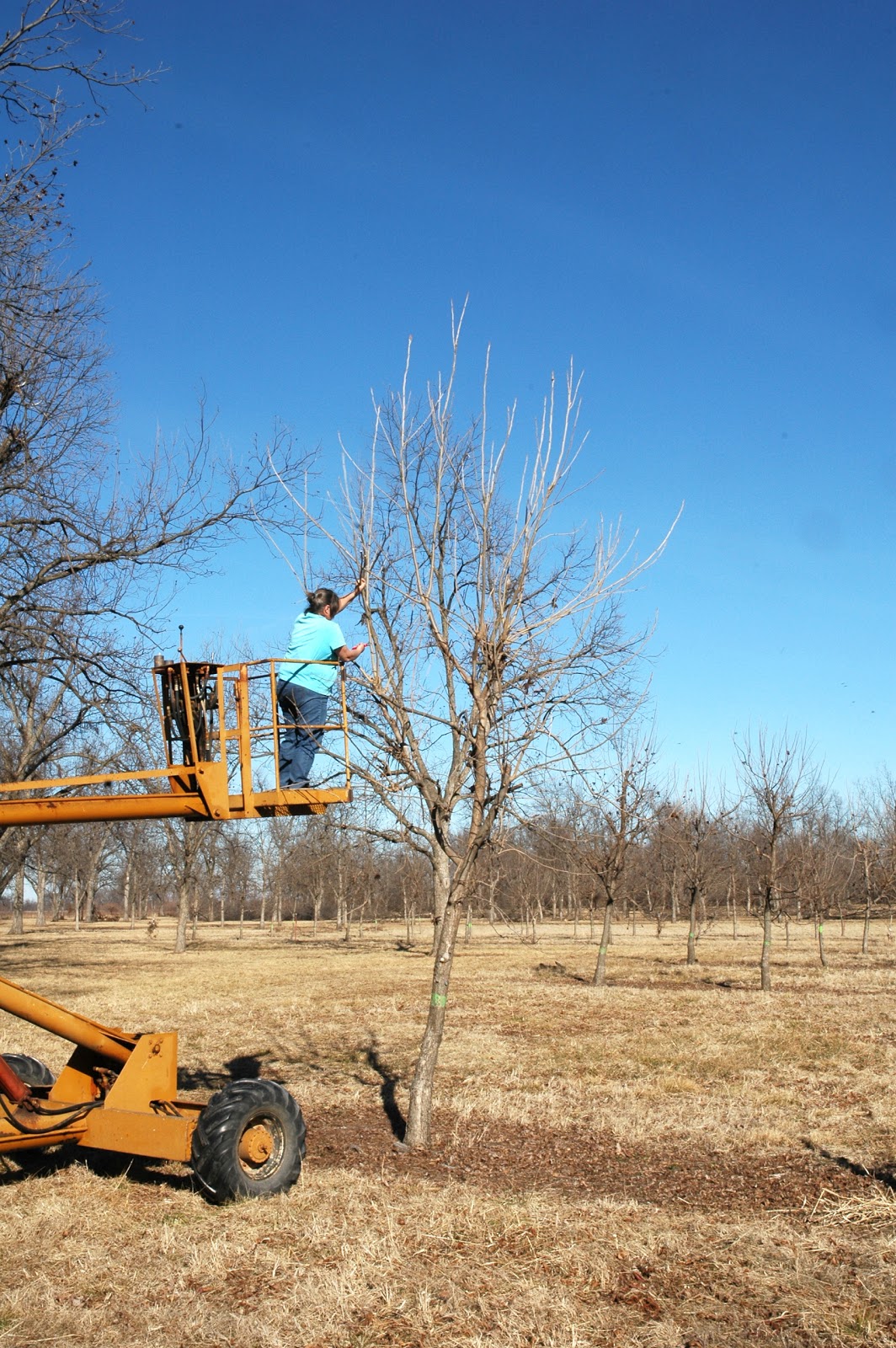
Our annual January thaw came around this week, so we took advantage of some beautiful weather to cut pecan scion wood. One of the best ideas we've had when it comes to growing high quality propagation wood is to develop a scion wood orchard. In the photo at left, long, one-year-old shoots are cut from specially grown scion wood trees. Its nice to have a hydraulic lift for this type of work but most of the scions could be reached with a pole pruner.
     In the photo at right, you can see one of our a scion wood trees with all the scions removed. Note that we leave lots of stubby branches on the trees to provide ample places for the tree to sprout new vigorous shoots next summer.
    Even when these trees are butchered annually they still produce a few nut clusters (note shucks on still on the tree). We collect the first nuts produced by each tree in our scion wood orchard and verify that the cultivar is true to type. We then  paint the green ring on the trunk (green=good to go) to indicate that the tree is ready for scion wood production. The trees in the scion wood block are planted 15 feet apart in rows 30 feet apart.

 
 Once we collect the scion wood branches, we cut the wood into ~8 inch long bud sticks and place them in plastic boxes (photo at left).  Inside the boxes we also place some dampened paper towels to ensure high humidity inside the box during storage.  We store the wood at 35 degrees F until it time to ship out the wood in early April.

What's wrong with my pecans?

   I often receive pecan samples from home owners that have a pecan tree or two in their yard with a note simply saying--"Whats wrong with these pecans?". So I thought it might be a good idea to describe how I determine the problems associated with these type of samples. The sample pictured above came from a gentleman from the Wichita, KS area. The note that came with the sample stated that the pecans produced by his tree rarely fill well and some nuts have an "off" flavor.
    The first step to determine the cause of poor pecan performance is to determine if the nut comes from a grafted tree. These nuts were smaller than most cultivars and the thick shell confirmed the nut to be a seedling. Before cracking the nut open, I noticed that the shell markings that are normally dark black on a pecan were lighter and reddish on the submitted sample. This told me this pecan did not receive a long enough growing season to complete normal nut development. I cracked open the nut and found more evidence that this pecan is not adapted to the Kansas growing season.  Three kernel defects were present--hollow kernels, kernels that don't extend the full length of the shell, and brown fuzz adhering to the kernels. All 3 of these defects indicate that this tree ran out of time (length of growing season) to fill the kernel properly.
   The "off" flavor of some kernels were caused by stinkbug feeding. This problem shows up as darkened areas on the kernels. A full explanation of this malady can be found in a previous post call "black spots on kernels".
  So now its time to make recommendations. There are no remedies for poor genetics. The tree that produced the pecan pictured above likely originated from a seedling tree (or nut) collected in Texas and moved to the Wichita area. During years when we experience a longer-than-normal growing season the nuts will fill better. Stink bugs can be controlled in the commercial pecan orchard setting but the chemicals used are not compatible with application  within suburban neighborhoods.
   This nut sample provides yet another example of why proper cultivar selection is critical for successful pecan production in the North.