Monday, March 14, 2011

Judging nut samples

    We had a great meeting of the Kansas Nut Growers Association last Saturday--lots of fun and a great time for fellowship. Featured at our annual meeting are exhibits of nuts grown by members of the association and by the Pecan Experiment Field. The 2010 crop proved to be a good one and we had some great pecan samples (photo above). I always enjoy watching nut growers inspect the samples. They pick up a nut to get a feel for its weight and then take a closer look at the details of nut shape and outside shell markings. Kernel quality is especially important to our growers. Bright-colored, plump kernels are preferred by both grower and consumer. You'll note we place the shelled-out kernels in plastic bags to deter taste testing so everyone can get a chance to inspect kernel quality.
     The growers were excited to see nut samples from our pecan breeding project (photo at right). This is the 1st year some of the trees in our breeding block have produced nuts. As you might have expected, I was given dozens of opinions on which clone should be propagated. But there is one thing I've learned during 30 years of pecan cultivar testing--it's impossible to judge a pecan clone based on a single year's nut crop. The 2011 crop should give us even more clones to evaluate and an opportunity to see a second crop from the trees that produced in 2010.

Monday, March 7, 2011

Lakota takes the cold

   We spent most of today cutting Lakota pecan scionwood. With a quick slice of the knife we found that Lakota did not exhibit the the same kind of internal browning we saw on our Pawnee wood (see previous post). I was kind of surprised by this because both Pawnee and Lakota represent hybrids of southern and northern cultivars. Pawnee is the results of Mohawk X  Starking Hardy Giant cross, while Lakota is a Mahan X Major cross. Could it be that having a female parent of Major make a clone more cold hardy? Remember that Kanza is a Shoshoni X Major cross and we've seen only green healthy bark this year on our Kanza scions.

Friday, March 4, 2011

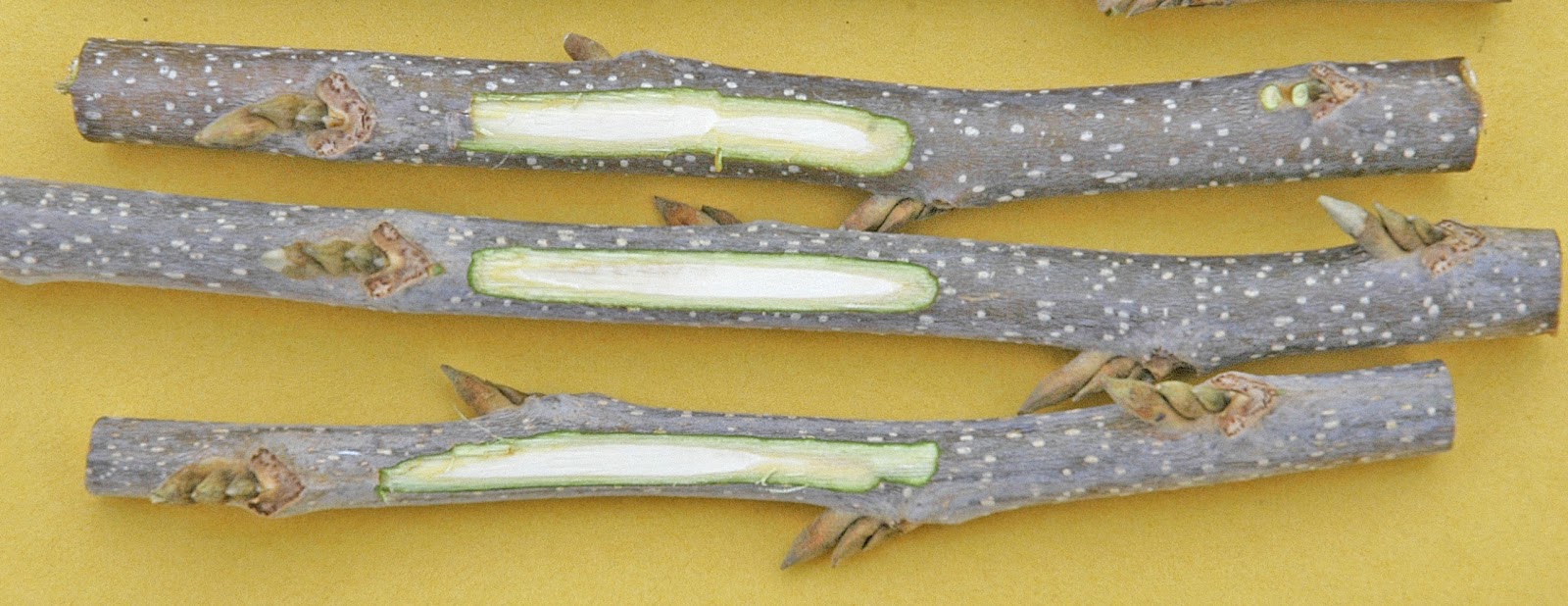
Pawnee suffers winter injury

   We cut into some Pawnee twigs yesterday and discovered that the cold snap we experienced back in February (-16 F) has caused some internal browning (photo above). The damage looks like it should not prevent normal bud break and shoot growth but it will be interesting to see if pistillate flower formation is affected by the freeze damage.
   Over the coming weeks we will be evaluating all of our pecan cultivars for cold injury. Then, later in the season, we'll see how the cold injury affect bud break and flowering.    

Tuesday, February 22, 2011

Moving in a new orchard


     I drove by V.O. Morgan's pecan farm today and noticed that he had 2, truck-mounted tree spades moving seedling trees out into rows. Like every native pecan grower, V.O. has a ready supply of sapling trees growing in fence rows and field margins (you can see the native trees behind the truck). The trucks are moving trees that average 1 to 2 inches in diameter. The open fields of this farm are filling up fast with young trees and it will be interesting watch this new orchard grow.
     From past experience, we know that using a tree spade to move trees requires a large commitment to post transplanting aftercare. The area around each tree needs to be tilled all summer long to make certain the seam between transplanted root ball and the surrounding soil doesn't open up during dry periods. In addition, the trees will need water during the heat of the summer. Both watering and tillage are necessary to keep the transplanted root ball from drying up and killing the young tree.
    Eventually these trees will need to be grafted. Grafting should not be attempted until the transplanted tree overcomes transplant shock and begins to make at least 2 feet of new growth in a year's time. Only when the tree is ready to accept a graft will you find success in propagating pecan cultivars onto transplanted trees.