Wednesday, December 21, 2011

Crows are a major pecan pest

A couple of crows high in pecan trees
    Every year crows from all over the upper great plains migrate south for the winter in search for easily-accessible, high-energy food sources. Unfortunately, that means they like to stop in our pecan grove right at harvest time to feast on pecans. Its hard to photograph crows (photo at right) because they are such wary birds. Or, maybe, they have come to realize that a man on foot in a pecan grove is often followed by shotgun blasts.
    It is estimated that a single crow can consume 15 pounds of pecans per month. Crows will knock nuts to the ground, hold the pecan between their feet, and crack open the shell with their large, heavy beak. After cracking the nut open, they pick out the kernel, leaving shell and packing material on the ground.

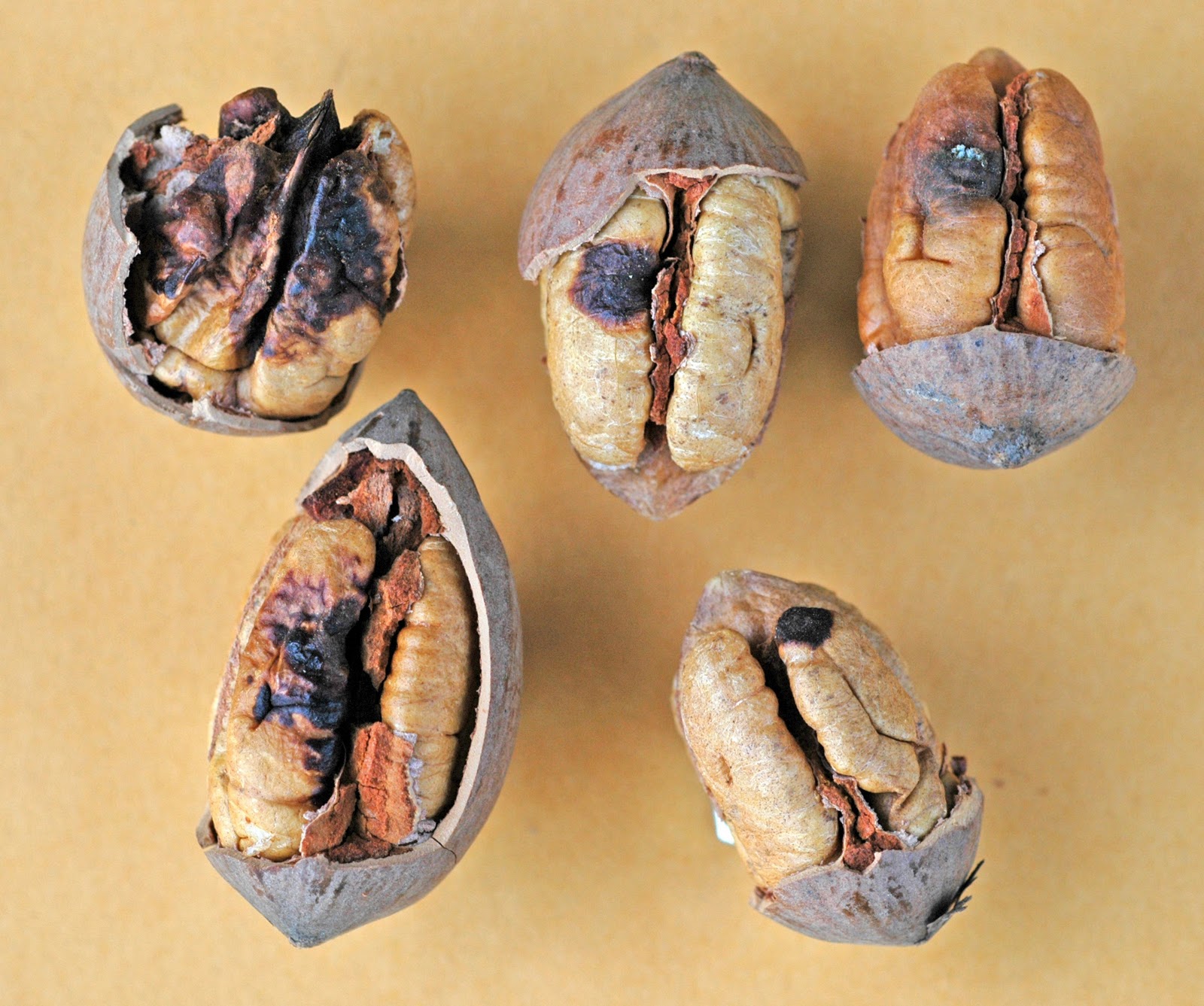
Pecan shells left after crow feeding
   If you walk out under your trees you can spot the shell fragments left by crows (photo at left). You usually don't see a lot of shells in one location but I gathered up a few examples and placed them all in one photo.
    Crows have become an increasing problem for pecan growers ever since they became federally protected bird--a result of the NAFTA treaty (the crow is the national bird of Mexico). Later this winter, we will be holding a meeting with Federal and State wildlife managers to develop an action plan for reducing crow populations. Watch this blog for further details as we make plans for this meeting.

Thursday, December 15, 2011

Watch for old pecans gathered at harvest

    Here's a photo of three pecans we picked up with the harvester this fall. You might recognize these nuts as being all from the same cultivar--Kanza. The light colored nut on the right is from this year's crop, while the other 2 nuts were left behind from the 2010 crop. One of the things we look to remove from the cleaning table are old nuts that usually appear as dark reddish black nuts (nut pictured in the center).  After sitting on the ground an entire year, these nuts become rancid and/or moldy.
    We missed the moldy nut on the far left on the cleaning table only to find it later in a batch of cracked nuts. Look at the shell that still remains on the moldy nut. Its darker than the new crop nut but doesn't have that oil soaked appearance of the nut pictured in the middle. With thousands of nuts moving across the cleaning table, it easy to see how we missed pulling the moldy nut (before it was cracked) out of our 2011 crop.
    I find it remarkable that pecans missed at harvest can survive an entire year out in the field without being discovered by squirrels, mice, crows, woodpeckers, insects and even deer. However, every year we find just a few old nuts come racing across the cleaning table that need to be thrown in trash pile.

Wednesday, December 14, 2011

Pecan harvest 2011

Sonja raking sticks off the orchard floor
    We have working hard to harvest this year's pecan crop before the rain and snow of winter rolls in. Since I usually end up shaking our native groves, I get a pretty good idea about the size of our crop by the sound of nuts hitting the top of the tractor cab. This year's crop will be slightly smaller than last year's harvest mostly because  the 2011 drought decreased average nut size.
    While shaking our trees, I started  thinking about area farmers that have spent most of harvest season complaining about a lack of nuts in their groves.  One guy even argued that the cold temperatures we had last February (-17 F) were the reason he didn't have a crop. But when confronted by the fact that the Experiment Field was producing nuts in 2011, he simply stated that a dome of warm temperatures protected the trees just east of Chetopa. Talk about hot air!

Darrell harvesting pecans
    The real reason growers don't see annual crops in their groves is because they cut corners when it comes to annual inputs. If you want consistent nut production, fertilizing the grove twice a year every year is a must. In 2011, we spent $90.58/acre on fertilizer. We applied 70 lbs. N and 60 lbs. K in early March and 46 lbs. N in October. Our native pecans will yield around 1000 lbs/acre; more than enough to cover the cost of ferilizer.
    Pesticides are another major input for pecan producers. This year we invested $42.63/acre in insecticides and fungicides. We sprayed for casebearer and scab in June, stinkbug and weevil in August, and weevil in September. This year's dry summer helped prevent the spread of pecan scab.  As a result, our fungicide applications were kept to a bare minimum and we were able to save a little money.
Cracked pecans
    It takes several years for pecan trees to respond (bear nuts) to fertilizer and pest control. It takes even longer to build up tree strength with years of consistent inputs to achieve reliable annual nut production. 
    

Saturday, December 3, 2011

Fewer black spots on kernels in 2011.

    Its not until you crack open a sample of  this year's pecan crop do you discover the level of damage created by stink bug feeding. As I mentioned in an earlier post, the black spots found on pecan kernels are the result of feeding by stinkbugs and/or leaf-footed bugs (photo at right).
    Last year (2010) we found quite a bit of stink bug damage. This year (2011) the number of kernels with black spots are far fewer. I wish I could come up with a good explanation for the year-to-year variation in stink bug damage but it turns out that the movements and population numbers for this group of plant feeding bugs are very hard to predict.
    Over the past several years, our  control strategy for kernel feeding bugs has been to apply an insecticide (Warrior II) in early August. Subsequent insecticide applications aimed at pecan weevil also help decrease stink bug populations. These control measures are not perfect but seem to keep kernel damage down to less that 1% of kernels.