Thursday, January 29, 2015
Late January pecan harvest
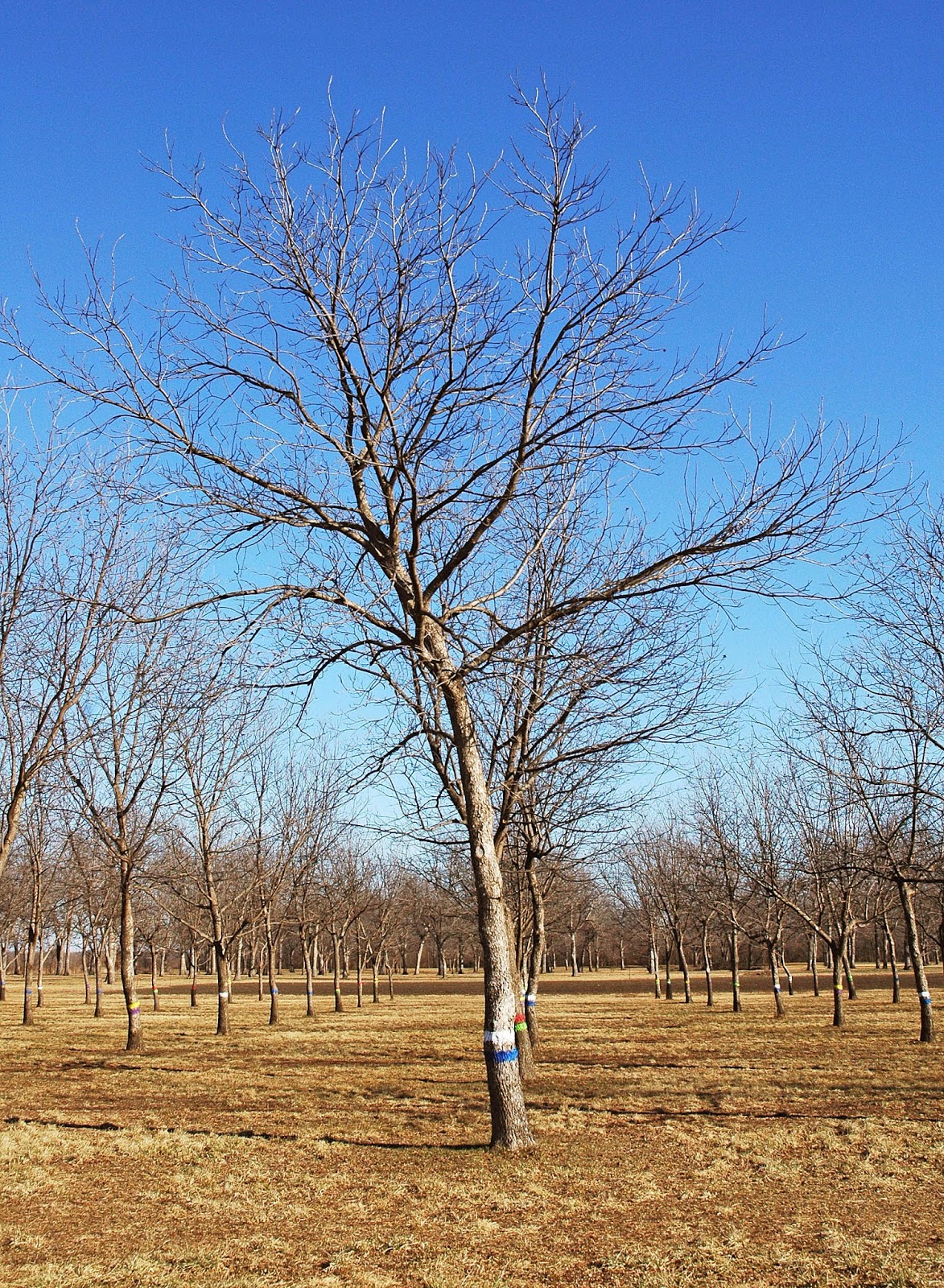
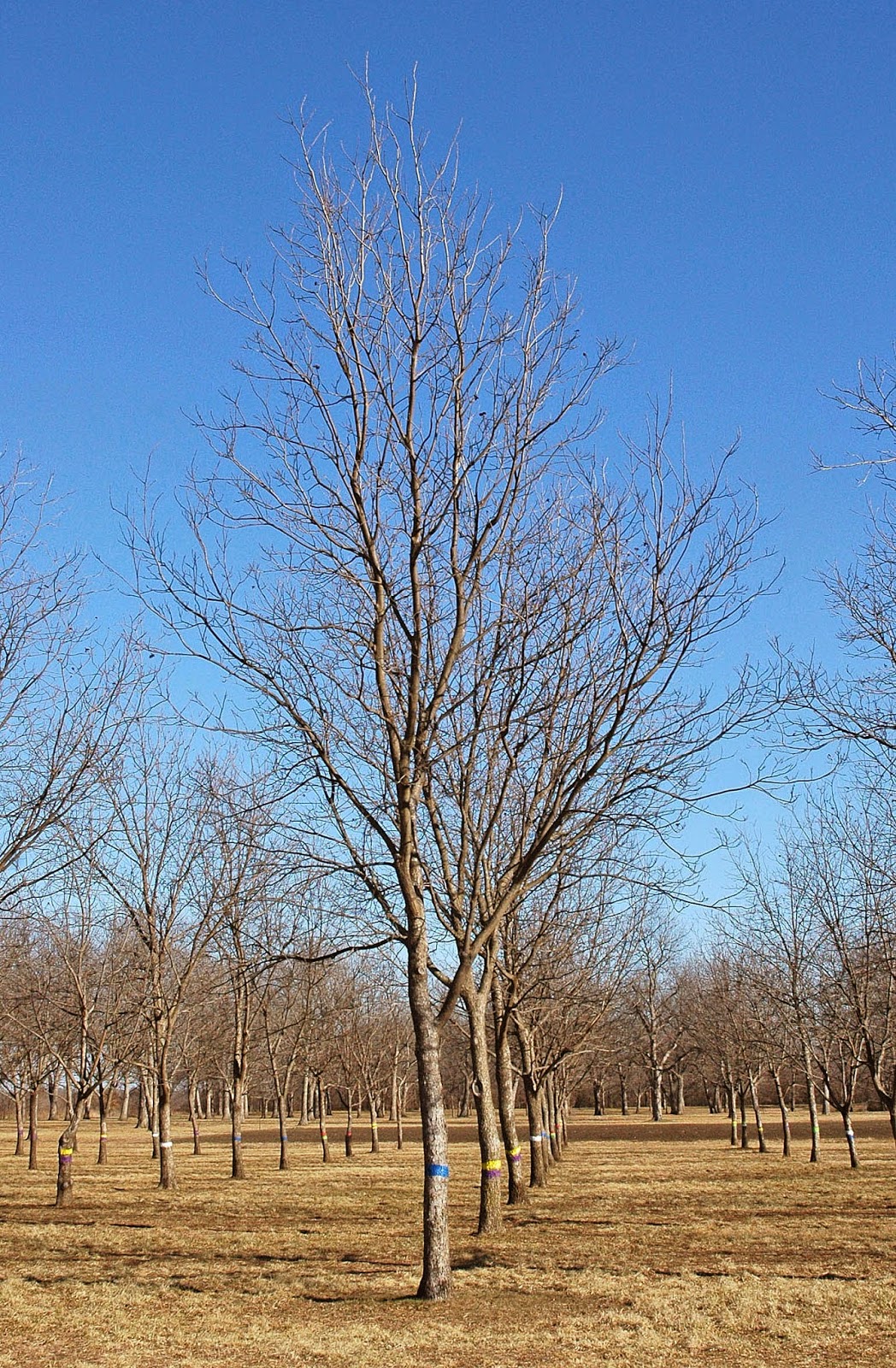
Every year we experience several days of unseasonably warm weather during the last week of January. This year was no different. On Wednesday (28 January), the sun was shinning and the temperatures topped out above 70 degrees F (21 C). It was a great day to wrap up the second harvest in many area pecan groves. In the photo above, a local pecan grower employed a swarm of harvesters to cover the ground as quickly as possible.
Labels:
harvest
Monday, January 26, 2015
Pecan nut casebearer's winter home
Mid-winter is not the usual time to be thinking about pecan nut casebearer, an early-summer, nut-feeding insect pest (photo at right). But if you have been a regular reader of this blog, you will know that we spend a lot of time monitoring this insect during the months of May and June. I have even placed a special tab at the top of this blog so you can follow the progress of moth flight and first significant nut entry each summer. But have you ever wondered where and how the pecan nut casebearer overwinters?
Yesterday, I was looking at a pecan twig under a dissecting microscope and I found the casebearer's winter home. Nestled at the base of a pecan bud was a small partially grown caterpillar wrapped in a protective case called a hibernaculum. In the photo at left, note how small the hibernaculum is compared to the dormant pecan bud and leaf scar. No wonder it is nearly impossible to spot hibernacula in the field.
The larva will emerge from its winter home shortly after budbreak and begin feeding on the expanding new pecan shoot. Once the larva grows to full size it will pupate in the stem of the damaged shoot. An adult moth emerges from the pupal case in May and is part of the generation of moths we catch in pheromone traps. This generation of moths eventually lay eggs on nut clusters in early June.
Saturday, January 24, 2015
Similar but different: Pawnee, Faith, and Gardner
We have three pecan cultivars growing at the Pecan Experiment Field that are so similar they are hard to tell apart. Look at the photo at right. Pawnee, Faith and Gardner nuts have the same basic shell appearance with all three nuts sharing a similar apex shape. However, a closer look reveals some differences. On average, Faith nuts are slightly smaller than Pawnee. Gardner is also smaller than Pawnee and the nut is rounder in cross section. Handle a Gardner nut and you'll find the nuts are not a flat as Pawnee or Faith nuts.
Inside the shells of these three cultivars you will find kernels that also look very similar (photo at left). Pawnee, Faith, and Gardner all yield over 57% kernel and produce quality kernels. Look carefully at all three cultivars and you will see the same light brown mottling on the surface of the kernels. However, this slight kernel discoloration doesn't seem to deter brisk sales for these nuts.
The rounder shell shape of the Gardner pecan is also reflected in the shape of the kernel. Gardner kernel halves are narrower but thicker than Pawnee and Faith.
Pawnee is a USDA cultivar created by crossing Mohawk with Starking Hardy Giant. Faith originated from an open pollinated Mohawk seed planted in Arkansas City, KS. Gardner was found as a roadside tree of unknown origin and growing in Gardner, KS.
Thursday, January 15, 2015
Tree architecture varies between pecan cultivars
| Osage, narrow and upright |
Often overlooked in discussions of pecan cultivars is a scion's natural tree architecture. Does a tree have an upright or spreading canopy? Do limbs grow out at nice wide angles or are branch angles narrow and prone to breakage? For anyone that has tried to train a young, grafted tree you soon learn that some cultivars are far easier to train into a central leader tree than others.
| Greenriver, vase-shaped |
Each cultivar has a distinctive growth pattern. Today, I took advantage of a warm sunny day to photograph the architecture of a few cultivars. I chose these cultivars to give you a feel for the variation we see among pecan cultivars. It is difficult to quantify pecan tree forms but look at enough trees of the same cultivar and some descriptive words come to mind.
Osage is a narrow, upright growing tree prone to forming narrow branch angles. Giles is just the opposite. Giles trees grow wide, sprawling canopies that produce drooping branches. Greenriver produces a vase-shaped tree while Chetopa forms a rounded canopy.
| Chetopa, rounded canopy |
| Giles, sprawling canopy |
The trees pictured above are all twenty years old. Does tree architecture change as a tree ages? If the wind, ice, and lightning don't cause major structural damage, the growth form of a cultivar remains fairly consistent. The photos below show a 20-year-old Kanza tree in comparison to a 50-year-old Kanza tree. The older tree is more than twice the size of the younger tree but you can easily see how both trees share the same pattern of tree growth.
Subscribe to:
Posts (Atom)