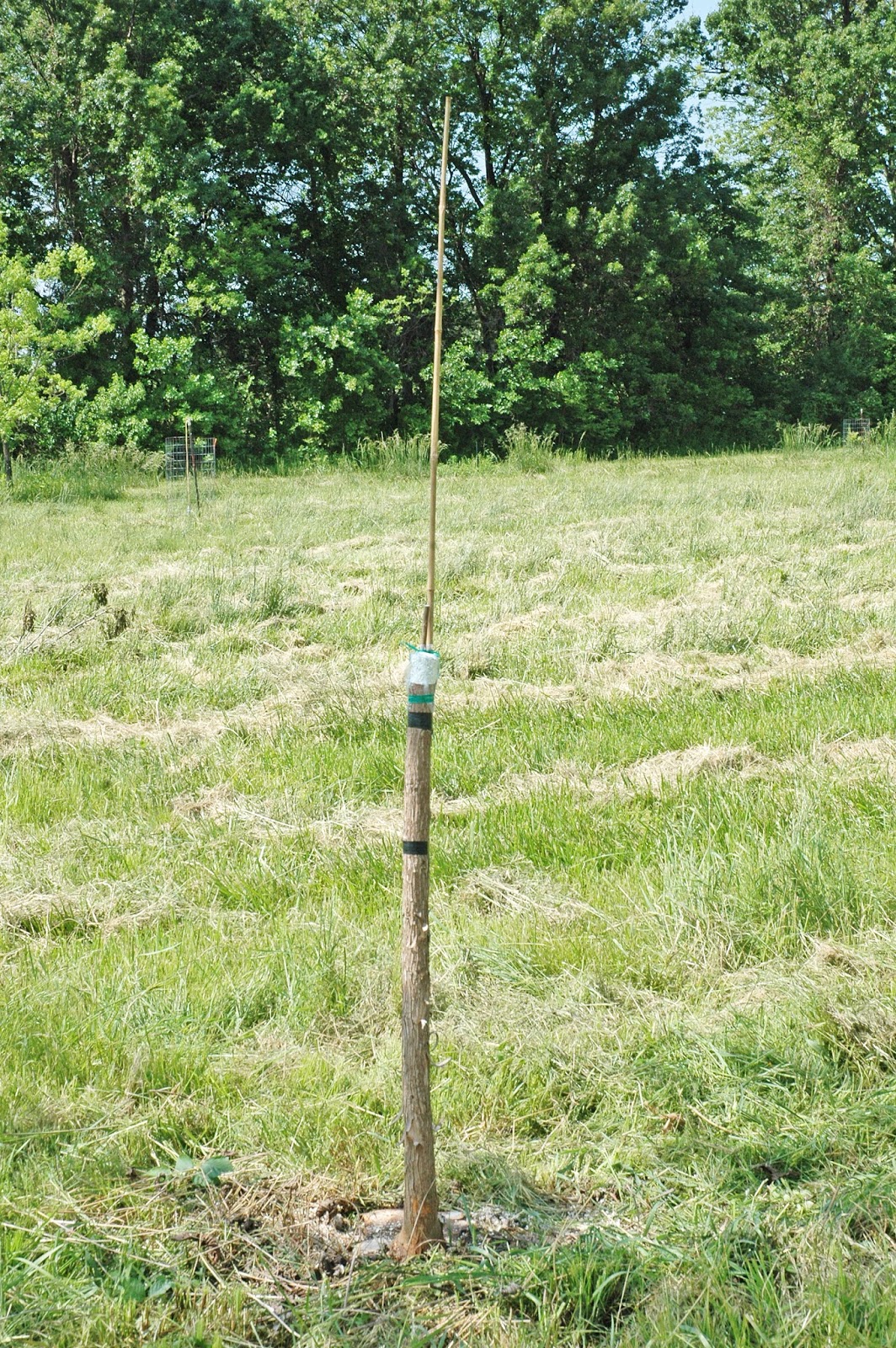
This year, I made my first pecan graft on Sunday April 24th. Exactly three weeks later (May 15th), I checked on one of those early grafts and found buds bursting from the scion (photo at right).
During the past three weeks I've been grafting pecan trees almost every day. I've grafted trees at the Pecan Experiment Field, during grafting schools, and on my own farm. The weather forecast for this coming week is cloudy, wet, and cool--great grafting weather. At every break in the rain, I'll be outside grafting even more trees.
One of the most frequent questions I receive during grafting schools is--"How long can I keep grafting?" The answer, like almost every outdoor activity, is that it depends on the weather. The grafting season ends when daytime high temperatures start to climb into the low 90's F. High heat seems to literally cook newly placed grafts to death. In the past, hot weather occurred as early as mid-May in SE Kansas. Most years, the heat will hold off until June.
I watch the long range forecasts to see when weather experts predict the first real heat wave. If a week of mild temperatures is forecast before the heat hits, I'll keep on grafting. If a heat wave is immenant, making additional grafts is not a good idea.
Monday, May 16, 2016
Thursday, May 12, 2016
Coppicing before re-grafting a large pecan tree
Last year, I placed 9 bark grafts in a large tree in an effort to change a seedling tree into tree that would produce large, high-quality nuts (photo at right). Today, I spent nearly 90 minutes up in a hydraulic lift moving from graft to graft, trimming each graft union, and removing new sprouts growing on the trunk and main scaffold limbs. I can't imagine how long this task would take if I had to use a step ladder to access these graft unions.
The hazards associated with grafting, pruning, and training a top-worked tree from the top steps of a ladder are obvious. No tree is worth broken bones and a extended recovery period. If you would like to graft a seedling tree that has grown too large for conventional grafting methods or you end up changing your mind on a previously grafted tree, consider coppicing the tree at ground level.
The practice of coppicing works pretty well for trees that have not grown over 10 inches in trunk diameter. Out in our pecan breeding plot, I've been removing trees that produce poor quality or scab susceptible pecans. As a result I have produced dozens of coppiced trees. The photo at left shows the current size of many trees in the breeding plot compared to a tree that was cut at ground level a couple of years ago.
In the two years since cutting the tree at ground level the tree has sprouted multiple stems from the stump (photo at right). The tallest sprouts have already grown to over seven feet in height. These fast growing shoots make excellent sites for bark grafting, and I can even make the graft with two feet firmly on the ground.
Take a close look at the sprouts growing from the coppiced tree (photo at left). The sprouts are all growing from around the outside edge of the stump. These sprouts actually arise from epicormic buds buried under the bark of the stump.
Before grafting this tree, I trimmed off all but the most vigorous sprout. Using my chain saw I cut off all competing sprouts at the same height as the stump (photo at right). The white wood in the photo reveals the location of the removed sprouts. The dark (stained) wood is the original tree stump.
Once all competing sprouts are removed I have what looks to be the perfect tree for bark grafting (photo at left). But be forewarned. The stump will produce additional sprouts this coming summer and I'll need to add stump-sprout removal to my list of summer pruning tasks.
I usually recommend leaving a couple of lower limbs below a bark graft. However, this sprout had grown so rapidly that the lowest limbs were all above my preferred graft height. I figured that this tree had already survived coppicing, so a brutal cut for placing a bark graft couldn't hurt. I placed the graft at a comfortable height for both grafting and for summer training of the sprouted scion. Judging from the vigor of the stump sprout, this scion should make at least 4 to 5 feet of new growth this summer. I'll need to watch this tree carefully. Summer pruning to ensure a central leader and careful tying to a strong stake will be critical for graft success.
Labels:
grafting
Wednesday, May 11, 2016
Mid-way through pecan pollination season
Looking over at the terminals of the Gardner tree's new growth I found numerous clusters of pistillate flowers (photo at left). Gardner, like all protandrous cultivars, produce pistillate flowers late in the pollination season. The stigmas of Gardner flowers turn red and glossy when receptive to pollen. The flowers pictured at left are just about ready to capture pollen from the air.
In contrast, the pistillate flowers of protogynous cultivars have already been pollinated. The photo at right shows a cluster of Posey pistillate flowers. The stigmas of Posey flowers are green in color but note the the upper edges of the stigmas are starting to turn brown and look dry. This is the first sign that these pistillate flowers have received pollen and are on their way to setting a nut crop.
The pollen sacs on Posey catkins are only now starting to turn from green to yellow (photo at left). It won't be long before these pollen sacs will begin to open and release the pollen needed to fertilize the pistillate flowers of protandrous cultivars like Gardner.
Labels:
flowering
Thursday, May 5, 2016
Pecan pollination season rapidly approaches
Yesterday, I took a quick trip around the Pecan Experiment Field to check for pistillate flowers (female flowers) on our pecan trees. The catkins or the male flowers have been out for some time but the female flowers are just now starting to show themselves at the ends of new shoots on protogynous cultivars. Lets take a look at the 2016 pecan pollination season as of 4 May 2016.
The first thing I noticed was that early pollen shedding cultivars (protandrous), like Pawnee, had large fully developed pollen sacs (photo at right). The pollen sacs will eventually turn yellow just before they split open and release millions of pollen grains into the air.
In contrast, late pollen shedding cultivars (protogynous) have long narrow catkins with pollen sacs that are still far from obtaining full size (photo at left). It will be a couple of weeks before pollen is released from these Kanza catkins.
The only pistillate flowers I could find yesterday appeared on protogynous cultivars. In looking at several cultivars, I found flower clusters in several stages of development. Pistillate flowers on some cultivars were just beginning to peak out of a terminal's new growth (City Park, photo at right), while others had fully formed flower clusters (Mullahy, photo below). I was very glad to see a good pistillate flower crop developing on my Kanza trees (photo below).
| Pawnee catkins |
| Kanza catkins |
In contrast, late pollen shedding cultivars (protogynous) have long narrow catkins with pollen sacs that are still far from obtaining full size (photo at left). It will be a couple of weeks before pollen is released from these Kanza catkins.
| City Park pistillate flower cluster |
| Mullahy pistillate flower cluster |
| Kanza pistillate flower cluster |
Labels:
flowering
Subscribe to:
Posts (Atom)