Friday, May 31, 2013
Just another Spring flood
Over the past two days we've had 5 inches of rain in the Chetopa, Kansas area. Two to three more inches are predicted for tonight. At this point the Neosho River has already spilled over its banks and many area pecan groves are covered in flood water (photo above). Last year, a Spring flood helped recharge subsoil moisture in our drought stricken pecan groves. In fact, the flood we had on May 2, 2012 was largely responsible for helping make the 2012 pecan crop possible during a year of record heat and drought. So this year, we welcome another Spring flood to help fill up the subsoil water reserves we may so desperately need come August.
Labels:
flooding
Thursday, May 30, 2013
Yellow pecan aphids and natural biological control
When I travel to pecan meetings in the south, I often hear horror stories of massive yellow pecan aphid outbreaks in the early part of the growing season. At high populations, these sap feeding insects can literally drain the life out of pecan leaves.
Fortunately, I have never seen a springtime outbreak of yellow pecan aphids in a northern pecan grove. But this doesn't mean that yellow pecan aphids don't occur in our area. This spring, I've spotted a very light population of yellow aphids feeding on the underside of our pecan leaves (photo at left). In the photo, an adult yellow aphid is feeding on sap flowing through the main mid-rib of a pecan leaflet. Above the adult you can see a small yellow aphid nymph moving across the leaf surface in search of a good feeding spot.
While scouting our trees, I also discovered one of the main deterrents to yellow pecan aphid outbreaks . The convergent lady beetle is one of the most common, native, biological-control agents found in pecan-tree canopies (photo at right). Both adults and their larvae actively seek out and feed on yellow pecan aphids.
I stopped scouting for a minute just to watch a lady beetle scurry over the underside of pecan leaves in her endless search for prey (photo at right). I found it a fascinating lesson insect behavior.
![]() |
| Yellow pecan aphid, Monelliopsis pecanis |
![]() |
| Convergent lady beetle, Hippodamia convergens |
I stopped scouting for a minute just to watch a lady beetle scurry over the underside of pecan leaves in her endless search for prey (photo at right). I found it a fascinating lesson insect behavior.
Wednesday, May 29, 2013
Graft placement influences scion vigor
As I traveled around Mid-America conducting grafting schools a few weeks ago, I had the opportunity to see some common grafting errors made by some very well-intentioned pecan growers. One of the most common mistakes folks make is not cutting the stock tree back enough to force rapid growth of the scion. In the photo at right, a 3-flap graft was placed on a side limb of a young sapling. If you look at the top of this tree, the stump visible between the two upper-most shoots was probably the location of a second 3-flap graft that ended up not taking. In any case, the new shoot from the successful graft is only about 8 inches long--way too little growth for a new scion during first year after grafting. The upper portion of this tree should have been pruned off as soon as the shoot on the successful graft was 2-3 inches long (at that point you are certain the graft has succeeded) . All those leaves and shoot growth above the graft only served to slow the growth of the scion.
When I set a graft, I prefer to cut off more of the stock right at the beginning. I know that cutting off so much of a well-tended pecan tree can cause the novice pecan grower a slight panic attack but its for the best. Cutting back the stock drastically helps to focus all the tree's root energy into growing a strong and vigorous scion. The photo at left shows a tree I grafted about 18 inches off the ground. At this height, the stock tree was about 1 1/4 inches in diameter and I used a bark graft to place the scion on the stock. Once the buds on the scion had grown out about 3 inches, I selected the strongest new shoot to become my new central leader and pruned off all the competing scion buds. This photo was taken in mid-July and I had over 3 feet of new growth that could be easily trained to a bamboo stake.
Labels:
grafting,
tree training
Tuesday, May 28, 2013
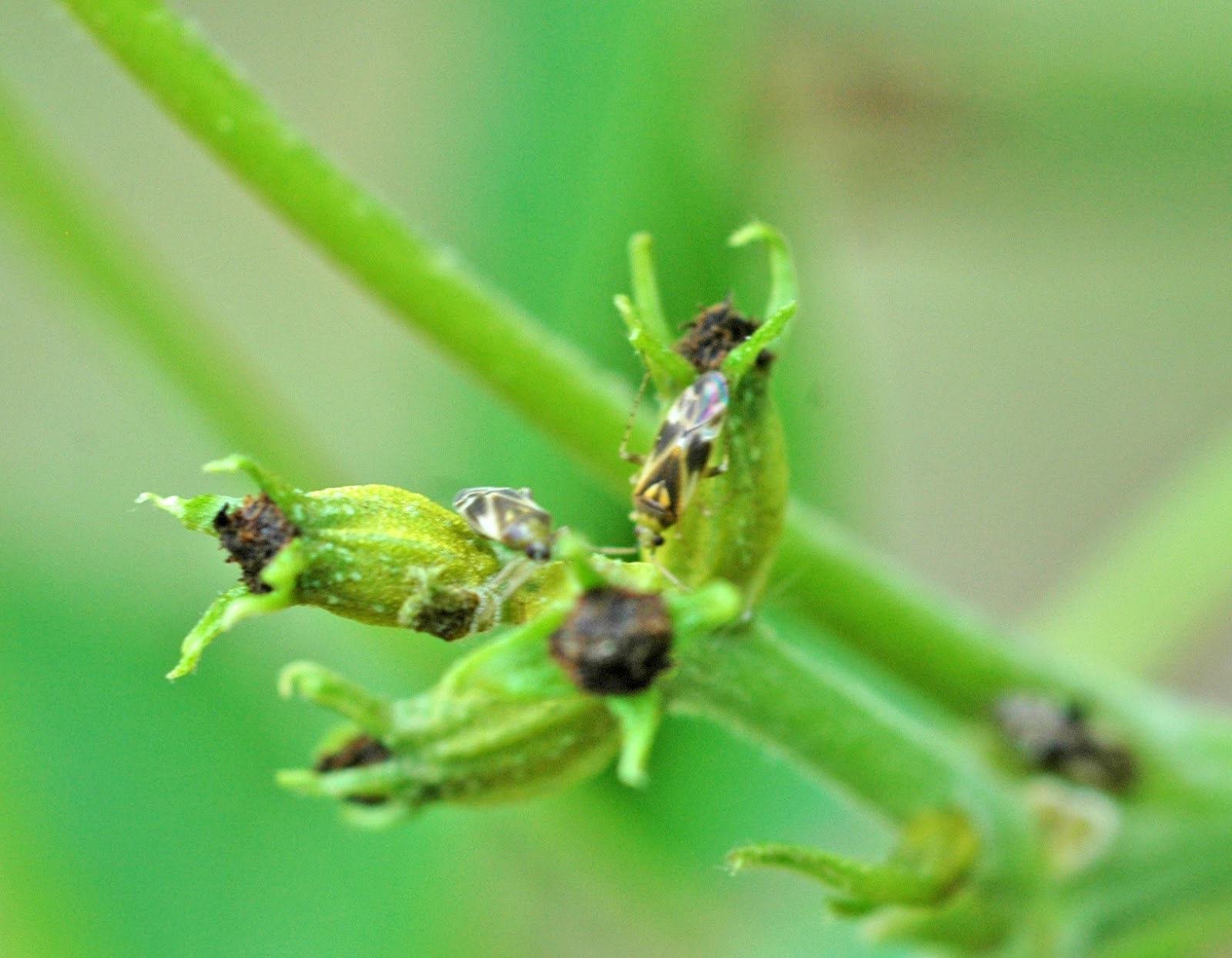
Mirids on flower clusters
At this time of year I like to check on the progress of pecan flowering. While inspecting pistillate flowers, I always spot numerous plant-feeding Mirids crawling around young nutlets. In the photo at right, note the two, mottled-brown insects on the flower cluster. These are examples of the Mirid, Plagiognathus caryae. In the photo, they are using their piercing-sucking mouthparts to feed on plant juices.These insects can also be seen feeding on catkins and expanding leaves. Although they look like they could be damaging, we have found that these insects do not cause significant crop losses.
Labels:
minor insects
Subscribe to:
Posts (Atom)