Wednesday, November 10, 2021

Pecan harvest 2021: A view from the tractor seat

        This past week, I had the pleasure of starting the 2021 pecan harvest. Surprisingly, we still haven't experienced a killing freeze so split-open shucks are still green which has slowed the nut drying process (photo at right). However, our customers are clamoring for new-crop pecans so I decided to get an early start harvesting. These early harvested nuts will just need to dry down further inside a warm and dry barn.


     Back when I worked for K-State, I was able to photograph one of my employees operating the machines we use for pecan harvest. On my own farm, I'm a one man operation, so my view of harvest is confined to the seat of a tractor.  The first step in harvesting pecans is to shake the nuts out of the tree using a 3-point hitch mounted pecan shaker (photo at left). I hydraulically clamp the shaker onto the trunk of the tree then engage the power-take-off to rotate weights inside the machine. The moving weights create a back-and-forth motion which vibrates the entire tree. It only take a few seconds before nuts start raining down to the ground.
 

    When I purchased my shaker I was sure to get one equipped with  donut pads rather than hard rubber pads. With the super-thick donut pads I'm able to shake trees  when they first start cropping  (photo at right). With a tree as small as the one pictured at right I go easy on the throttle and give the tree just a few short bursts of light vibration.

Once I've shook a good number of trees, I hop into my picking tractor. I use a Savage pull-type pecan harvester to sweep pecans up from the ground (photo at left).  When harvesting pecans I always start outside the drip-line of the tree's canopy and work my way towards the trunk. One important thing to remember when operating a Savage harvester is that you can only make right-hand turns (a sharp left turn while the machine is running will break drive-line bearings).
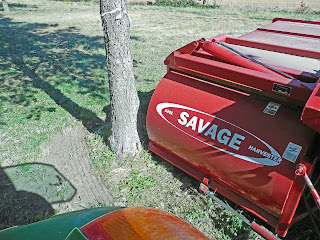
   When I'm harvesting, I sit sideways on the tractor seat so I can keep my eye both ahead and behind. I've found that I've got to especially watch the front right corner of the harvester. To harvest as many pecans as possible, I need to steer as close to the trunk as I can without ramming the machine into the base of the tree. Since the harvester trails well outside of my right rear tractor tire, learning how to avoid hitting trees take a little practice.
    Once I've filled the hopper on the harvester with pecans, I'll drive up to my barn and dump the nuts into my pecan cleaner. When conditions are perfect for harvest, I'll keep harvesting during daylight hours then switch over to cleaning when the sun goes down.  Needless to say, I put in a lot of long days during the harvest season.


Monday, October 18, 2021

Fall pecan tree planting


     Earlier this month, I drove over to Elsberry, Missouri to see my friends at Forrest Keeling Nursery and to pick up some of their container-grown pecan seedlings. This week the weather has been perfect for planting those trees.

    The first step in planting a container-grown tree is to dig a hole about the same depth as the pot (photo at right). I also dig the hole larger than the diameter of the pot which ensures that I have plenty of room to pack soil around the root ball.


      When planting container-grown pecan trees I always check for circling roots that have grown at the bottom of the pot (photo above). Allowing these roots to remain in a tight circle can cause major problems for the tree as it becomes re-established in the orchard.  As the tree grows these circling roots can grow to girdle each other and cause slow tree decline.


    Before planting the tree, I pull large circling roots away from the root ball and prune them off (photo above).  Once the tree starts growing in the orchard, new roots will form at each pruning cut. These new roots will grow straight downwards into the soil and eventually form multiple tap roots.


    Before setting the root ball in the hole, I shake off all loose potting soil. This will expose a lot of the root system's fibrous roots and force them to grow into the surrounding soil (photo at left).  As I fill soil into the hole, I carefully pack soil all around the root ball. By shaking off all loose potting soil, the root ball appears to sit about 1 to 2 inches below the surface of the soil. Once I've filled in all around the sides of the root ball, I'll cover the root system with a 1 to 2 inch layer of soil. Covering the root ball with my native silt loam soil will slow water evaporation from the potting soil that's still clinging to the tree's roots.

     I've learned that these container-grown trees are extremely attractive to deer for browsing. In the past, I've even had deer pull a freshly planted tree out of the ground.  So before moving on to planting another seedling pecan tree, I cover the tree with a cage made of 4" x 2" welded wire fencing that is 4 feet tall (photo at right). To hold the cage in place, I tie it to a steel fence post. You might also note that I used all the loose potting soil that I removed from the root ball as a mulch for the tree. 


Saturday, October 16, 2021

Fall fertilization: Fertilizer prices have skyrocketed!


     This past week I applied my regular fall mix of fertilizers to my pecan grove-- equal parts of urea, di-ammonium phosphate,  and potash. I am a firm believer in fall fertilization for reducing alternate bearing of pecan trees, but this year, I was shocked by the price I had to pay.

    Late last Spring the price of fertilizer and pest control chemicals started to rise. Prices continued to rise all summer and now, this Fall, the same amount of fertilizer that I applied in Fall on 2020 cost more than twice as much in 2021.  We've seen spikes in fertilizer prices in the past but I think this year must be setting a record for percent increase over the previous growing season.

  After getting over my initial shock, I realized that, if I want to keep my trees on the road toward increased nut production, I  had to invest in fertilizer even at inflated prices.  I've been growing pecans for 40 years and one thing that I've learned is that a consistent fertilizer program is the most important input that can be made to ensure annual nut production.

Sunday, August 22, 2021

Spraying for weevil control


     Its been a relatively dry summer this year so I decided to delay making my first weevil spray until after we got a good soaking rain. Well, during the early morning hours of August 21st we received our first good rain (0.96 inches) in several weeks. This rainfall event should allow pecan weevils to emerge from their underground cells and find their way to the nearest pecan nut cluster. The photo above shows both a female (longer snout) and male adult weevils.

   The first order of business for these insects is to move to a pecan nut cluster in the hope of finding a weevil of the opposite sex. After mating, the female will start puncturing pecans to discover if the nuts are suitable for egg laying. She will not deposit eggs inside the nut until the kernel inside has entered the gel stage.


    I cut several pecans open today and found that even early-ripening cultivars were still in the water stage (photo at left). As I mentioned in my previous post, pecan kernel development is much later than normal the year due to unseasonably cool Spring temperatures.

    The combination of a concentrated weevil emergence due a triggering rainfall event and a nut crop not ready for weevil oviposition means that weevils will just keep probing nuts until kernels start to firm up inside the shell. A pecan that gets punctured during the water stage will drop off the tree (both weevils and stink bugs cause nut drop).

    To prevent a possible significant amount of weevil induced nut drop, I decided to spray my orchard with and insecticide. In spraying the orchard, I started at dawn this  morning (22 Aug 2021) and quit around 10:30 am as air temperatures climbed above 85 degrees F. The forecast for tomorrow is afternoon temperatures in the mid 90's (F), so I'll be getting up early tomorrow morning to finish the job. 

    With cooler temperatures and high humidity, early morning is the best time for spraying. The water droplets that blow out of the sprayer stay airborne longer and do a better job at coating all the surfaces of the pecan tree's canopy. For this weevil spray I used Warrior II insecticide. I'll probably spray again in 10 to 14 days depending on soil conditions and rainfall patterns.