Thursday, November 3, 2011

Waiting for harvest

     Pecan leaves have turned golden yellow and are starting to fall from the trees (photo above). Our pecan shakers are all greased up and the broken fingers in our pecan harvesters have been replaced. In short, we are all ready to start the 2011 harvest season but the nuts just aren't ready yet. 
     Even though most shucks have been split for several weeks now, we still have too many green shucks to start harvest (photo at right). We could shake our trees today and the harvester would beat off the green shucks but the harvested nuts would be full of moisture. Wet nuts turn into moldy nuts and we can't afford to degrade the quality of the crop just because we are anxious to get the harvest started.   
     If you pull off one of the green shucks, you can actually see moisture trapped between the nut and shuck (photo below right). A pecan will not dry completely until the shuck has turn dark brown and lost all its moisture.  A good hard freeze (26 degrees F or below) is what we really need. Cold temepratures would kill the remaining green tissues in the shuck and allow both shuck and nut to dry quickly.  

Tuesday, October 25, 2011

Shuck split date and young pecan trees

    For northern pecan growers, the date of shuck split is one of the most important cultivar attributes we measure. Pecan cultivars that are well adapted for production in our area, split shucks at least one week before the average date of first fall freeze.  Late ripening cultivars usually suffer from poor kernel fill, fuzzy kernels, or "stick-tights" (pecans frozen in the shuck).
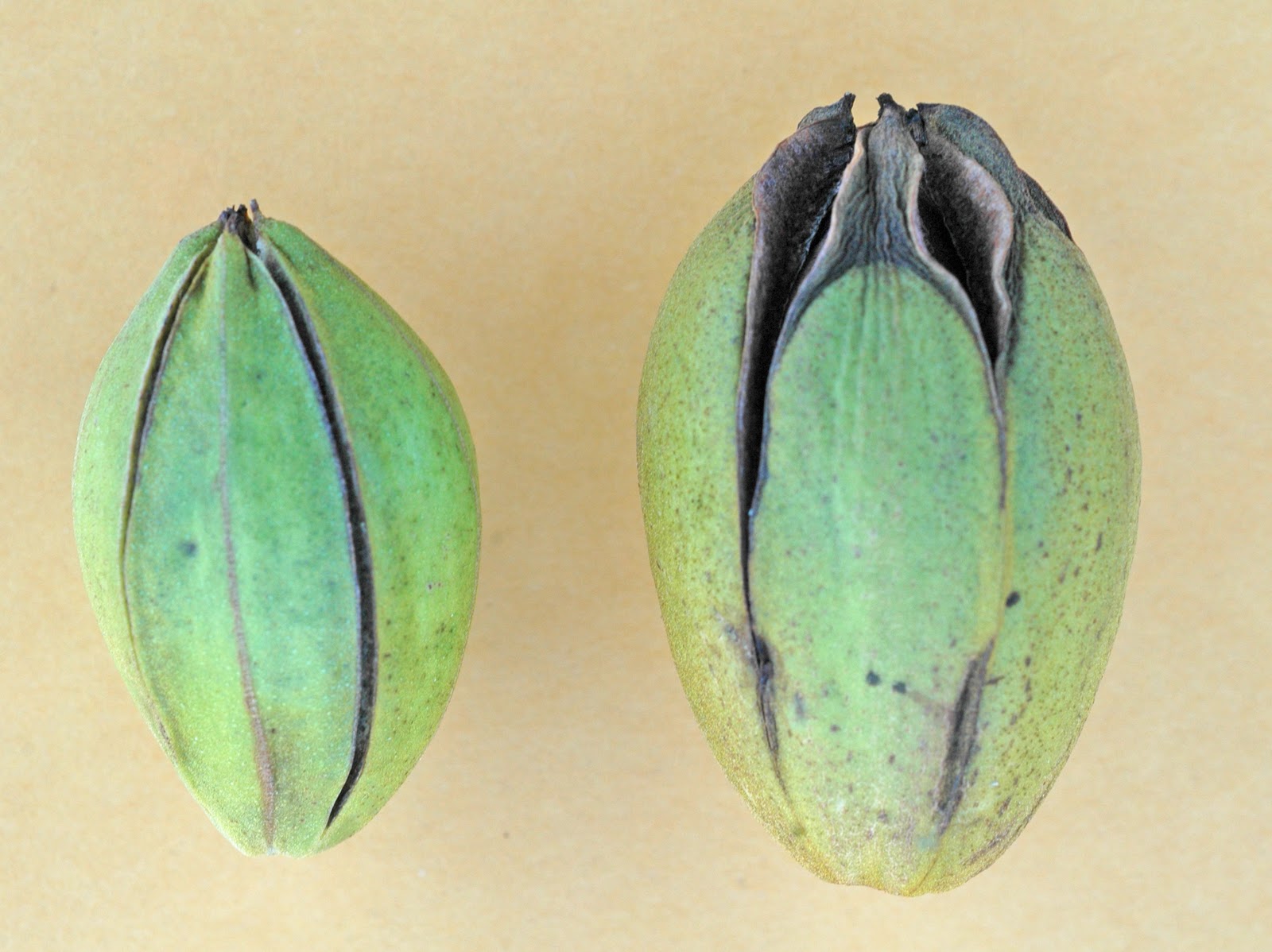
    In testing new cultivars, we are always anxious to discover the average date of shuck split. However, we have learned to be a little patient before coming to any conclusions about ripening time. In the photo above, you see two clusters of pecans. Both clusters were collected on the same day and from the same cultivar--Lakota. The cluster on the left was taken from a young tree (4 inches in diameter) while the one on the right was taken from a tree 28-years-old (12 inches DBH). In previous posts, I've talked about tree age and drought stress and how pecan trees grow to dominate the landscape. Here is another example of how young trees can differ from mature trees.
     Lakota pecans taken from the mature tree have been split for a good two weeks. Note the browning of the shuck near the tips and along the edges of each shuck quarter (pecan on right). In contrast, only one of the 5 nuts in the cluster cut from a young tree shows any signs of shuck split (pecan on left).
      Break off the shucks and you can see further evidence that pecans produced by young trees have delayed nut maturity. Full shell color has not yet developed (nut on left) as compared to the pecan collected from the mature tree (nut on right).
    It is no wonder why it takes so long to develop and test a new pecan cultivar.  Only trees that have grown large enough to "dominate the landscape" provide reliable nut size and maturity date information.

Friday, October 21, 2011

Harvesting intercrop soybeans

    Today we harvested the soybeans planted in our intercrop study. If you've been following this blog, you know that I've described the double-row intercrop system  in a previous post and also posted photos of this Spring's soybean planting. Like every field crop planted in SE Kansas this year, our soybean crop suffered from a lack of water. Yield was well below normal for full season beans. The final tally was 23 bushels/acre sold at $11.62/bu.

Thursday, October 20, 2011

Pecan cultivar performance in the Bootheel

   Several years ago I started a cooperative pecan cultivar trial with Rick and Cindy Faulkner down in the Bootheel of Missouri. This fall, the young trees in the trial have started to bear a healthy crop of nuts. Pictured at right is a USDA clone 75-8-9 which bore a light crop and showed only a touch of scab.  Of all the cultivars under test at this location, Lakota, Kanza, Gardner and USDA 75-8-5 were the first cultivars to bear full crops with nuts hanging throughout the canopies.

    I visited the Bootheel in early October and found that Lakota was fully shucksplit (photo at left) at that time. That's great news for SE Missouri pecan growers.  It looks like scab-resistant Lakota will be well adapted to the SE Missouri growing season.
      Kanza is another scab-free cultivar that is doing well in the Bootheel (photo right). However, an increasing  problem facing pecan producers in the Mississippi Delta are the many species of kernel feeding plant bugs that attack pecan. In the photo at right, a leaf-footed bug is feeding on a Kanza nut even at shuck split.
    Plant geneticists have created genetically altered cotton and soybeans cultivars resistant to boll worm and pod worm. This has dramatically reduced the amount of pesticides applied to these crops in the Bootheel. However, with fewer sprays, plant bugs flourish and multiply in cotton and soybean fields. When these field crops mature, plant bugs look for alternative plant hosts on which to feed and pecan fits the bill.