Showing posts with label shucksplit. Show all posts

Thursday, October 24, 2024

Fall color in the pecan grove


Kanza tree, 24 Oct. 2024

        Most years we experience a hard freeze in late October that causes the complete defoliation of green leaves from our trees. This year, the combination of warm fall days and drought conditions has caused pecan leaves to remain on the trees and turn golden yellow (photo above). 

Kanza nut cluster, 24 Oct. 2024  

     A hard freeze will also kill pecan shucks, turning them black, and promoting shucks to fully open. This year is different. The shucks are slowing drying exposing the ripe pecans inside. In the photo at right, you can see that the tips of the shucks are fully dry and have turned brown while areas of the shuck closer to the base of the nut are still green. These Kanza nuts should shake out of the tree easily and separate from the shucks allowing me to start harvesting tomorrow.


Labette, 14 Oct. 2024

     During early October, I continued to monitor the shuck split dates of all the seedling trees in my breeding block. Labette, one of the cultivars I developed, ripened on 14 Oct. 2024 (photo above). While I was observing shuck-split this year, I observed that the deeper we descended into drought this fall to more shuck-split was delayed on later ripening clones. Labette provides a good example. Labette matured on October 9 in 2023 but 5 days later in 2024.  


Sunday, September 22, 2024

Pecan shuck-split underway


Earlton, 13 Sept. 2024


     Each Fall, I scout my pecan orchard to record the date of 50% shuck-split for each cultivar and breeding selection. As usual, Earlton was the first cultivar to split shuck (photo at right). The first indication of shuck-split is not terribly dramatic. A hairline crack appears in the shuck along the sutures. The shuck will need time to dry a bit before the shuck actually opens up (see below).

Earlton, 20 Sept. 2024


     One week after I first noticed shuck-split on Earlton, the shucks had dried enough to fully reveal the nut inside the shuck (photo at left). I even noticed one Earlton pecan ready to fall to the ground.


    The photos below represent all the pecans that have ripened during the past week. They are published in order of ripening. As a general observation, pecan ripening seems earlier than normal this year.  

   Earlton, Caney, Liberty and Thayer are cultivars originating from my breeding project. Selections numbered starting with "KT" are unnamed clones from that same breeding program.


Caney, 16 Sept. 2024


Liberty, 16 Sept. 2024

USDA 61-1-X, 16 Sept. 2024

Thayer, 18 Sept. 2024

KT121, 18 Sept. 2024

KT307, 18 Sept. 2024

Gardner, 20 Sept. 2024

Pawnee, 20 Sept. 2024

USDA 96-2-140


Wednesday, October 18, 2023

Pecan cultivars that ripened in October

Jayhawk, 4 Oct. 2023  

      In my area of Kansas, pecan cultivars must ripen by mid-October to reliably split open their shucks before the first killing freeze in the Fall. Pictured here are some of the cultivars that ripened during the first 2 weeks of October in my orchard.

Shepherd, 6 Oct. 2023

KT330, 6 Oct. 2023

Labette, 9 Oct. 2023

St. Paul, 13 Oct. 2023

Notes: 

    Jayhawk -- an open-pollinated seedling of Giles

    Shepherd -- a native seedling from Central Missouri

    KT330 -- a selection from my breeding project. The result of a cross of Pawnee and                                 Greenriver.

    Labette -- tested as KT334 from my breeding project. A cross of Pawnee and Greenriver. 
 

    St. Paul -- tested as KT201 from my breeding project. A cross of Pawnee and Major.


Monday, October 2, 2023

Pecan cultivars continue to ripen as we head into October


Kanza, 2 Oct. 2023
  This year I recorded October 2nd as the ripening date for Kanza. My Kanza trees have produced an excellent crop this year as you can tell by the photo at right. When Kanza first splits open, the shucks hardly open up. All you will see is a slight crack between shuck quarters. During most years, it is a killing freeze that finally kills the green husk and allows Kanza nuts to fall free at tree shaking. 

   I found several other pecan cultivars that ripened at the same time as Kanza. Their photos appear below.

Hark, 2 Oct. 2023

Pleasanton, 2 Oct. 2023

Yates 68, 29 Sept. 2023


Wednesday, September 27, 2023

Cultivars that ripen on the same day as Pawnee

Pawnee, 27 Sept. 2023.
     Pawnee is one of the most popular pecan cultivars adapted to short season climates (photo at right). Large nut size and early ripening are the main positive cultivar characteristics for Pawnee. Severe susceptibility to pecan scan disease is the primary production drawback.

     Since Pawnee is so widely known by pecan growers across the nation, I think it is important to look at a few other cultivars that ripened on the same day as Pawnee (photos below) This year, my Pawnee trees split shuck on 27 Sept. 2023.

Gardner, 27 Sept. 2023


Waccamaw, 27 Sept. 2023

Cultivar Notes:

1. Gardner was found as a chance seedling in Gardner Kansas. This cultivar is very similar in size and appearance to Pawnee but I prefer the nut quality of Gardner over Pawnee. Gardner is susceptible to pecan scab but is not as severely effected as Pawnee.

2. Waccamaw originated as a chance seedling grown in Golden City, MO. Waccamaw nuts are similar in size to Pawnee. I'm still evaluating this cultivar for its reaction to the pecan scab fungus.

Tuesday, September 26, 2023

Pecan shuck split dates for of early ripening cultivars

     This fall, timely rain showers have helped pop open pecan shucks on a more normal schedule. Over the past week,  I've been photographing each cultivar on the day I find at least 50% of nut shucks on the tree split open. Below you will find photos of named cultivars, USDA advanced selections, and a few numbered selections from my breeding project. 


Caney, 22 Sept. 2023

USDA 92-2-148, 22 Sept. 2023

KT121, 22 Sept. 2023

Liberty, 23 Sept. 2023


USDA 61-1-X, 23 Sept. 2023

Thayer, 25 Sept. 2023

KT307, 25 Sept. 2023


Notes on cultivars shown above:

1) Caney, Liberty, and Thayer are cultivars I've named from my pecan breeding project. Caney was tested as KT129, Liberty was tested as KT316, and Thayer was tested as KT255.

2) the two USDA clones have not been named and may never be given names. 

3) the clones KT121 and KT307 are from my breeding project. At this point, I'm still evaluating them but they look promising. All of my breeding selections are labeled starting with KT which is simply short for Kansas Tree.  The numbers denote the row and tree number in my pecan breeding block.

4) I've decided to name all my pecan cultivars in honor of small rural towns located in SE Kansas.

Saturday, September 16, 2023

Earlton: First cultivar to ripen in 2023

Earlton, 15 Sept. 2023

     It has been a long hot summer with just barely enough rainfall to produce a pecan crop.  Our dry summer weather has created smaller than normal pecans with some kernel filling issues. However, this year my pecans seem to be ripening normally. As expected, Earlton was the first cultivar in my orchard to split shuck (photo at right). Earlton originated from my pecan breeding project and is the result of a controlled cross between  Pawnee and Greenriver.


    The first pecan tree to ripen in any pecan grove often suffers from immense wildlife pressure. While I was collecting a nut sample from Earlton, I spotted the tell-tale signs that a bushy-tailed thief had stolen a pecan right out of the shuck (photo at left). Note that a portion of the shuck was chewed off to allow better access to a fully ripened pecan (now gone).


    On closer inspection I noted a pile of shucks at the base of the tree (photo at right). Squirrels often cut off an entire nut cluster then bring the cluster down to the base of the tree to remove the shucks. Once they free a pecan from the shuck they scamper back up the tree with the pecan to eat the nut or cache it away for future use. They definitely don't take the time to eat the pecan while on the ground; That would put them in danger of being eaten themselves by a hawk, owl, or coyote. Note that you can't see any shell fragments amonst the green shucks. It clear all these pecans where taken elsewhere.

   I will be checking nut ripening 3 times per week this fall. It will be interesting to see how the other cultivars in my orchard split their shucks in comparison to previous years.

Tuesday, October 18, 2022

Erratic shuck-split during this drought year


Caney, 15 Oct 2022
    Our local weatherman is predicting a strong cold front to drop temperatures into the low 20's by tomorrow morning. Once that happens, the 2022 pecan growing season will come to an abrupt end. Pecan leaves will freeze and drop from the tree. Nuts that have not shuck-split at this point will be frozen in the shuck to cause what is commonly called "stick-tights".

   Because this massive cold wave has been predicted for some time now, I made sure to scout my pecan grove for shuck-split last weekend. All of the photos presented in this post where taken on  Saturday, Oct. 15th. All of the cultivars pictured normally ripen ripen much earlier, in late September or very early October. This year's extended and deep drought has changed everything.


Kanza, 15 Oct. 2022
   I was very pleased to see Kanza split (photo at left) on most of my trees. However, I noted that most of the younger Kanza trees (< 6 inches DBH) were still tight in the shuck. It is likely that the younger trees had more difficultly in competing with the ground cover for water. And without adequate water, the shucks can't open.

    Since Kanza represents about one half of my total production, it looks like I'll have some nuts to sell this Fall even if they are much smaller than normal (drought decreased nut size).


Gardner, 15 Oct. 2022

       Unfortunately, some cultivars are were not even close to opening their shucks. Gardner (photo at right) usually ripens at the same time as Pawnee in Late September. This year Gardner nuts are smaller than normal and have adequate kernel fill. The shuck has separated from the shell but it has not split open. It will be interesting to see if the freeze will pop Gardner shucks open. If not, I'll be amassing a huge pile of stick-tights  for the burn pile.

Thayer, 15 Oct. 2022

    This year, several cultivars are demonstrating a wide variation in shuck development within a single nut cluster. The cluster of Thayer pictured at left illustrates this observation. Note that the largest nut in the cluster is split while the three smaller nuts are still tight in the shuck. After tomorrow's deep freeze, will I have just a single saleable nut to harvest from this cluster. By next Saturday, when I scout the orchard again, I'll get a better idea of crop losses due to this early hard freeze. 

    The 2022 growing season in SE Kansas has proven to be one for the record books, and not in a good way. I keep thinking back to 2007 when we suffered a trio of weather disasters. First we had a late spring freeze that killed emerging shoots followed by the second highest river flood on record in July. The third shoe dropped when our trees were covered by a limb-breaking ice storm in December. Now in 2022, after drought and early fall freeze, I keep thinking, "What's next".  Fortunately, pecan trees are resilient and will bounce back to produce great crops in future years.  


Thursday, October 6, 2022

Extreme drought impacts pecan shucksplit

     During the first week of October, I usually note several pecan cultivars that have split shuck. However, this year, the extended drought has delayed the normal timing of nut ripening. The photo at right shows a cluster of Earlton nuts with the first signs of shucksplit on October 3rd, 2022.  

    Earlton is a cultivar I released from my pecan breeding program primarily for its early ripening date. During a more normal rainfall year, Earlton ripens in mid-September. The photo at left was taken on 18 Sept. 2020 and shows a cluster of Earlton nuts as they normally appear at shucksplit. 

    Besides splitshuck two weeks later than normal, this year's Earlton nuts appear barely split open. This is a good reminder that adequate water supply is necessary for normal shuck opening.


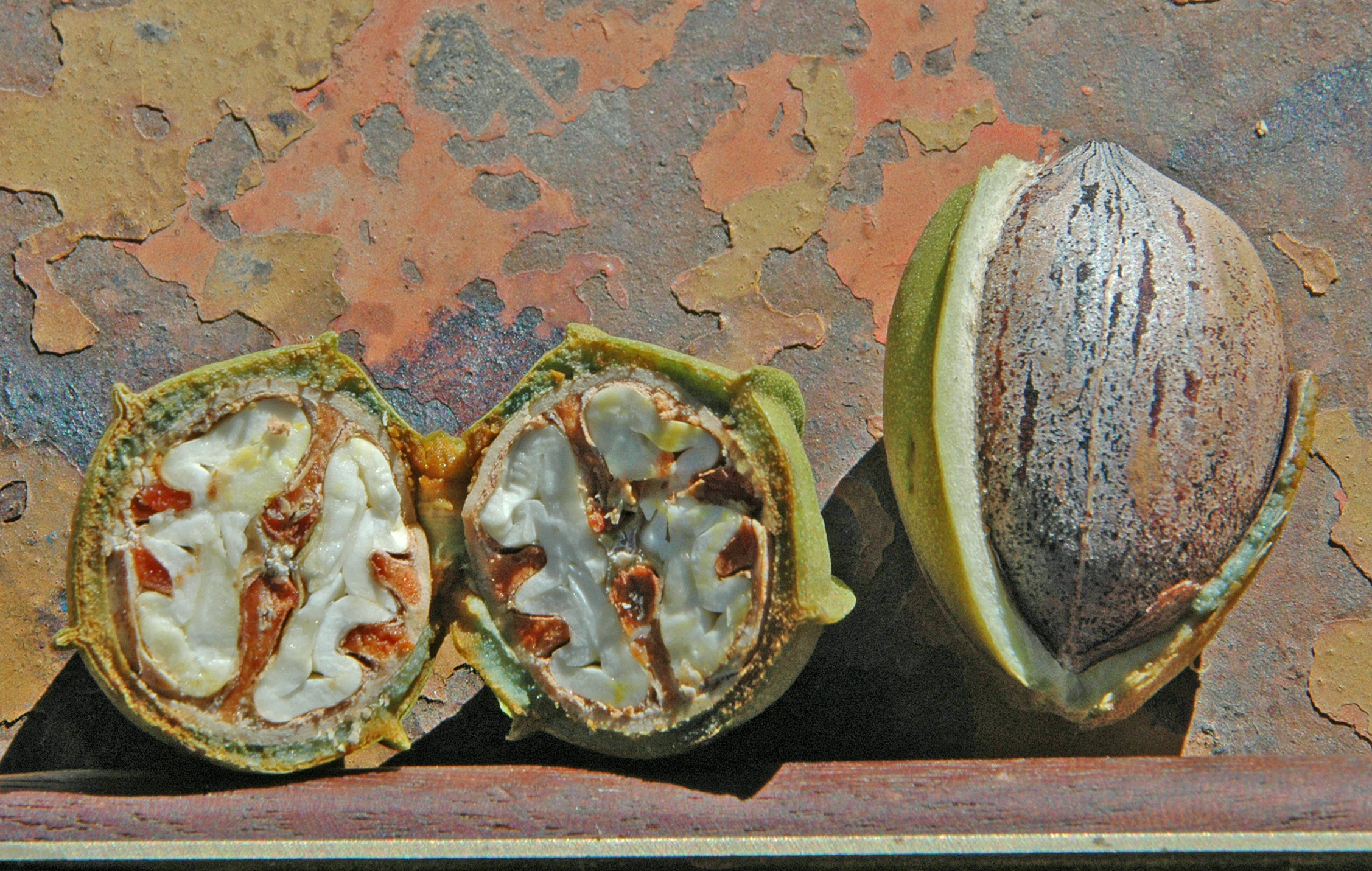
    Liberty, another of my pecan cultivars, usually ripens around September 24th at my location. However, the drought has also delayed normal shucksplit for Liberty. The photo above shows a Liberty nut in cross section and a whole nut that I cut off a portion of the shuck to reveal the shell. This photo illustrates several impacts of the 2022 drought. First, these Liberty nuts are less that 1/2 the size of normal Liberty pecans. Although there is a good amount of kernel inside the nut, I noted that kernel fill was less than ideal. There are voids within the kernel halves and the central kernel partion is not fully compressed. These observations lead me to predict drier and less oily kernels at harvest. When this photo was taken on Oct. 3rd,  the shucks were not split open. When I cut off a portion of the shuck, I revealed a fully colored shell underneath. This tells me that the nut is fully mature but the tree lacks sufficient water to pop the shucks open on schedule.  

Tuesday, September 15, 2020

Waiting for pecan shuck-split


     One of the cultivar traits important to northern pecan growers is ripening date. I judge pecan ripening date by recording when at least 50% of the nuts on a tree have split shucks. 

    I always start scouting my orchard starting in mid-September and pay particular attention to the trees in my pecan breeding plot. One tree, a cross of Pawnee and Greenriver, is always the first to shuck split. Over the previous 4 years, the tree I've labeled 'KT337' has ripened on 19 Sept 2016, 20 Sept 2017, 17 Sept 2018, and 13 Sept 2019.  This year, I first checked this tree yesterday (14 Sept 2020) and found some nuts shuck-split (photo above) but the tree had not yet achieved the 50% shuck-split level.


    I pulled several nuts off the KT337 tree to show you the variation in ripening you can find on a single tree (photo above).  The nut on the far right was pulled from fully split shucks, while the nut next in line was loose in the shuck but I had to forcibly peel back the shucks. You will note that the shell of nut #2 is still partially white, indicating that the nut was not yet fully mature. Nuts #3 and #4 illustrate how the shuck splitting process proceeds. The first sign that pecan ripening has begun is when the shuck starts to pull away from the shell near the tip of the nut. In time, shuck separation moves downwards towards the base of the nut. As the shuck separates, the shell starts to develop cinnamon-colored markings on its white shell surface. These markings will turn jet black and the shell a rich brown when the nut is fully mature.   

Update: 18 Sept 2020


     By Friday, September 18th, KT337 had reached over 50% shuck-split (photo above). This selection remains the earliest ripening pecan in my pecan breeding block.


Friday, November 8, 2019

Hard freeze will allow full pecan shuck opening

 
    I woke up this morning and checked my thermometer. At dawn, it was 22 F (-5.5 C), cold enough to freeze both leaf and shuck tissues. By mid-morning I could see pecan leaflets dropping from my trees.  The photo at right shows a Gardner pecan tree still holding on to most of its leaves. However, the leaves have the dull green cast of freeze killed tissue.

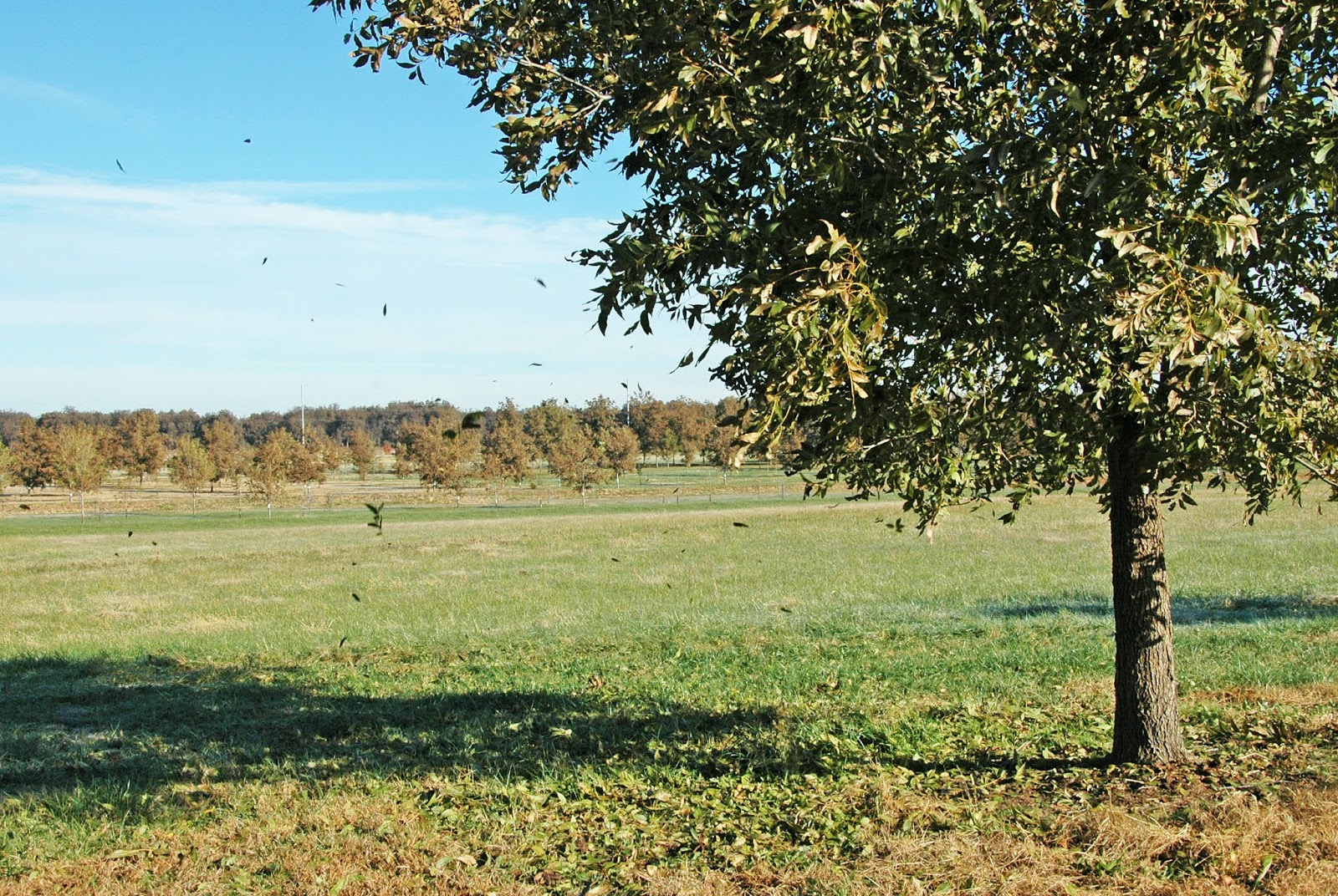
    As I stood watching, green leaves were falling off the tree. After several camera shots, I was able to capture a flurry of leaves as they blew off the tree (photo above). Note the litter of green leaves on the ground, while a strong south wind sent several leaflets airborne.


    The hard freeze also impacted the pecan shucks. The photos above show a Kanza nut cluster before and after the 22 F freeze. A few days ago, Kanza shucks appeared to be drying very slowly. Although the shucks had split, the nut was still closely held by the 4 sections of the hull. This morning the shucks looked only slightly different. The outside surface of the shucks appeared wrinkled and the hulls were beginning to pull away from the nut. The freezing temperatures caused the cells of the shuck tissue to rupture allowing water to escape and the hull to start drying more rapidly. In a few days, a lot more of my Kanza pecans will look like the cluster pictured at right.