Showing posts with label drought. Show all posts

Saturday, November 5, 2022

Pecan Harvest 2022: Making the best of a bad situation


    Following an extended summer drought and an early Fall freeze, the outlook for my 2022 pecan harvest season looked bleak. Staring up into the canopies of my trees all I could see were small black stick-tights. Should I just walk away from the whole mess or should I attempt to salvage what I could of the 2022 crop? I decided to shake the trees and see if I could recover at least a few edible nuts.   

    The photo above shows the nuts I collected from a row of Gardner trees using my pecan harvest equipment. Most were sticktights and would have no commercial value. Surprisingly, I discovered a sprinkling of good pecans among those collected.   Once I ran the harvested nuts through my pecan cleaner, I ended up with about 5% saleable pecans. I definitely won't be covering my production costs via pecan sales this year.

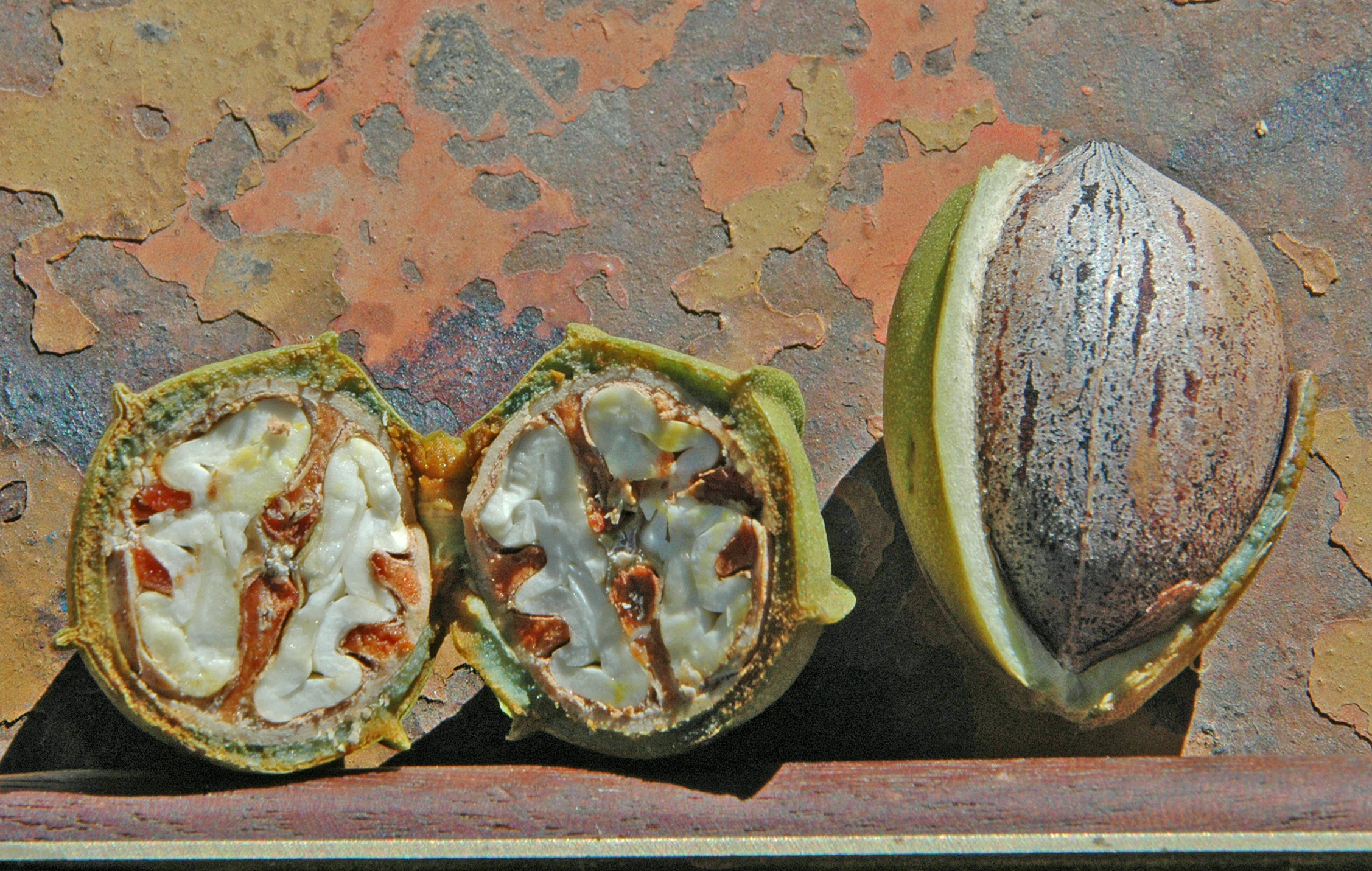
     Before the freeze, many Gardner nuts were showing signs of shuck-split. However, this past summer's drought prevented normal shuck dehiscence. The photo at right shows two Gardner nuts harvested this year. The sticktight appeared to have split along normal suture lines but the shuck is still firmly held in place.

   To discover a possible explanation for why one the Gardner nut released normally from the shuck while the other did not, I decided to cut the nuts open to check on kernel development (photo at left). Although both nuts had developed kernels inside the shell, the pecan with attached shucks did not produce the plump kernels associated with a normal Gardner nut. Full kernel development inside the shell is an important stimulant for shuck opening.

   Remember this year's fall freeze occurred on October 19th, three weeks after the normal shuck split date for Gardner. This year, all of my trees were suffering from intense water shortage. The drought delayed and even inhibited normal shuck opening. The deep freeze only stopped an already damaged crop-ripening process.     


Tuesday, October 18, 2022

Erratic shuck-split during this drought year


Caney, 15 Oct 2022
    Our local weatherman is predicting a strong cold front to drop temperatures into the low 20's by tomorrow morning. Once that happens, the 2022 pecan growing season will come to an abrupt end. Pecan leaves will freeze and drop from the tree. Nuts that have not shuck-split at this point will be frozen in the shuck to cause what is commonly called "stick-tights".

   Because this massive cold wave has been predicted for some time now, I made sure to scout my pecan grove for shuck-split last weekend. All of the photos presented in this post where taken on  Saturday, Oct. 15th. All of the cultivars pictured normally ripen ripen much earlier, in late September or very early October. This year's extended and deep drought has changed everything.


Kanza, 15 Oct. 2022
   I was very pleased to see Kanza split (photo at left) on most of my trees. However, I noted that most of the younger Kanza trees (< 6 inches DBH) were still tight in the shuck. It is likely that the younger trees had more difficultly in competing with the ground cover for water. And without adequate water, the shucks can't open.

    Since Kanza represents about one half of my total production, it looks like I'll have some nuts to sell this Fall even if they are much smaller than normal (drought decreased nut size).


Gardner, 15 Oct. 2022

       Unfortunately, some cultivars are were not even close to opening their shucks. Gardner (photo at right) usually ripens at the same time as Pawnee in Late September. This year Gardner nuts are smaller than normal and have adequate kernel fill. The shuck has separated from the shell but it has not split open. It will be interesting to see if the freeze will pop Gardner shucks open. If not, I'll be amassing a huge pile of stick-tights  for the burn pile.

Thayer, 15 Oct. 2022

    This year, several cultivars are demonstrating a wide variation in shuck development within a single nut cluster. The cluster of Thayer pictured at left illustrates this observation. Note that the largest nut in the cluster is split while the three smaller nuts are still tight in the shuck. After tomorrow's deep freeze, will I have just a single saleable nut to harvest from this cluster. By next Saturday, when I scout the orchard again, I'll get a better idea of crop losses due to this early hard freeze. 

    The 2022 growing season in SE Kansas has proven to be one for the record books, and not in a good way. I keep thinking back to 2007 when we suffered a trio of weather disasters. First we had a late spring freeze that killed emerging shoots followed by the second highest river flood on record in July. The third shoe dropped when our trees were covered by a limb-breaking ice storm in December. Now in 2022, after drought and early fall freeze, I keep thinking, "What's next".  Fortunately, pecan trees are resilient and will bounce back to produce great crops in future years.  


Thursday, October 6, 2022

Extreme drought impacts pecan shucksplit

     During the first week of October, I usually note several pecan cultivars that have split shuck. However, this year, the extended drought has delayed the normal timing of nut ripening. The photo at right shows a cluster of Earlton nuts with the first signs of shucksplit on October 3rd, 2022.  

    Earlton is a cultivar I released from my pecan breeding program primarily for its early ripening date. During a more normal rainfall year, Earlton ripens in mid-September. The photo at left was taken on 18 Sept. 2020 and shows a cluster of Earlton nuts as they normally appear at shucksplit. 

    Besides splitshuck two weeks later than normal, this year's Earlton nuts appear barely split open. This is a good reminder that adequate water supply is necessary for normal shuck opening.


    Liberty, another of my pecan cultivars, usually ripens around September 24th at my location. However, the drought has also delayed normal shucksplit for Liberty. The photo above shows a Liberty nut in cross section and a whole nut that I cut off a portion of the shuck to reveal the shell. This photo illustrates several impacts of the 2022 drought. First, these Liberty nuts are less that 1/2 the size of normal Liberty pecans. Although there is a good amount of kernel inside the nut, I noted that kernel fill was less than ideal. There are voids within the kernel halves and the central kernel partion is not fully compressed. These observations lead me to predict drier and less oily kernels at harvest. When this photo was taken on Oct. 3rd,  the shucks were not split open. When I cut off a portion of the shuck, I revealed a fully colored shell underneath. This tells me that the nut is fully mature but the tree lacks sufficient water to pop the shucks open on schedule.  

Thursday, September 29, 2022

Tree spacing influences nut production during drought


    The other day I was scouting my orchard for pecan shuck split when I noticed a dramatic difference in nut size and ripening between a young grafted Caney tree and the mature mother Caney tree located in my pecan breeding block.

    Let's look at the trees in question. The photo at right is a young Caney tree. This tree has a good crop of nuts and the nuts are only slightly smaller than normal. The important thing to notice in this photo is how much open space there is around the tree. In a year of short water supply this Caney tree has very little competition from other trees for water.

    The photo at left shows the original Caney tree growing in my pecan breeding block. This tree is much larger (28 yrs. old) and is crowded by other large trees (note the shade on the ground). Note the yellowing of some of this tree's leaves. This is an indication of extreme water stress caused by the competition for water from neighboring large trees. Although there is a good crop of nuts on the tree, the nuts are tiny.


     The photo above illustrates the differences I observed in the nuts produced by the young, well-spaced Caney tree and the mature, crowded Caney tree.  First there is the obvious size difference. But secondly, note that the nuts produced by the young tree have split shuck while shucks are still firmly attached over the nuts collected from the mature tree. This simple observation leads me to a very important decision; After harvest, I need thin out more trees in the pecan breeding block.

      Caney is one of the scab-resistant cultivars I developed from my pecan breeding project. The photo above gives you a good idea of what Caney nuts look like. Over the years, Caney has produced nuts that are larger than Kanza with nearly 53% kernel. Caney matures a week before Kanza. This cultivar has a protandrous flowering habit making it a good pollen pairing for Kanza. Kernels are straw-colored and  have excellent quality.

Wednesday, September 28, 2022

Severe drought impacts pecan production


    For the past 4 months, I have watched clouds pass over SE Kansas without dropping significant rainfall. According to the National Weather Service, my farm in Cherokee County (extreme SE corner of Kansas) is experiencing an Exceptional Drought (figure above). I've lived through several Kansas droughts but this year is most memorable because of its extended duration. Extreme drought, although uncommon in SE Kansas has occurred several times in the past 100 years. The Dust Bowl of the 1930's is probably the most historically significant drought to impact Kansas agriculture. However, other exceptionally dry periods occurred  during the 1950's and as recent as 2012-2013.

   The dry weather has definitely illustrated why pecan trees prefer growing in the deep soils found in river flood plains. These soils have a large sub-surface reservoir of water that can move up through the soil profile to keep pecan trees green and growing. However, this year's limited water supply has impacted the 2022 nut crop. Nut size and kernel fill will both be reduced. Many trees aborted a portion of their nut crop in mid-summer due to drought. I have also noted that shuck-split is delayed compared to normal years. 

    Now that the days are getting shorter, I should have more time to post on this blog. As you might expect, the drought of 2022 will color my observations for the remainder of this crop year.    


Sunday, October 11, 2020

Dry summer changes pecan appearance

     The summer of 2020 was hot and dry in S.E. Kansas. In fact, it was so dry that normal nut development was inhibited. This past week, I was collecting nut samples when I decided to see how much nut size and shape was effected by comparing nuts harvested this year with nut samples I have saved from the high rainfall year of 2019. Since most of the nut samples I've been collecting are from my breeding project, several examples pictured below are numbered selections. However, I collected Kanza nuts to illustrate the impact of dry weather on a known cultivar. You should note that all of the nuts collected in 2020 have darker shells that 2019. That is because the 2020 samples were just pulled out of the husk (at shuck-split) and are still quite wet.   


    The Kanza pecans from 2020 are visibly smaller that 2019. In addition, the 2020 nuts are shorter and more rounded. The good news for Kanza this year is that we received just enough rain in late August/early September to completely fill out the kernels inside the shell.
 

     Dry weather had minimal impact on the overall size of KT114. However, nut shape was effected. The 2020 nuts are not as blocky as the 2019 nuts. You can see the difference by looking at the base and apex of the nuts.


    KT217 nuts collected in 2020 illustrate two common changes in nut appearance associated dry weather. First, overall nut size is smaller. But secondly, the 2020 nuts are more tapered toward the base. Remember, all nut development processes start at the apex and work down toward the base. In the case of KT217, water became increasingly limited during nut enlargement resulting in a nut that has a much smaller diameter base.

 
    KT252 nuts are much smaller in 2020. The nuts are less blocky and ever show some basal taper. The overall changes in nut shape in 2020 make it hard to believe that nuts from 2019 and 2020 came from the exact same tree.

   Since irrigation is not an option for my pecan grove, yearly fluctuations in nut size and shape are to be expected. Each year, I collect nut samples from each cultivar and breeding selection in my orchard. Part of the data I collect from these samples is a photographic record of nut appearance.  As the years progress, I'll be able to see exactly how each clone reacts to variable weather conditions.  


Monday, July 8, 2013

Poor tree growth and the appearance of stump strouts


        The past couple of summers have been hard on young pecan trees growing in the Midwest. The heat and drought have been brutal. This spring I have seen several young trees produce only a smattering of new leaves on upper branches while sending up vigorous stump sprouts from below the soil surface (photo at right).  The stump sprouts on this tree first developed in 2012 and have continued to grow this year. 

   This year's new shoots are only one-inch in length on the upper portion of the tree (photo at left). The leaves are small and have several missing leaflets. The tree just looks sick!


      At the base of the tree, the bark on the main stem is sloughing off (photo at right). To me, this indicates that the conductive tissues (xylem and phloem) in the stem have been damaged, interrupting the normal flow of water and nutrients.  Its no wonder the top growth on this tree is so anemic.
   The growth of stump sprouts is the tree's way of replacing the damaged portion of the tree with healthy stems that support large, healthy leaves.

    One way to deal with this situation is to coppice the tree (photo at left). It was obvious to me that I was going to lose the original portion of this tree. The growth I found on the upper branches was just too sparse to keep the tree going. On the other hand, one of the stump sprouts had already grown 5 feet tall in two years time.  I simply used my chainsaw to cut down the original trunk and the smaller stump sprouts at ground level.  My tree might have a much smaller top after coppicing but the potential for new growth is much better.
    This tree is a seedling growing in our pecan breeding plots and will remain a seedling in the future. If you need to coppice a grafted tree, plan to re-graft the tree in a year or two.  

    The stump sprout I saved had three equally vigorous shoots growing near the top of the tree. To shape this tree into the central leader form, I tipped back the two side shoots to outward growing buds and left the central shoot free to grow into a strong leader (photos at right). I'll need to watch this tree carefully this summer. There is a lot of root energy pushing the new top growth and that will require plenty of return visits for additional summer pruning.   

Tuesday, June 4, 2013

Sprouts from a drought-injured pecan tree

   Last summer's heat and drought was hard on a lot of plants including young pecan trees. This morning, I photographed a tree that I had grafted two years ago (photo at right). I was so disappointed; I lost almost the entire top of the tree to drought-induced die-back. This tree had been growing great, with over 4 feet of new top growth added just last year.  But if you look at the tree now, all you will see is a few new sprouts growing from the base of the tree.
     The photo below is a close-up of the sprouts that are now growing from the tree's base. Notice that the sprouts seem to come in one of two different colors. The sprouts with a reddish tinged leaves are growing from the rootstock portion of the tree (below the graft). Red pigmentation of expanding new leaves is a juvenile characteristic of a seedling pecan tree.
   

    The bright green sprouts have developed above the graft union. The all-green color is indicative of sexually mature tissue and tells me that these sprouts originated from the Kanza scion. 
    Now, the tree training process must start all over again, but this time with a twist.  First, I removed all the sprouts with red colored leaves. Next, I pruned off all but one of the green "Kanza" sprouts in an effort to restart a central leader. For the time being, I left the dead portion of the old trunk in place to act as a training stake for the new shoot. To keep this tender shoot from being broken off by a wind storm, I used grafting tape to tie the shoot to the old trunk.
    I'll cut the dead portion of the old trunk out in mid-summer once the new shoot has developed a woody stem of its own.  However, this tree will still need staking. Until the pruning wound is completely healed over, this tree will be prone to wind breakage at the point of connection between new central leader and older trunk.  Once I remove the dead stem, I'll use an eight foot long piece of steel conduit (3/4 inch tubing) as a stake for tying  at the new leader.
    After pruning I installed a deer cage around this tree. In the photo above, you can see that a deer had already sampled the succulent new growth sprouting from this tree.  With all the root energy pushing my new central central, I should see at least 5 feet of new growth this summer. If the deer, were allowed free access to this tree, I'd end up with a 2 foot tall pecan bush.


Friday, March 22, 2013

Pawnee kernels defects following 2012 drought

    Last fall, many of our Pawnee kernels developed dark blotchy spots in response to last summer's heat and drought. In looking over Pawnee samples provided by growers for this year's nut evaluation, I found a wide range in kernel appearance. The photo above illustrates these kernel defects. There are two kernel halves from each of four Pawnee samples.
    The two kernels in the lower left portion of the photo came from a well irrigated tree that I would consider "normal" in appearance. The kernels in the upper left position suffered the greatest drought induced color changes. These kernels are dark, covered in black blotches and have adhering kernel fuzz. These tree were not irrigated last summer.
    The kernels in the lower right position are less-intensely blotchy and slightly darkened. These kernels were produced by trees had a limited supply of water last summer provided by trickle irrigation. This nut sample points out one of the deficiencies of trickle irrigation in pecan orchards. Under severe drought conditions, many trickle systems can't provide enough water to totally eliminate water stress.
    The kernels in the upper right position illustrate a different type of kernel discoloration.  Rather than numerous small black blotches, these kernels have a large, uniformly-dark area centered on the eye of the kernel (the kernel eye is that area where one kernel half is attached to the other).  With this type of discoloration, the dark spot on underside of the kernel often larger that what appears on the upper side.
    Any type of kernel discoloration will reduce the marketability of pecan crop. A return to more normal rainfall patterns will greatly improve the kernel quality of Pawnee in future years.
   

Friday, February 1, 2013

Oswego pecan - 2012 results

   When I was collecting pecan samples from our cultivar trial last fall, I came across our Oswego trees and, frankly, I was little disappointed. The nuts were small and not that well filled (sample from Chetopa at right). It wasn't until I collected samples from our cultivar trial at New Madrid, MO that my faith in Oswego as a cultivar was restored (photo at right). The New Madrid sample had the size and kernel quality that spurred the naming of this seedling in the first place.  
   I've talked about the effects of tree size and drought on nut size, nut shape and quality in previous posts. Here we see similar results. The Oswego nut from New Madrid was produced by a tree that was irrigated all throughout last summer's heat and drought. In contrast, The Oswego nut from Chetopa was produced by a young tree that was not irrigated. I'm so glad I decided to set up multiple sites to test pecan cultivars.

Saturday, January 19, 2013

Pecan size determined by soil and available water


     Last summer's drought and high temperatures effected agriculture across the Midwest, including pecan groves. In previous posts, I discussed how drought can effect nut size, influence nut shape, retard kernel filling, and prevent proper shuck opening. Today we were evaluating nut samples collected from several locations and soil types. The differences we found  among four Pawnee samples were astounding and I just had to share our observations (photo below).

 
    Its almost hard to believe that all four samples were produced by trees of the same cultivar. The largest Pawnee nut was produced in Illinois, growing in a deep silt loam soil and irrigated during the mid-summer drought. The combination of great soil and ample water provides ideal conditions for nut growth and kernel fill.
    The second largest nut was produced in Kansas at the Pecan Field. Last summer we were fortunate to have a flood in May that saturated our heavy clay soils. Our Pawnee trees ended up mining that water later in the summer to produce a smaller but well filled nut. However, last summer's heat and drought did cause some kernel defects on our Pawnee nuts. 
    The two samples from Missouri were collected from trees growing at the Horticulture and Agroforestry Research Center in New Franklin. Central Missouri was hard hit by the 2012 drought, decreasing nut size significantly. These samples provide a great example of how site and soil type can effect nut production. The tree growing in the silt loam soil is actually located in a very fertile and moist creek bottom. Trees in this planting have grown exceptionally well with many reaching 12 inches in trunk diameter in just 15 years. Planted at the same time and just 1/4 mile away, the trees growing in the silty clay soil have grown much slower reaching only 8 inches in diameter. Although the silty clay soil is located within the greater Missouri River flood plain, this land is cut off from minor flooding events by a levy.  In the end, the nut size difference between the two Missouri samples can be attributed to a difference in both available water (the silty clay had less) and tree size. If you remember, tree size has a enormous effect on a pecan tree's ability to capture soil water, impacting both leaf and nut size.

Friday, December 14, 2012

Testing pecan cultivars: Soil and water effects


    In testing new pecan cultivars, its important to evaluate each clone over several years and at several locations. This year provided some good examples of how location can effect cultivar performance.
    We are currently testing two early ripening clones developed by the USDA pecan breeding project at several locations. The photo at right shows nut samples of USDA 75-8-5 collected from two locations--Chetopa, KS and New Madrid, MO.  At the Chetopa site the trees are growing in a heavy clay soil without irrigation while in New Madrid the trees are growing in an irrigated sandy soil. Both locations suffered extremely hot and dry summers but you can definitely see the benefits of irrigation on nut size and shape.

   In the photo at left, you can see that USDA 75-8-9 behaved just like its sibling clone; The nuts produced under irrigation were larger and plumper that the nuts produced without irrigation water.
   Last summer, soil moisture availability had an  overwhelming impact of nut size and shape. However, during years of normal rainfall we would still see differences in nut size between these two locations. Trees growing in heavy clay soils tend to produce smaller pecans than trees of the very same cultivar grown in loamy or sandy loam soil.  But, there is one advantage of growing pecans in a heavy clay soil--Clay soils have a greater soil moisture holding capacity. During drought years, quality kernels can be produced without irrigation in a clay soil while kernels produced by trees growing on sandier, non-irrigated soils will be shriveled.   

Wednesday, December 5, 2012

Kanza: Yield and nut quality 2012

2012 Kanza Crop
    I am a fan of the Kanza pecan cultivar. These beautiful, tasty and easy-to-shell nuts are the only ones that end up in my freezer (photo at right).
    Over the past few years I've been sharing production records from a block of Kanza trees we established in 1995. Last winter we removed 7 trees from this block of 112 trees as part of a planned tree thinning operation. What is interesting is that nut production did not drop significantly from 2011 to 2012 despite the loss of 6% of the orchard's trees.
    Weather conditions during the 2011 and 2012 crop years were similar; both summers were hot and dry. In 2011 we averaged 899 lbs/acre from this young orchard, while in 2012 yield averaged 810 lbs./acre. I was really surprised that the cumulative effect of two years of  drought did not impact the 2012 crop even more that it did.

    I've been cracking Kanza nuts over the past several days and have noticed a few nuts with severe kernel defects. In the photo at left, the 5 nuts in the top row are indicative of the quality of nuts produced by Kanza this year. However, as you can see by the four nuts in the bottom row of the photo, I've also found a smattering poorly filled and dark kernels in our cracked Kanza nuts. Fortunately, the number of these wafer-like kernels is probably less that 0.1% of all cracked nuts. But this makes me wonder: Is  this year's lower Kanza yield due in part to a greater number of light nuts being blown out of the cleaner or removed from the picking table as stick-tights? I think so.

Sunday, November 18, 2012

Pawnee kernel defects caused by drought

    I was cracking some Pawnee pecans and noticed that this past summer's drought didn't effect nut fill as much as it created  kernel color defects. In the photo at right the upper two kernel halves are plump and exhibit normal kernel color for Pawnee. The lower two kernel halves have dark blotches and prominent veins. Look carefully at the lower two kernels and you will see that they are also not as plump as the upper kernels. The area between the dorsal groves looks shrunken and the meats are not fully expanded all the way to the tip of the kernel.
     You can find both types of kernels produced by the same tree. Without enough available water this past summer,  the tree was unable to completely fill out the kernels of all nuts produced. 
    I've tasted both normal and darkened kernels and found little difference in flavor. However, the dark blotches can be a big "turn-off" to consumers. If  Pawnee had just produced some kernels with less than perfect kernel fill and no color changes, no one would probably notice. Blotchy kernel darkening associated with incomplete nut fill seems to be unique to this year's Pawnee crop.

Wednesday, November 14, 2012

Drought induced stick-tights

    After harvesting for a couple of weeks we have finally started to clean some of the 2012 pecan crop. Today, I walked over to the piles of rejected nuts that came out of the cleaning plant and grabbed two handfuls of stick-tights. The first handful came from the pile that was blown out of the cleaner by the air leg (photo at right). As you can see, the cleaner blew out stick-tights that had wafer-like kernels and nuts that fell out of the shuck normally but had shriveled or no kernel. These are the type of pecans we definitely want to keep out of our final product.

    I took a second sample from the the rejects that had been pulled off the inspection table by hand. These were all stick-tights but unfortunately, these nuts contained edible kernel (photo at left). The summer-long drought we experienced in 2012 has caused the shucks of some nuts not to open properly. This type of incomplete ripening seems more prevalent on trees with heavy crop loads. It's a terrible shame to waste these perfectly good kernels but if the shucks stay firmly attached the nut, the nut is  unmarketable.  Fortunately, stick-tights with good kernel inside are far fewer in number than the numerous stick-tights we are seeing being blown out of the cleaner (nuts with little or no kernel).

Friday, November 9, 2012

Incomplete shucksplit on native pecans

    Today we switched from harvesting pecan cultivars to picking some of our natives.  While shaking the trees I noticed about %5 of the trees had nuts with green shucks. I climbed out of the tractor and collected some of the green hulled pecans (photo at right). I noted that some of the nuts had split their shucks normally while others were not split at all.

     Taking my knife, I cut into the shuck of a pecan that had not opened properly and popped off the shuck (photo at left). The pecan inside was fully colored and loose in the shuck but the shuck had not split along the four suture lines. This called for futher investigation.
    I collected 3 pecans that had normal shucksplit and compared them to 3 pecans that I had to cut out of the shuck. I then cracked open each of the nuts to reveal the kernel inside (photo above, right). The 3 pecans on the right had shucks that opened normally. The pecans with shriveled kernels on the left were cut out from closed shucks.
    During a drought, some heavily bearing trees "choose" to fill only a portion of their crop. Those pecans that do not fill their kernels do not shuck-split properly. We saw the same phenomenon when we harvested our "Posey" crop.

Monday, August 27, 2012

Building pecan kernel? Just add water.

    Last Friday I cut open pecans to see how crop load and drought interact to affect kernel filling. If you recall that post, I discovered that trees with heavy crop loads were way behind in terms of kernel fill. Well, a lot has changed in just 72 hours. We received 1.70 inches of rain over a 2 day period (Sat. & Sun.) with every drop soaking into the soil. The result has be an explosion of kernel filling. This morning I collected nuts from the same trees as before and cut them to inspect kernel fill. In the photo above, the 2 nuts on the left side are from a light bearing Giles tree (28% fruiting shoots) while the 2 nuts on the right are from a tree holding a good crop load (60% fruiting shoots). The 2 nuts on the top row were cut on Friday while the 2 nuts below where cut today (Monday).  The amount of kernel packed into nuts from both trees has increased over the weekend. However, the rapid development of kernel in the tree bearing a good crop (60% fruiting shoots) is truly amazing. Unlike last week, there is now only a slight difference in kernel filling due to crop load. 

    Now lets look at pecans cut from Chetopa pecan trees. For this cultivar, I selected a tree with 46% fruiting shoots and compared to a heavily bearing tree (76% fruiting shoots). This past weekend's rain storm promoted rapid kernel development in nuts from both trees. However, the nut from the heavily loaded tree is still struggling to fill out the kernel. Note that kernel near the inner wall partition is not as well developed as the kernel located adjacent to the outer shell. With 76% fruiting shoots, this tree may have too many nuts on the tree to ever get 100% kernel development.
     With more rain forecast this coming weekend, it looks like we should expect good for kernel quality for the 2012 Kansas pecan crop.

Friday, August 24, 2012

Pecan crop load, nut size, and kernel filling

    This summer, we have been looking at the influence of crop load on nut production, especially during this year's drought. Today, I collected a few nut samples in this trial to check on the progress of nuts growing on Giles and Chetopa trees. I selected two trees from each cultivar; each tree with widely differing crop loads.
   The photo at right shows Giles nuts collected from a tree with a light crop (28% fruiting shoots) vs. nuts collected from a tree with a good crop (60% fruiting shoots). Its easy to see that the tree with a smaller crop load had larger pecans.

    This summer our Chetopa trees have a greater overall crop than the Giles trees but you can still see a difference in nut size between the tree with the small crop load (46% fruiting shoots) and a large crop (76% fruiting shoots). Again, fewer nuts on the tree results in larger nut size.
    The simple relationship between crop load and nut size means that pecan trees can partially compensate for yield loses associated with a weaker nut set by growing bigger pecans.

    I also cut into all the nuts I collected to check on kernel development and was somewhat surprised at what I found. Giles kernel development was far more advanced on the light crop load tree as compared to the good crop load tree (photo at right). Could it be that, in this year of short water supply, the tree with the good crop was "waiting" for more water before it could begin to fill the kernel?

    I cut into the Chetopa nuts and found a similar trend although not as striking (photo at right). Kernel development was farther along on a tree with a lighter crop load. To fully understand the kernel filling process check out this post.
   It will be interesting to see if the differences in nut develop present in mid-August will be visible as differences in kernel quality come this November (harvest time). 
   

Wednesday, August 22, 2012

Pecan tree spacing and drought stress

    Last winter I wrote about  thinning a block of Kanza trees. If you recall, we thinned only a portion of a Kanza block last winter with additional tree removals planned for this coming winter. In any case, this left the planting with Kanza trees at two different tree spacings. The original planting was made at 30 ft. by 30 ft. (9.1 m x 9.1 m). After we thinned the trees on the diagonal, trees in the thinned portion of the orchard were spaced 42 ft. by 42 ft. (12.9 m x 12.9 m). Well, this summer's drought has got me thinking about tree spacing and its impact on tree water uptake. So this morning, I went out to collect some nut samples.

    In theory, trees spaced wider apart should have more water available to them than trees spaced closer together. With more water available during a drought year (and no irrigation), wider spaced trees should have bigger and better filled pecans.  To test this theory, I collected nuts from two trees of equal trunk diameter but one sample came from a tree in the thinned portion of the orchard while the other came from an unthinned area (photo above). If I stare at the photo long enough, it looks like the nuts from the thinned portion of the grove are slightly larger than the unthinned area.

     Now, lets look at kernel fill (photo at right). Again, the differences between trees is slight with the unthinned kernel having a fraction more air space within the kernel.
     My theory that wider spaced trees will produce larger and better filled nuts during a drought year may be true but the nut samples I collected today only gave us a hint in that direction. Could it be that the full effect of wider tree spacing hasn't kicked in yet? The orchard was only thinned last winter and the root systems of the remaining trees have yet to take full advantage of the greater soil resources now available to them.
    Hopefully, we'll get some rain and all my worries about water and kernel filling will disappear.     

Monday, August 20, 2012

Drought leads to poor kernel filling


    Its been 10 days since we last looked at the kernel development of Osage, Kanza, and Maramec pecans (see previous post). In the photo above, you can see that both Osage and Kanza have well defined kernels. Maramec is just starting the kernel filling process (note thin layer of kernel developed around the still water-filled void). It is also interesting to note how small the this year's Maramec nut is compared to what we usually except from Maramec.  In a normal year, Maramec is one of the largest nuts we can grow in SE Kansas and is often 1.5 times larger in diameter than Kanza.
    At his point, the kernels of all three cultivars show major air voids and a lack of full kernel development. Last year we were seeing the same kind of poor kernel fill and then we received a major rainfall event that help fill out the kernels. The weather man is promising a general, area-wide rain this coming weekend. Lets hope he's right. If we do not receive a significant rain within the next 3 weeks the 2012 drought will be the cause of record poor kernel quality.