Its truly amazing that we live in an age when it is so easy for folks to take a digital photograph of their pecan tree and email that picture to me with their pruning and tree training questions. The photo at right is one such photo. Of course the photo came with the usual question--"How should I prune this tree?".
What's even more amazing are the software tools I have on my computer that allows me to edit the digital picture I receive and turn it into an neat instructional aid. I can usually enhance visual clarity of the photo then add words and arrows to point out recommended pruning cuts.
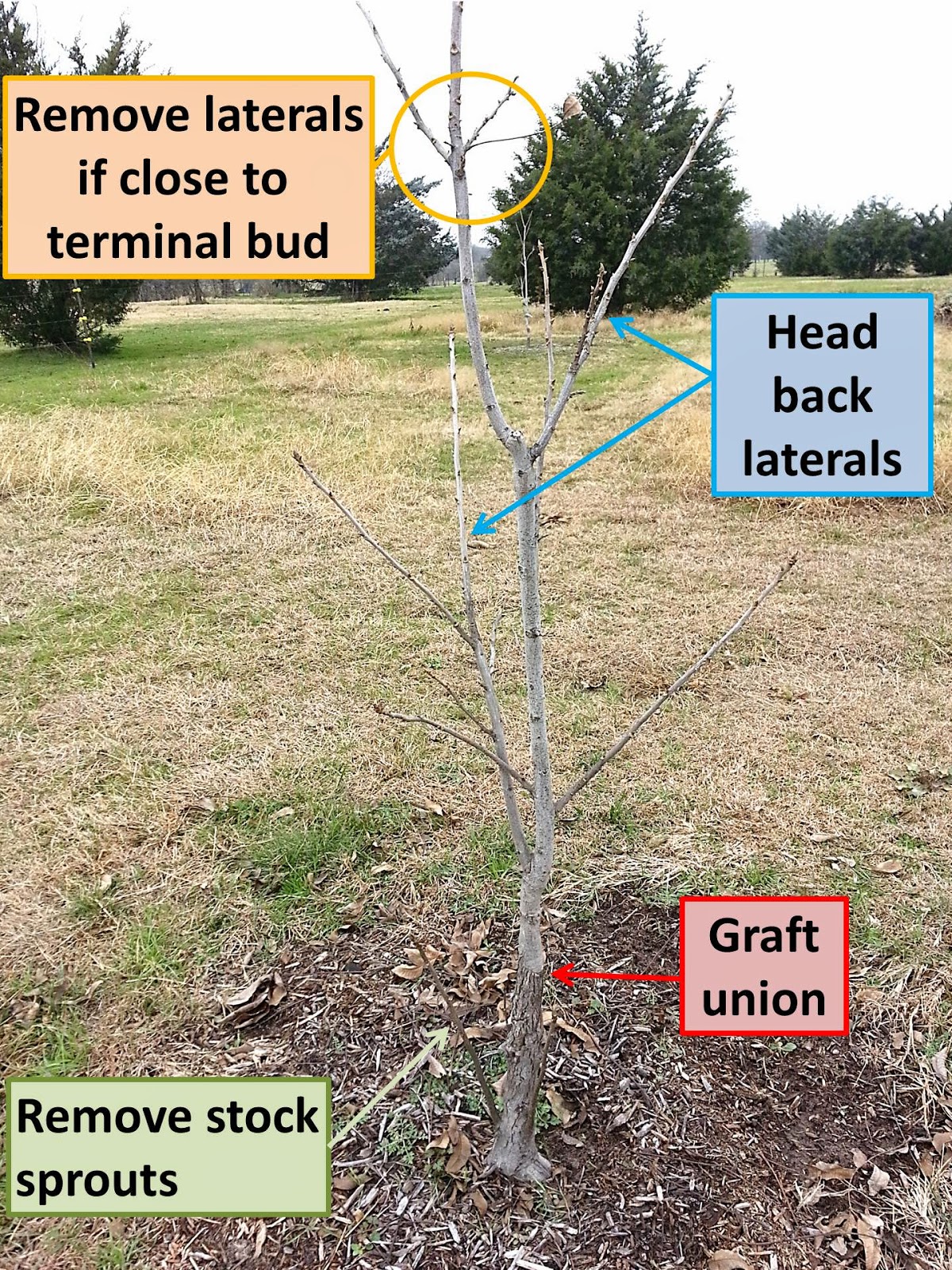
The photo at right is the same exact shot as the one shown above. I used photoshop to edit the photo then moved the image powerpoint to add graphics. Now lets talk about pruning. I'll start at the top. If those three small lateral branches within the orange circle are within two feet of the tree's apex, I'd remove them completely (
the two foot rule) to preserve the dominance of the central leader. Next, I would head back the two strongly growing laterals (blue arrows) by pruning them back to either an outward growing side shoot or outward growing bud.
You can clearing see the change in bark texture that marks the site of the graft union (red arrow). Below the graft, you can barely make out a stock sprout. Remove this sprout entirely.
The owner of this young tree was also concerned about how to prune the "branches" at the base of the tree (photo at left). These are not branches but are exposed roots. Judging from what I see of the root system I can tell this young tree was originally grown in a container and the tree should have been set 2-3 inches deeper into the soil. However, now that the tree has become established, I would simply trim off those two small roots and leave the bigger exposed roots alone. In time, the tree will grow in trunk diameter and the exposed roots will seemingly disappear.
This photo of a back yard pecan tree was sent to me from South Africa (at left). The owner of this tree wanted to know the best way to prune this tree to a single trunks without tearing up the bark. Judging from the photo, this is a grafted pecan tree (graft union at the base of the tree) and its most likely the cultivar, Wichita.
Wichita is widely available in South Africa and the profusion of narrow angled branch connections as seen in the upper portion of the photo is characteristic of this cultivar. I'm going to let the tree's owner decide which side of the tree to keep, because in the end it won't really matter to the tree. With that said, I'd probably choose to remove the right fork because when I cut the limb it would have an open space to fall. Cutting the left side would mean placing a large limb on top of the garden wall.

Removing a large limb from a tree is a three cut process (graphic above). In cutting off a large limb you are removing a lot of weight and that falling weight can lead wood splintering or bark pealing. To control the limb removal process, start by making an undercut about 1/3 way through the branch at a point about one foot away from the trunk (cut 1 above). Next, start cutting from the upper side of the limb about one inch further out from the trunk (cut 2 above). Keep cutting until you start hearing wood crack. Stand back and watch the limb snap off the tree under it own weight. Now, with most of the weight pruned off, remove the branch stub just outside the branch collar (cut 3 above). If the limb crotch is wide enough for your chainsaw, you can make the final cut from the top downward. For narrow crotches, the final cut with the chainsaw will have to be from the bottom up. For folks experienced in using a chainsaw and know how to avoid saw kick-back, I generally use a plunge cut from the side to remove any angle branch stub.

My final pruning example comes from Texas. This back yard Choctaw pecan tree looks to be growing every direction but upwards (photo at left). For backyard trees is important to remember that the tree doesn't need to look textbook perfect; the tree will still make shade and nuts however it is mistreated. However, it is probably a good idea to make a couple of cuts on this tree just to give the tree a more balanced appearance and to encourage a central leader.
The lowest side limb on this tree is extremely vigorous and seems to be almost as large as the central leader (red arrow). To promote growth of the main trunk, this limb should be cut back . I've marked the place to cut with a short red. Note that this one cut will remove the upward growing portion of this side limb. What's left is less vigorous and outward growing. In removing this limb, I would use the 3 cut method described above in order to avoid possible bark damage to the remaining portion of the limb.
The yellow arrow points to a side limb that is directly competing with the central leader. The cut I would make here is shown by the short yellow line. Once again, I would remove an upward growing branch pruning it back to outward growing limb.