Showing posts with label breeding project. Show all posts

Friday, November 15, 2024

Picturing nut size

     For the first time in 3 years, we have received enough summer rainfall to promote a more normal development of nut size. This fact gave me the opportunity to photograph all of the cultivars I have named from my pecan breeding program and compare them to Kanza, a  widely propagated pecan cultivar.  This past summer, while shopping in a local home center,  I found a very useful measuring tool that should make illustrating pecan nut size easy. This measuring tool is marked in both inches and centimeters (1 inch = 2.54 cm).

Kanza, 2024

    As you look over the photos below, not only can you judge overall nut size, but you can also see general shape, relative nut diameter, typical shell markings, and the often characteristic shell apex appearance.  The cultivars below are presented in alphabetical order.

Caney, 2024

Earlton, 2024


Labette, 2024

Liberty, 2024

Pleasanton, 2024

St. Paul, 2024

Thayer, 2024


Wednesday, May 18, 2022

Notes on pecan pollination


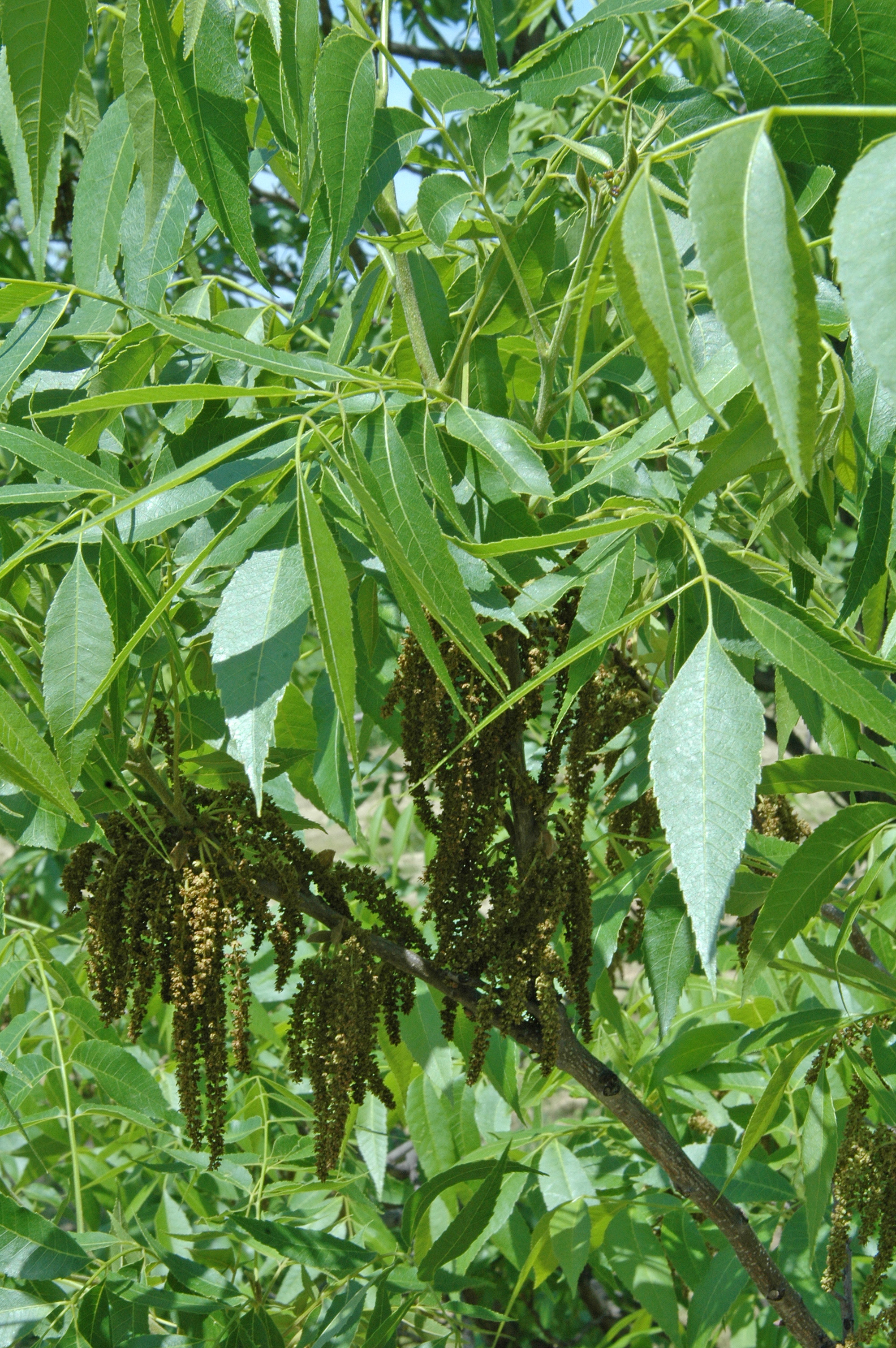
     Last weekend I took advantage of calm winds and sunny skies to photograph pecan flowering and pollination. I also like to scout my orchard at this time of year to get a feel for this year's nut crop. During the month of May, my trees are always covered with catkins--the long worm-like structures that hang down from last year's shoot growth. Male flowers (pollen sacs) cover each catkin and eventually split open to release millions of yellow pollen grains into the air to hopefully find their way to a receptive female bloom.

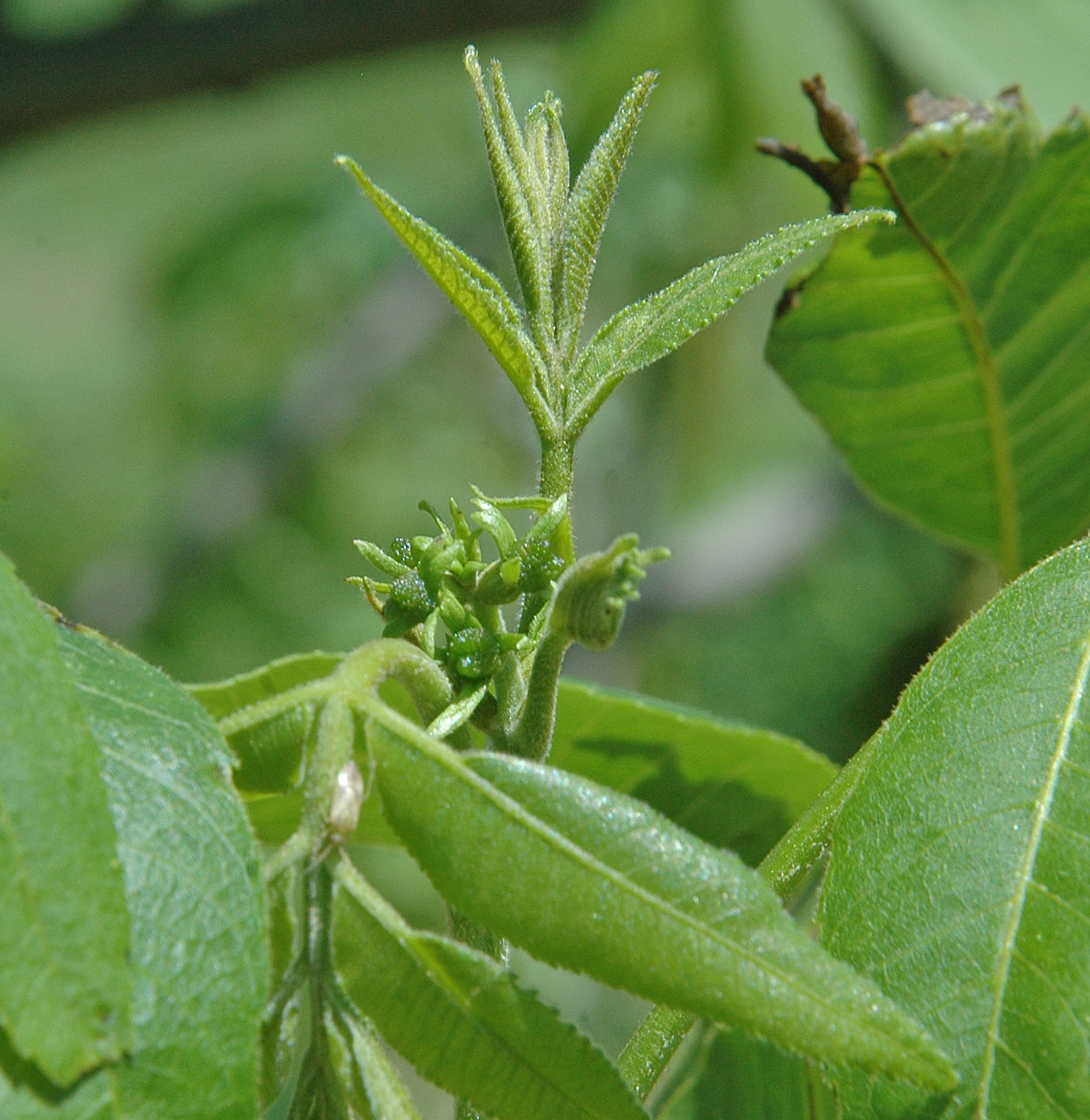
    Pecan female blooms are not very showy (photo at right) and can be found at the terminal new spring shoot growth. Look carefully at the flower cluster in the photo and you will note that the ends of each flower (the stigmatal surface) has started to turn dark brown-black indicating these flowers have been pollinated. The flower cluster pictured here is from a Kanza tree. Kanza is a protogynous cultivar meaning the female flowers on the tree become receptive early in the pollination season while Kanza pollen is released late.

     When scouting my orchard for yield potential, I concentrate on counting the number of terminals on a tree that have developed female flower clusters. The good news for my orchard is that the 2022 crop looks very promising at this point.

On my trip around the orchard, I decided to concentrate recording the flowering habits of the pecan cultivars originating from my breeding project. I took 2 photos of each cultivar. The first shows the entire fruiting shoot. The second is a close-up of a female flower cluster. All photos were taken on May 14th. I've noted the flowering habit of each cultivar.

CANEY - PROTANDROUS


Caney was actively shedding pollen at the time this photo was taken.


Caney pistillate flowers were still growing and not yet receptive. The stigmas will be bright red at receptivity.


 EARLTON - PROTOGYNOUS

Earlton has long slender catkins typical of protogynous cultivars.


A Earlton flower cluster shows signs of already being pollinated.


LABETTE - PROTOGYNOUS

Look carefully. See if you can spot the female flower cluster held at the end of the new Labette shoot.


Labette female flowers look ready to receive pollen.


LIBERTY - PROTANDROUS

Liberty was shedding pollen and should make a good pollinator for Kanza.


Liberty female flowers were still growing in size. Stigmas will be red in color.


PLEASANTON - PROTOGYNOUS

Pleasanton catkins are starting to turn yellow in color. It won't be long before pollen sacs start to open and release their pollen grains.


Pleasanton female flowers have started to turn brown indicating pollination has occurred.


ST. PAUL - PROTANDROUS

St. Paul catkins were shedding pollen. So much pollen that I had to clean off my camera lens.


St. Paul female flowers were still not fully formed. These females will have green stigmas.


THAYER - PROTANDROUS

Thayer catkins have shed most of their pollen and have turned brown in color.


Thayer female flowers are still growing. The stigmas will be bright red when receptive to pollen


Monday, December 30, 2019

Giving pecan trees room to grow


   To maintain good nut production, pecan trees need plenty of room to grow and develop a full canopy. When I established my pecan breeding block, I planted trees far closer than normally recommended to allow for the evaluation and selection of new cultivars. As the trees started to produce nuts, I started to remove trees that produced small nuts or displayed poor resistance to pecan scab disease. This project started with over 800 trees but currently, I've already removed 90% of the original trees.
     This winter, I'm back thinning out more trees (photo at right). At this point in the project, my tree removal objective is to make certain that trees that have the greatest potential to become new cultivars have plenty of room to expand their canopies. The trees in the photo were growing only 20 feet apart within the row (row spacing = 40 feet)  with adjacent canopies shading each other. After tree thinning,  the remaining trees will be spaced 40 feet by 40 feet.


KT334
      The photo at left is an example of the nuts produced by one of my selections that I have made a priority for ensuring adequate tree spacing. In fact, tree KT334 is pictured above as the first tree in the row at the left side of the photo. Now that KT334 has a more normal tree spacing, I'll be able to get a better feel for its production potential.


Wednesday, September 18, 2019

Judging the date of shuck-split

   Every fall, I look forward to recording the date of shuck-split for each of the pecan cultivars and breeding selections growing on my farm.  Three times per week, I stop by every tree and take a close look at nut production, nut size and fill, and judge the progress of shuck-split. Once the tree achieves shuck-split, I collect a nut sample to be evaluated after I've completed my commercial harvest.
   On any one tree, the process of shuck opening does not happen all at one time. Today, while examining trees in my breeding, I came to tree KT214. The photo at right show a cluster of KT214 has split shuck.   
    However, as I looked over the entire tree I found that most KT214 nuts had not yet split (photo at left).  Whenever I record the date of shuck-split, I am actually judging the date when at least 50% of the nuts on a tree have split shucks. In the case of the KT214 tree, only a hand full of clusters had split shucks, so I will not record today as the date of shuck-split. That important date will probably be this Friday or next Monday.


KT674 16 Sept. 2019 
KT415 18 Sept. 2019
    Shuck-split is just starting in my breeding plot. Since most seedlings in the trial are the results of crosses between a northern cultivar and Pawnee, the ripening dates for these trees tend to be early with the majority splitting shuck during the last week of September or the first week of October. However, since my last post, two additional trees in the breeding plot have split shuck: KT674 and KT415 (photos above).

Sunday, November 18, 2018

Evaluating nut samples

    Last week we had a light snow fall that covered the pecan grove with about two inches of wet snow (photo at right). The snow turned out to be only .16 inches of precipitation but the cold weather that followed meant that the orchard floor stayed snow covered and wet for several days. Wet soil conditions means that I was unable to finish harvesting my pecans. So, I parked the tractors and moved inside to start cracking nut samples I had collected from the pecan breeding block.
   At shuck split, I collected at least 25 nuts from each tree. I let these nuts air dry for several weeks then began the process of measuring, weighing, and cracking nuts.
    The first step in my evaluation process is to record the diameter size class of each nut in the sample. I do this because every nut ever brought to a shelling plant is run through a nut sizer in preparation for cracking. Pecans are sized by a series of steel cages with various size slots for nut to fall through. The sizes are recorded in sixteenth of an inch increments. A size 12 pecan falls through an opening 12/16 or 3/4 of an inch wide. I use a series of end wrenches (measured in 1/16 increments) to simulate the nut sizing process (photo above). In the photo, note a nut stuck in the 15/16 wrench. This same nut passed easily between the jaws of the 16/16 wrench (1 inch) and would be classed as a number 16 diameter pecan. By measuring every nut in a sample I can develop a size profile for each clone. The sample I was processing when I snapped these pictures was 50% size 15 and 50% size 16 nuts.

    The next step in my nut evaluation process is to weigh 10 randomly selected pecans. This weight will give me an average nut weight but can also be used to calculate average nuts/pound. I use a gram scale to weight the nuts (photo at right).  This sample weighed 101.97 grams. This nut averages 10.197g per nut and if you divide the conversion factor of 453.6 by the average nut weight in grams you'll find that this particular pecan averages 44.48 nuts/lb.
    With the inshell nuts weighed, I next use a hand cracker and shelling tool to extract the kernels from the shell. In cracking the nuts, I use a light touch because I take great care in trying to extract full kernel halves from every nut.
    Once all the kernels are removed from the ten nut sample, I weight the kernels. This sample had kernels that weighed 54.91 grams. By dividing the kernel weight by the nut weight and multiplying by 100, I can calculate the percent kernel for this nut sample. In this case the math works out like this:  (54.91/101.97)*100=53.85% kernel.
    In addition to the hard numbers that I record on nut size, weight and percent kernel, I take notes on kernel color, ease of extracting full halves, adherence of shell packing material, and any glaring kernel defects.
    As I collect this information year after year, I should be able to recognize those trees that produce quality pecans every year. Hopefully, that will lead to some new cultivars.
  

Wednesday, February 7, 2018

Evaluating pecan cultivars takes time

    A few years ago, I grafted several seedling trees with scions collected from our pecan breeding project. This past fall, those young grafted trees had their first crop of nuts which gave me the opportunity to compare the nuts they produced to nuts produced by the mother tree.


    When I made the grafts, I actually top-worked trees that were roughly three inches in diameter.  By starting with such large stock trees, it is not surprising that these grafts set a crop in their third year.  In comparison, the mother trees are 21-years-old and are 10 to 12 inches in diameter.


    I was able to look at 3 clones from the breeding project. KT143 and KT149 are crosses of Pawnee and Major. KT334 is a hybrid of Pawnee and Greenriver. All three clones have been consistent producers of early ripening pecans.


    It is interesting to note that all young grafts produced smaller nuts than their mother trees. I've seen this phenomenon numerous times over the years. In testing new pecan cultivars, you just don't see the full potential (warts and all) of a pecan cultivar until the tree has grown to at least 10 inches in diameter.


    I also cracked a sample of nuts from each young graft and their corresponding mother tree to check for differences other than size.  With KT143, the kernels from the young graft looked very different than kernels from its corresponding mother tree. Kernels from the grafted tree were shorter, almost round in shape, and darker in color. These differences in kernel appearance can be attributed to a young tree's struggle to compete with the ground cover for water and nutrients. 


     The KT149 kernels, like the inshell nuts, were very close in size to kernels extracted from nuts borne by the mother tree. The lower percent kernel I found from young tree nuts were probably due to kernel defects caused by stinkbug feeding. In managing my orchard, I only apply a full spray program to trees with a full harvestable crop. Since they weren't bearing enough of a crop to justify harvesting, the young KT149 trees did not receive the sprays needed to control stink bug.  


     When comparing kernels from young KT334 trees to kernels from the mother tree, the nut meats look identical. Surprisingly, the numbers indicate that the young trees actually produced nuts with higher percent kernel. This might be a sign that KT334 can fill kernels completely under various growing conditions or an indication that the tree never sets enough nuts to cause kernel filling problems (inherit low yields). I need to take a closer look next year.
    I wanted to share these pictures from our pecan breeding work to give you some idea why it takes slow long to develop new pecan cultivars. Weighing and cracking nut samples are among the easiest measurements to record but it takes many growing seasons to learn how cultivars hold up under widely varying weather conditions.  In addition, things like alternate bearing, disease resistance and susceptibility to cold injury usually aren't revealed until the trees are at least 25 years old. If I have learned anything from working with new pecan cultivars for the last 37 years it is that patience and caution are needed to avoid costly cultivar mistakes.  

Tuesday, September 26, 2017

More early ripening pecans split shuck

KT143 (Pawnee x Major)
    Yesterday, I spent the day in a hydraulic lift evaluating the nuts of pecan trees in our pecan breeding trial. I found 14 pecan hybrids that had split shuck since my last trip thru the orchard (Sept. 20)  As I traveled down the row of pecan crosses, I came to tree KT143. This tree has a special place in the history of our pecan breeding project. KT143 was the very first tree in the planting to start bearing pecans and has produced a crop every year since. KT143 is the result of a cross between Pawnee and Major. The nut appears to be scab resistant and the shucks opened before either parent this year (photo above).


    Of course, its whats inside the shell that counts when evaluating pecan hybrids. My records from previous years tell me that KT143 averages 7.52 g/nut and produces 54.8% kernel. From a practical point of view, I measured the 2017 crop and found it would drop out of a pecan sizer as a number 15 (15/16 inch).  As you can see from the photo above, the kernels have wide dorsal grooves meaning the kernels will drop free of all shell fragments when cracked. We currently have this clone under advanced testing in a new planting at the Pecan Experiment Field.

Friday, March 4, 2016

Pecan seedlings heading for advanced testing

    Twenty years ago I made some controlled crosses between several pecan cultivars. Over the past three years we have been evaluating the nuts produced by the seedling trees that grew from those crosses (photo at right). This year, I have collected scions from a select group of trees from our breeding project to be grafted into advanced trials. The advanced trials should give us a better idea of how these selections perform in terms of yield, precocity, alternate bearing and tree growth habit.
   Yesterday, I photographed the nuts from trees that will be entering advanced trials this year. When you look at each photo, be aware that the two inshell nuts were placed on different sides to give you a feel for overall nut shape. A table of the 2015 average nut weights and percent kernel for these selections is given at the bottom of this post.

KT 114
    This first group of selections all resulted from crosses made between Pawnee and Greenriver (photos at left).
KT 116

KT 156

KT169


KT 342
KT378

KT 129


    The next group of selection are the results of crosses made between Pawnee and Major.

KT 143

KT 149
KT 201

KT 178


   The last seedling to enter into advanced trials this year will be an open pollinated Kanza seedling.


Nut weight and percent kernel data for the 2015 crop season is given below.