Wednesday, May 18, 2022

Notes on pecan pollination


     Last weekend I took advantage of calm winds and sunny skies to photograph pecan flowering and pollination. I also like to scout my orchard at this time of year to get a feel for this year's nut crop. During the month of May, my trees are always covered with catkins--the long worm-like structures that hang down from last year's shoot growth. Male flowers (pollen sacs) cover each catkin and eventually split open to release millions of yellow pollen grains into the air to hopefully find their way to a receptive female bloom.

    Pecan female blooms are not very showy (photo at right) and can be found at the terminal new spring shoot growth. Look carefully at the flower cluster in the photo and you will note that the ends of each flower (the stigmatal surface) has started to turn dark brown-black indicating these flowers have been pollinated. The flower cluster pictured here is from a Kanza tree. Kanza is a protogynous cultivar meaning the female flowers on the tree become receptive early in the pollination season while Kanza pollen is released late.

     When scouting my orchard for yield potential, I concentrate on counting the number of terminals on a tree that have developed female flower clusters. The good news for my orchard is that the 2022 crop looks very promising at this point.

On my trip around the orchard, I decided to concentrate recording the flowering habits of the pecan cultivars originating from my breeding project. I took 2 photos of each cultivar. The first shows the entire fruiting shoot. The second is a close-up of a female flower cluster. All photos were taken on May 14th. I've noted the flowering habit of each cultivar.

CANEY - PROTANDROUS


Caney was actively shedding pollen at the time this photo was taken.


Caney pistillate flowers were still growing and not yet receptive. The stigmas will be bright red at receptivity.


 EARLTON - PROTOGYNOUS

Earlton has long slender catkins typical of protogynous cultivars.


A Earlton flower cluster shows signs of already being pollinated.


LABETTE - PROTOGYNOUS

Look carefully. See if you can spot the female flower cluster held at the end of the new Labette shoot.


Labette female flowers look ready to receive pollen.


LIBERTY - PROTANDROUS

Liberty was shedding pollen and should make a good pollinator for Kanza.


Liberty female flowers were still growing in size. Stigmas will be red in color.


PLEASANTON - PROTOGYNOUS

Pleasanton catkins are starting to turn yellow in color. It won't be long before pollen sacs start to open and release their pollen grains.


Pleasanton female flowers have started to turn brown indicating pollination has occurred.


ST. PAUL - PROTANDROUS

St. Paul catkins were shedding pollen. So much pollen that I had to clean off my camera lens.
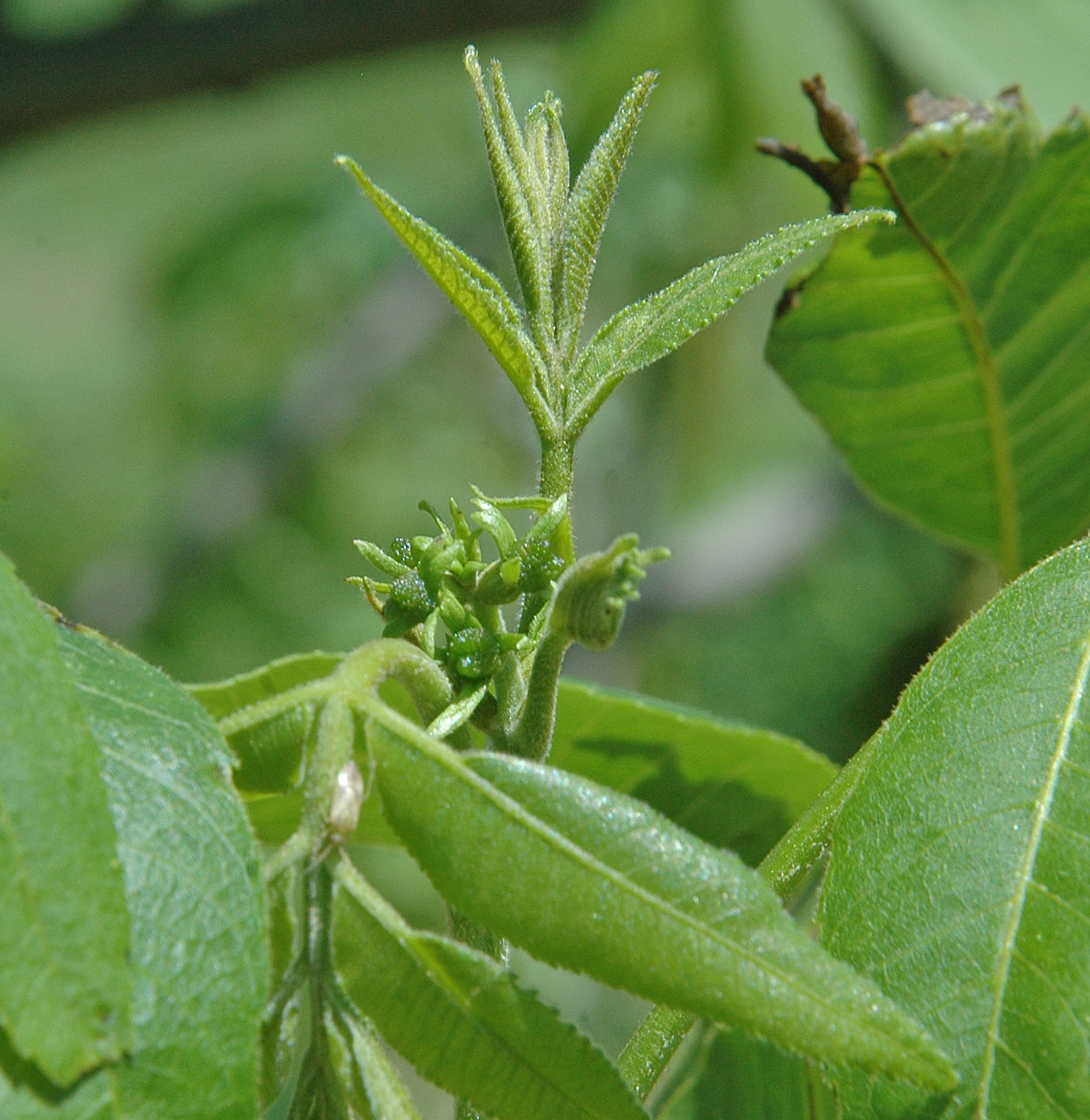

St. Paul female flowers were still not fully formed. These females will have green stigmas.


THAYER - PROTANDROUS
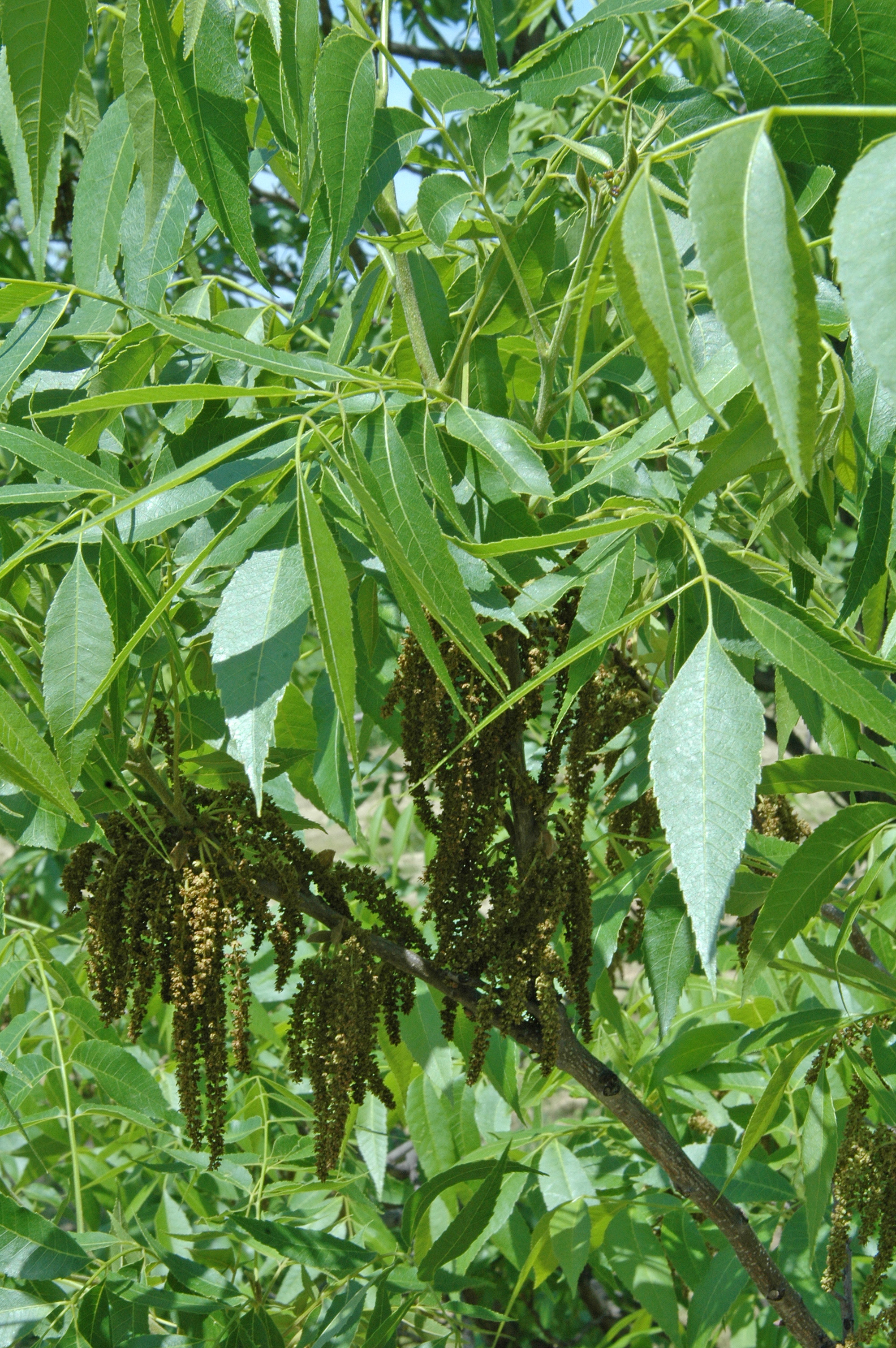
Thayer catkins have shed most of their pollen and have turned brown in color.


Thayer female flowers are still growing. The stigmas will be bright red when receptive to pollen


Thursday, May 12, 2022

Grafting time

Preparing a scion for grafting
     During a normal year, I usually starting grafting pecan trees during the first week of May. However, last week (the first of May) we received over 7.5 inches of rain during the course of the week and the Neosho River spilled over its banks flooding a large part of my pecan grove. Needless to say, my 2022 grafting season got off to a late start. 

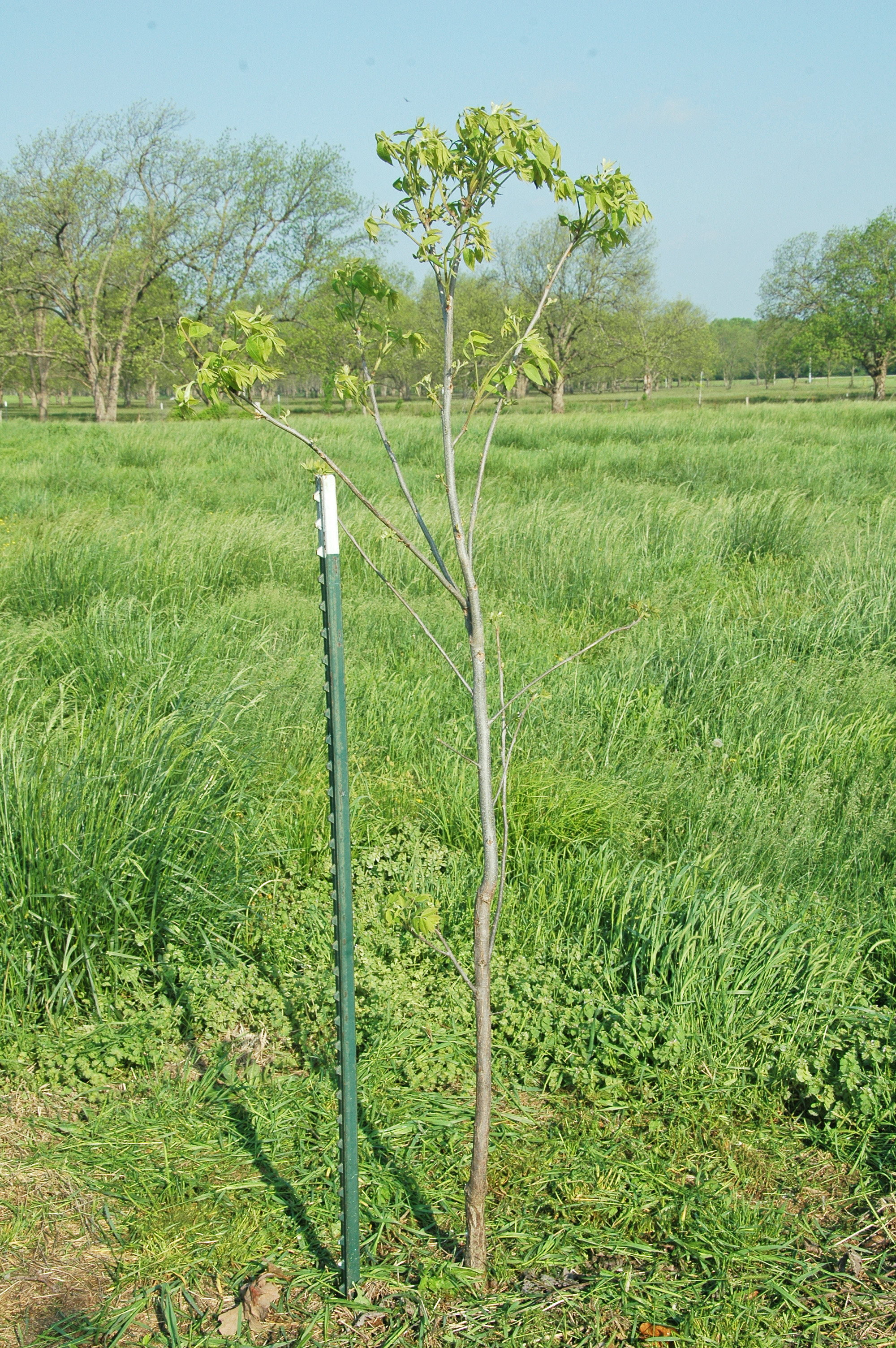
    This week, summertime temperatures and ample sunshine dried the fields enough to make getting out in the field to graft trees possible. One of the biggest mistakes novice pecan growers make in grafting trees is  attempting to place a graft on a tree that is too small and does not yet have a well established root system.  My rule of thumb is to never graft a tree unless it grew at least 2 feet of new shoot growth the previous growing season.

   The tree pictured at left is ideal for grafting. By the time a pecan tree has achieved this size above the ground, the root system is extensive and features a massive tap root.  


   I usually graft this sized tree at about 20 to 24 inches above to soil (photo at right). I choose this height for two reasons. First, 20 inches is a comfortable working height for me while I sit on my cooler to carve the scion and place the graft. Secondly, removing a majority of the top will force the tree to focus all its energy on pushing shoots that sprout from the scion. Ultimately, the rapid growth that results from such drastic pruning is easy to train into a strong central leader trunk.  

  The tree I selected for grafting is roughly one inch in diameter at the point I made the cut (photo at left). I like to use a bark graft in this circumstance. Once the graft starts growing it won't be long until new wood growth completely covers over the wound I made on the seedling rootstock.


    For a small diameter bark graft, I choose a small diameter scion to insert under the bark (photo at right). If you would like to see a more detailed discussion of how to make this graft, check out a previous post HERE.

   I always attach a bamboo stake to the tree after I've completed the graft (photo at left). Initially, this stake protects the scion from bird damage (perching birds can break off the scion). Once the scion breaks bud, I tie emerging shoots to the stake to train the new growth and to prevent wind damage. 

     This photo also reminds me that I've been using the same grafting box for 40 years. It has served me well.


     Deer populations in Kansas have exploded to the point where I never leave a young tree uncaged.  The cage protected the seedling the entire time it was growing into grafting sized tree. Once grafted, the cage will remain until the young tree has grown limbs well above deer browsing height.   At that point, I remove the cage and place a trunk protector on the tree to prevent buck rub.

Tuesday, May 3, 2022

Pecan leaf burst and first signs of pollination season

Kanza leaf burst, 26 Apr 2022
      Last week I was able to photograph several pecan cultivars as new spring growth emerged from long-dormant branches. As buds break, you should note the strong apical dominance of new shoot growth that is characteristic of pecan trees.  In the photo at right, new shoots and leaves sprout primarily from a cluster of terminal buds that developed as shoot growth slowed to a stop during the summer of last year.  Further down the stem, you will note that buds have broken open but seem to only produce male flowers or catkins. This is a consequence of apical dominance. The buds at the terminal of the branch break first and their growth sends a hormonal signal down the branch to suppress the development of  vegetative buds lower on the branch. 

    For sexually mature pecan trees, each primary bud on last year's shoot contains a central vegetative bud and two lateral male reproductive buds. Note that each male reproductive bud produces 3 catkins. As terminal growth continues to expand the hormonal signals become so strong that it causes central vegetative buds lower on the stem to abort from the tree. The catkins, however,  remain until they complete pollen shed later in May. 

Gardner, 26 Apr 2022
    As I moved through my orchard, I observed obvious differences between cultivars in terms of bud development and the appearance of catkins. Some trees appear to produce catkins well before new shoot growth. This occurs with protandrous pecan cultivars like Gardner (photo at left).

    Pecan trees have one of two flowering habits. Trees that release pollen before their female flowers become receptive, have a protandrous flowering habit. Trees that produce female flowers that are receptive to pollen before they release their own pollen are termed protogynous.  

   Over the years, I have also noted that the catkins on protandrous cultivars appear short and fat while catkins on protogynous cultivar are much longer and narrow.

Labette, 26 Apr 2022

    The photo at right is of a  Labette shoot and is typical of the early Spring appearance of a protogynous cultivar. Note how far the leaves have expanded in contrast to the Gardner shoot pictured above. Catkins on Labette have also emerged but they are not nearly a prominent as the catkins on Gardner at this point. However, note that even though Labette catkins are still enlarging they are already longer than Gardner catkins.


    During my tour of the orchard I noted two cultivars that had significantly later bud development.  Both Liberty and Hark are protandrous cultivars. Liberty appears to lag several days behind the leaf burst of other protandrous cultivars. In striking contrast, Hark leaf burst is far behind all other cultivars on my farm. Late leafing is a desirable cultivar characteristic for a pecan cultivar when grown in areas with a high risk of late Spring frosts. 

Friday, April 15, 2022

Bud Break and Spring Fertilization

Kanza buds 14 April 2022

    As I have mentioned in previous posts, I like to time the application of fertilizer to my pecan grove to coincide with the very first signs of tree bud growth. We've had a cool spring in SE Kansas this year which has delayed the bursting of pecan buds. Here we are in mid-April and our pecan trees still appear largely barren of new growth. However, on close inspection I've found some trees have started to push their buds open (Kanza buds pictured at right).  

    Seeing bud growth, I rented a fertilizer spreader and applied 150 lbs./ac urea and 100 lbs./acre K-Mag. K-Mag is a naturally occurring mineral that contains potassium (K), Magnesium, and Sulfur. In my pecan grove, previous leaf analysis results indicated that my trees were low in Magnesium. This is what prompted my switch to K-Mag rather than use the more common potassium fertilizer, muriate of potash (potassium chloride).

    The cost of all fertilizer materials have increased dramatically over the past 18 months, which has made many pecan producers pause to question; "Can I really afford to apply fertilizer this year?".  At first, skipping a regular fertilizer application will seem to have little effect on pecan yield. The yield for 2022 is largely programed in the tree before you ever make a spring fertilizer application. The negative affect of skipping a fertilizer application this year will come in 2023. Without adequate nutrient applications in 2022, the tree will drain all of its reserves to grow and mature the current nut crop. This will leave the tree unable to create the pistillate flower buds that will form the basis of the 2023 crop.  Ultimately, skipping a fertilizer application will increase a pecan tree's tendency towards alternate bearing.   

USDA 61-1-X  14 Apr.2022

   While scouting my orchard for bud development, I observed that not all cultivars were at the same stage of bud development. For example, USDA 61-1-X had swollen buds that looked ready to burst open (photo at right).
Hark 14 Apr 2022


    In sharp contrast, Hark buds appeared fully dormant (photo at left). Late bud break is a positive trait for northern pecan cultivars. A delayed start to shoot growth often allows late budding pecan trees to avoid late spring frost damage.


    As a general rule, pecan trees are one of the latest tree species to break bud in the spring. On the same day that I was scouting pecans for bud break, my apple orchard was in full bloom, buzzing with the sound of hard-working honey bees (photo above).