Saturday, January 20, 2024

Thinning trees to maximize light penetration and remove problems

     All summer long I take mental notes on tree spacing within my orchard. This past summer, I noticed several areas in my pecan breeding block that were becoming crowded. Limbs of adjacent trees were nearly touching. Sunlight penetration into each and every tree canopy is critical for maximum nut production, so it was time to break out the chainsaw (photo above).  

     As you can see in the photo, I attach a couple of special implements on my tractor during the tree removal operation. On the tractor's front loader, I attach a hydraulic grapple to pick up the downed limbs and trunk. On the tractor's 3-point-hitch I've mounted a large tool box. The bottom of the tool box is lined with paving stones to provide sufficient weight to counter balance the pecan logs I lift with the grapple. Above the stones, I have plenty of room to carry 2 chainsaws, fuel, bar oil and tools for chainsaw maintenance.

    When removing trees of this size (about 12 inches dbh), I always notch the trunk at a comfortable height  so I can control the direction of tree fall. Once the tree is down, I'll cut the trunk off at ground level. Stump grinding comes later with a different implement and a different tractor.

    This winter I also removed one of my problem trees.  Tree number KT772 is a open pollinated seedling of Pawnee. As I young tree, I could forgive the scab susceptibility of this seedling (scabs about the same as Pawnee) because the nuts were large, thin-shelled, and good quality. However, like its Pawnee parent this tree started into alternate bearing at a fairly young age. In 2023, KT772 was the only tree in my orchard to set an excessive crop load. Note in the photo at left, all the limbs are drooping under the weight of nuts. By October, several limbs had snapped and fallen to the ground.

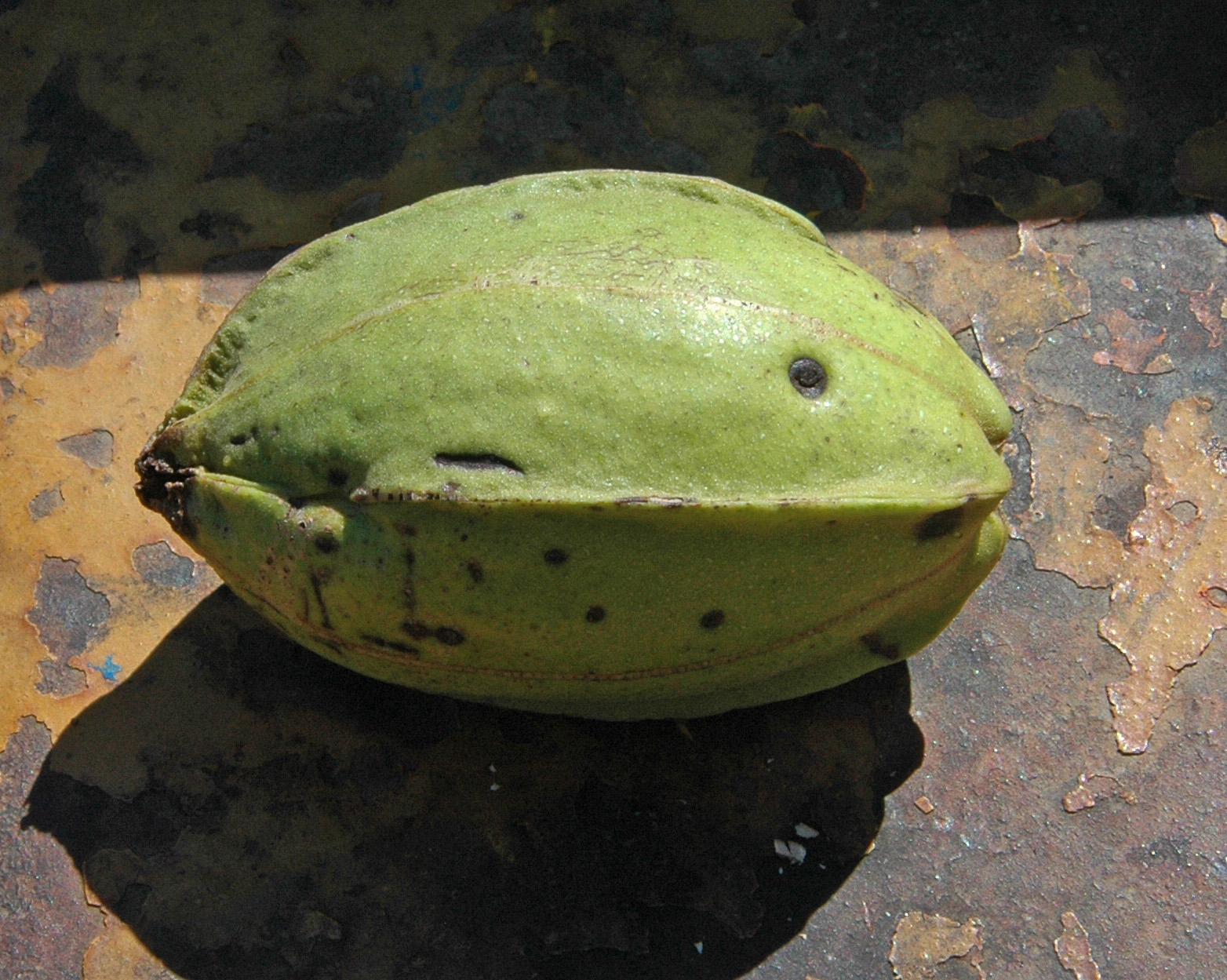
     In previous years, KT772 ripened around October 7. However this year, the shucks on this tree never opened (photo at right) and were frozen tight on the nut shell following the 1st fall freeze.


   Late in the fall I broke open a KT772 nut and found extremely poor kernel filling.  Shuck split in pecan is promoted by plant growth regulators stimulated by fully formed kernels. Without proper kernel development, shuck split is either extremely late (like the drought year of 2022) or it will never happen.


    Just before frost, I found that the shell of KT772 had only partially separated from the husk but the nut shell had developed its normal coloring. By the time I harvested my pecan crop, every KT772 nut was a blackened stick-tight (following 1st Fall freeze) and was totally worthless.  

   I have watched this tree long enough. So this winter KT772 was removed from my pecan breeding block.
 

Wednesday, October 18, 2023

Pecan cultivars that ripened in October

Jayhawk, 4 Oct. 2023  

      In my area of Kansas, pecan cultivars must ripen by mid-October to reliably split open their shucks before the first killing freeze in the Fall. Pictured here are some of the cultivars that ripened during the first 2 weeks of October in my orchard.

Shepherd, 6 Oct. 2023

KT330, 6 Oct. 2023

Labette, 9 Oct. 2023

St. Paul, 13 Oct. 2023

Notes: 

    Jayhawk -- an open-pollinated seedling of Giles

    Shepherd -- a native seedling from Central Missouri

    KT330 -- a selection from my breeding project. The result of a cross of Pawnee and                                 Greenriver.

    Labette -- tested as KT334 from my breeding project. A cross of Pawnee and Greenriver. 
 

    St. Paul -- tested as KT201 from my breeding project. A cross of Pawnee and Major.


Monday, October 2, 2023

Pecan cultivars continue to ripen as we head into October


Kanza, 2 Oct. 2023
  This year I recorded October 2nd as the ripening date for Kanza. My Kanza trees have produced an excellent crop this year as you can tell by the photo at right. When Kanza first splits open, the shucks hardly open up. All you will see is a slight crack between shuck quarters. During most years, it is a killing freeze that finally kills the green husk and allows Kanza nuts to fall free at tree shaking. 

   I found several other pecan cultivars that ripened at the same time as Kanza. Their photos appear below.

Hark, 2 Oct. 2023

Pleasanton, 2 Oct. 2023

Yates 68, 29 Sept. 2023


Wednesday, September 27, 2023

Cultivars that ripen on the same day as Pawnee

Pawnee, 27 Sept. 2023.
     Pawnee is one of the most popular pecan cultivars adapted to short season climates (photo at right). Large nut size and early ripening are the main positive cultivar characteristics for Pawnee. Severe susceptibility to pecan scan disease is the primary production drawback.

     Since Pawnee is so widely known by pecan growers across the nation, I think it is important to look at a few other cultivars that ripened on the same day as Pawnee (photos below) This year, my Pawnee trees split shuck on 27 Sept. 2023.

Gardner, 27 Sept. 2023


Waccamaw, 27 Sept. 2023

Cultivar Notes:

1. Gardner was found as a chance seedling in Gardner Kansas. This cultivar is very similar in size and appearance to Pawnee but I prefer the nut quality of Gardner over Pawnee. Gardner is susceptible to pecan scab but is not as severely effected as Pawnee.

2. Waccamaw originated as a chance seedling grown in Golden City, MO. Waccamaw nuts are similar in size to Pawnee. I'm still evaluating this cultivar for its reaction to the pecan scab fungus.