Showing posts with label nut thinning. Show all posts

Tuesday, August 11, 2020

Time for nut crop thinning

     This year, my Kanza trees have set way too many nuts to be able to produce high quality kernels come this Fall. To remedy this problem, I need to remove a portion of the nut crop to allow the remaining nuts to pack the inside of every shell with kernel. The most efficient way to reduce pecan crop load is to shake the trees when the nuts reach the water stage of nut development. So, ever since the first of August, I've been cutting open Kanza nuts to check on their kernel development.  

    Today, the nuts hit the water stage (photo above, right). It was time to shake trees.

   For summer tree shaking I use a 3-point hitch tree shaker equipped with doughnut pads (photo at left). When shaking trees in mid summer it is important to use a doughnut pad shaker to help prevent shaker damage to the bark. I also lubricate the inside of the rubber flap that covers pad with silicone lubricant. The goal is to allow the rubber flaps to slip and not the bark off the trunk of the tree.

     Shaking trees for crop load regulation is somewhat of an art. The duration and intensity of the shake largely determines how many nuts are removed. Starting on the first tree, I shake only lightly. Getting off the tractor, I visually inspect how much I've removed. I never look at the nuts on the ground only the nuts left in the tree. If I haven't removed enough, I'll shake the tree again. My goal is to get between 60 and 70%  of the terminals bearing nuts. 

    Once I've shaken a few trees. I get the feel for how much to shake the rest of the trees in the orchard. This year, I was somewhat surprised how easy it was to remove nuts. I had to make sure to use a light touch on the throttle or else I would remove too many nuts. Shaking my entire Kanza block (10 acres) took just a couple of hours.

Saturday, August 1, 2020

Kanza will need crop load thinning

   By the first day of August, pecans have gained enough size to be clearly visible on the tree. Looking at my Kanza trees, I could already see limbs weighted down with an immense crop (photo at right). More than 80% of the Kanza tree's terminals are supporting a nut cluster with each cluster containing 4 to 6 nuts. Left alone until fall, these trees will produce a huge crop of poorly filled nuts and will not be able to produce a sufficient number of pistillate flowers next year. It is a lose - lose situation. Poor quality nuts in the Fall and no crop next year.
   To avoid these problems, I plan to shake my Kanza trees this summer to significantly reduce the crop load. As you may recall, I  thinned the nut crop on all my Kanza tree last year and had great results.
    Crop load regulation works best when the nuts achieve between 3/4 and full water stage. At that point in nut development, the nuts are heavy enough to be removed by shaking but have not yet invested a lot of tree energy into filling the kernel.

   As the pecan near full size, I start cutting open pecans to check for nut development. Pictured at right is a Kanza nut I pulled from the tree today. The nuts seem smaller than usual this year, most likely due to the extended dry spell we suffered through the months of June and July.


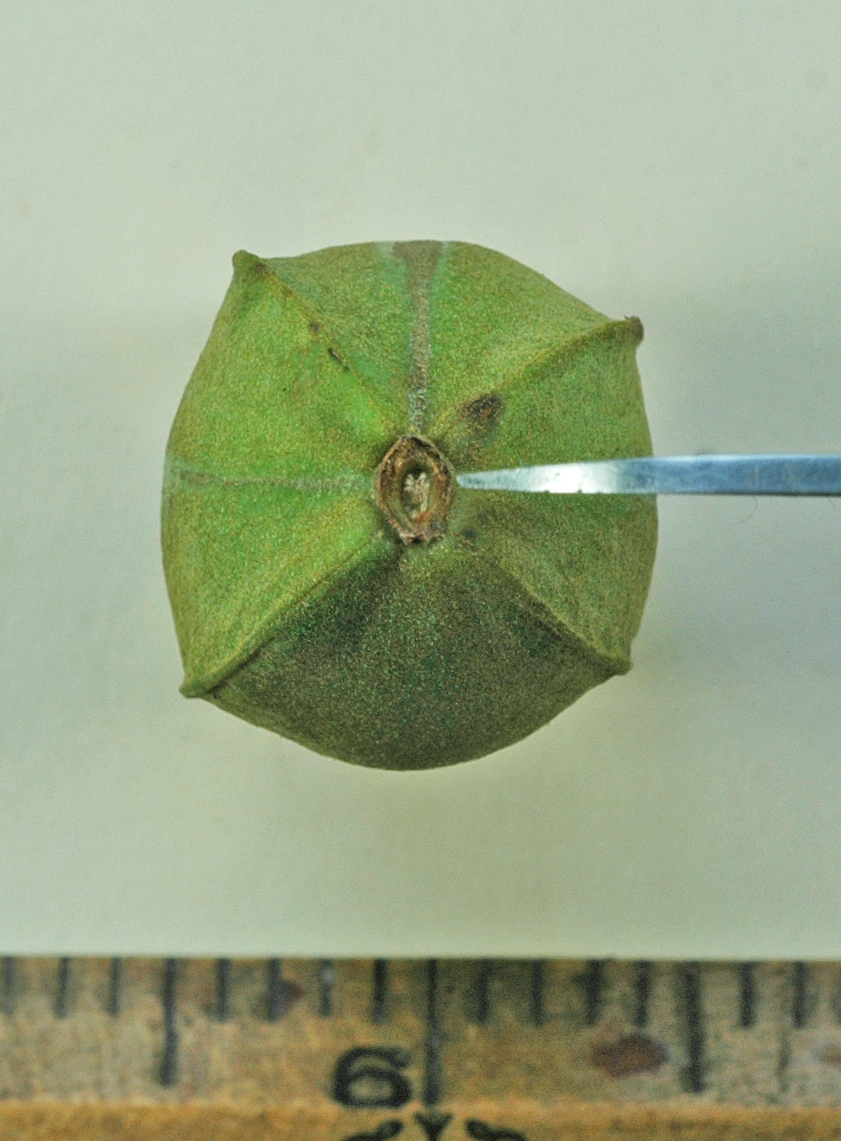
   To check on nut development, the nut must be sliced open in a very specific manner. First, hold the nut so that you are looking at the stem end. Note that the stem scar is oval in shape.  (photo at left)   


   Place a knife across the short width of the oval (photo at right) and slice the nut open the entire length of the nut. As you cut, liquid endosperm will leak out of the nut.   

 
   Once the nut is opened you should be able to see the two sides of kernel (photo at left). They appear as empty voids because all the liquid endosperm has dripped out. As of August 1, my Kanza nuts are a little more than 1/2 water stage. That's not quite full enough to start shaking. I'll check again in a few days. Since I can shake all my Kanza trees in one day, I'll wait until full water stage to start this summer's nut thinning.

Sunday, June 14, 2020

Heavy Kanza Nut Set

    Last week while I was scouting nut clusters for pecan nut casebearer activity, I was surprised to find that my Kanza trees had set an unusually heavy crop. It was just not the fact that a high percentage of terminals were bearing nut clusters but each cluster contained an usually large number of nuts (photo at right shows a cluster of nine Kanza nuts).
    From past experience, I've found that Kanza usually produces 3 to 5 nuts per cluster. So why the the difference this year? The number of pistillate flowers produced by a pecan tree is the product of the previous season's crop load, the nutritional health of the tree, and rainfall during the kernel filling period the prior summer.
    Last year we had ample rainfall throughout the growing season and I always try to make sure my trees receive adequate fertilizer both spring and fall.  In addition, last year I used summer shaking to  reduce a heavy crop load.  The result of this combination of weather and crop management turned out to be ideal for promoting flowering this past Spring. 
    There is no way a pecan tree can grow and fill a canopy full of 9-nut clusters. This kind of crop load will lead to limb breakage and poor kernel filling. To reduce the crop load, I plan to shake all my Kanza trees once again this summer.

Wednesday, January 22, 2020

Checking Lakota nut fill

    Lakota is a scab resistant pecan cultivar that performs well in S.E. Kansas but it has one fault that must be carefully monitored. Lakota will over-produce and slip into severe alternate bearing. To alleviate the problems associated with excessive nut set, I used my trunk shaker in mid-summer to remove a portion of the crop.
   Recently, I pulled a sample from my 2019 Lakota crop to check on nut quality and determine if I had shaken off enough nuts back in August. I found that 90+% of the kernels appeared plump and fully formed (photo above). However, a few kernels demonstrated the negative effects of a tree carrying a heavy crop (shriveled kernels). During the summer of 2019, we had ample rainfall so I knew that any kernel shriveling would be due to a excessive crop load and not be drought related.


    To check on kernel quality, I broke several kernels in half so I could see how well the kernel tissues were packed inside of each nut (photo above). Kernels that appeared plump from the outside had some small air pockets in the center of each kernel half indicating a not-so-perfect fill. Shriveled nut meats had thinner layers of kernel tissue and they had very pronounced air pockets. Several kernels developed hollow backs. These nuts appear plump on the top side of the kernel but the underside is sunken or hollow. The hollow back kernel has a well developed layer of kernel on the top but little or no kernel layer adjacent to the inner wall partition.
    After looking over dozens of nut samples from my 2019 Lakota crop, I concluded that summer shaking did improve my kernel quality but I should have shook even more nuts off each tree to achieve top kernel quality. Each year is a learning process when it come to crop load regulation, so hopefully, I'll do better in the future.

Monday, August 5, 2019

Summer shaking to reduce over-cropping


    Many of the Kanza trees in my orchard have set far too many nuts. Nuts can be seen on almost every terminal with way too many nuts per cluster (photo at right). At first, I thought my young trees could handle the heavy load but after already seeing some limb breakage, I decided that 2019 was a good year to practice nut thinning.
    Fruit thinning is standard practice for many fruit crops. In my fruit orchards, we remove a portion of our apple, pear and peach crops every year to ensure that the remaining fruit are top quality and the trees are able to bloom next year. The same holds true for pecan. Too many nuts on a tree will result in poor quality kernels during the current season and a much reduced flower crop the following season. To regulate a pecan tree's crop load, I use my trunk shaker to remove a portion of the crop.

    Today my Kanza nuts were in the water stage with limbs hanging low under the weight of  the crop (photo at left). Capturing a heavy crop in mid-summer on film is a little difficult. The green shucks of the nut clusters blend in with the green foliage. However, if you look closely, you'll note almost every shoot is terminated by a cluster of pecans.
    Over the years, we have learned that shaking pecan trees when nuts are in the water stage can reduce the negative effects of over-cropping.  In my orchard, I use a Savage 3-pt hitch trunk shaker equipped with doughnut pads (photo at right). In shaking trees for crop load regulation, I've learned that every cultivar shakes a little different and you need to develop just the right touch to get enough nuts removed. Normally I shake in short bursts; evaluating what is left on the tree after each shake. After a while, I get a feel for how the trees are shaking this year and I can start moving through the orchard at a more rapid pace. 
    For the most part, folks usually don't shake enough off on their first go-round with summer nut thinning. However, as you get used to the technique, you will begin to focus on what is left in the tree rather than what falls to the ground. 


Tuesday, November 27, 2018

Pawnee needs crop load management

    Pawnee is one of the most popular cultivars grown in our area (photo at right). The popularity of Pawnee is based on two factors; the nuts are big and they ripen early. However, Pawnee is a high maintenance cultivar. Pawnee is susceptible to pecan scab and the crop needs to be regulated to insure well filled nuts at harvest.
     Today, I collected a few Pawnee nuts from trees at the old Pecan Field Station. In previous years, I reduced the crop load of overloaded Pawnee trees by using a trunk shaker. Now that I've retired from the University, the field station has been abandoned and Pawnee was allowed to over-produce in 2018.


    I collected Pawnee nuts from two areas. The first was a mature orchard with nuts hanging from every terminal. Prior to 2018, these mature Pawnee trees received a good summer shake every year they loaded up with nuts. The second spot was in a young orchard, just starting to produce nuts. Like all young pecan trees, these Pawnee trees had not reached the age when over-cropping becomes a problem.  The young tree produced normal-sized Pawnee nuts while the over-loaded trees produced much smaller nuts (photo above). When I held those smaller nuts in my hands I could already tell the kernels inside were going to be shriveled.


    As I suspected, the kernels produced by the over-loaded Pawnee trees were smaller, poorly filled, and even darker in color. The two kernels on the far right in the photo above were so paper thin that they would be inedible.
   Pawnee is a cultivar that requires a high level of care but when treated right can produce beautiful pecans. Growing Pawnee profitably means adopting a good scab control program and shaking off nuts during the years when the trees set an over-abundant crop.     

Friday, January 19, 2018

Greenriver vs. Oswego: Kernel quality problems

Greenriver kernels, 2017
    Last summer we thinned the nut crop on several pecan cultivars including; Pawnee, Lakota, Faith, Gardner, and Kanza. Later, when we harvested the nuts from these cultivars, we found good to excellent kernel quality inside. However, after cracking open this year's Greenriver nuts, it looks like we should have thinned the crop on this cultivar also.
    The photo at right illustrates the type of kernels I found inside our Greenriver nuts. About 25% had darkened kernels and another 25% had kernels that where somewhat hollow inside.
 
Oswego kernels, 2017
   Oswego originated as a seedling of Greenriver. The nuts produced by Oswego are very similar in size and appearance to its parent. However, when I cracked a sample of Oswego nuts I found the kernels to have better color and nut fill (photo at right).
   Why the difference? It boils down to crop load.  At the Experiment Station,  Greenriver and Oswego are located in the same block of trees, grafted to the same rootstock, with very similar trunk diameters. In 2017, our Greenrivers  were loaded with nuts. In contrast, Oswego trees had a good crop of nuts but the limbs weren't hanging on the ground like our Greenriver trees.
    Over-production reduces kernel quality. With Greenriver, over-production caused a darkening of the kernel and meats that were not solid. Over-production is a manifestation of Greenriver's strong tendency towards alternate bearing. Next year, our energy-drained Greenriver trees won't have the capacity to produce many pistillate flowers. The 2018 Greenriver crop will be tiny.  Summer shaking is the only tool we have for reducing alternate bearing and I wish we would have shook our Greenriver trees last summer.

Monday, August 14, 2017

Crop load management

   This year, several of our pecan cultivars have set an over-abundance of nuts. So many nuts in fact that the tree couldn't possibly fill all those kernels and nut quality would suffer. So, I've been cutting nuts to determine when pecans enter the water stage (photo above) and when it's the right time to shake trees to reduce the crop load.  Today, with the nuts at the right stage and the sun shinning we used our tree shaker to remove a portion of our crop.


Lakota before nut thinning
   The cultivars in our orchard that required nut thinning this year were Pawnee, Gardner, Faith, Lakota, and Osage. Even some of the trees in our Kanza block needed crop load reduction. We used a Savage PTO shaker equipped with doughnut pads to give each tree a light shake. When the nuts are at full water stage, it only takes a short burst of vibration to rain down green nuts.  

Lakota after nut thinning
    Summer shaking is not an exact science but once you become accustomed to the practice you get a feel for the technique. During shaking you can actually see heavily laden limbs spring back upwards as the weight of nuts is reduced. Look closely at the before and after photos of shaking a Lakota tree, you can see the limbs have moved upwards.

   The one thing you can't do is look at the ground. Seeing hundreds of green nuts on the ground can make you feel like you've just thrown away a good portion of your crop (photo at left). But just remember, the remaining nuts on the tree can now fully pack kernel inside the shell resulting in a yield equal to or greater than if the tree was never shook. In addition, better quality nuts will command a better price and the tree will return with a good crop next year.
    One advantage to shaking for crop load regulation is that you can always skip over trees that are not overloaded. This year we shook about 80% of our Pawnee trees and 15% of our Kanza trees.


   The greatest danger it using a trunk shaker in mid summer is the risk of bark damage (photo at right). Clamp on the shaker improperly or not tight enough and you can tear off bark. This causes lasting tree damage that is hard to reverse. My advice is to not get in a hurry, and clamp on and off the tree with great care.

Thursday, August 3, 2017

Pecan development and summer shaking

    Many orchards in northern pecan states are blessed with excellent pecan crops this year. Some cultivars have even set excessive crop loads increasing the likelihood of poor kernel quality this fall and  increased risk of cold injury this winter. Using a trunk shaker to remove a portion of the crop in mid summer is the best way to avoid kernel quality issues this year and increase return bloom next year.  However, for summer trunk shaking to be effective growers must time their nut thinning operations by carefully monitoring nut development.
    Trunk shaking to thin the crop works best when pecans have reached full size and the kernel is in the water stage. This means that growers must monitor their crop to check on kernel development. Yesterday, I collected nuts from four pecan cultivars (photo above). Let's see what inside.


    To check kernel development, hold the nut so you can see the attachment scar on the bottom of the nut (photo at left). Note that the attachment scar is oval in shape. The long axis of the oval was aligned with the stem of the pecan shoot.
   To reveal both sides of the kernel and the progress of kernel development, I cut the nut in half perpendicular to the long axil of the oval attachment scar (photo at left). If you find the mid point perfectly, your knife will split the shell on the suture. 

      The nuts I cut open yesterday, revealed that kernels have not yet reached full water stage (photo at left). Currently, Pawnee is at 1/2 water stage and Giles 1/4 water stage.  Nut development can move quickly at this time of year so be prepared to monitor nuts about every 5 days or so. From past experience, we have thinned Pawnee about a week before Kanza and about 10 days before Giles and Lakota.

Tuesday, August 9, 2016

Mid-summer tree shaking to improve kernel quality

    As the pecans on our trees approach full size, it's a lot easier to see the crop load produced by each pecan cultivar. The photo at right shows a Pawnee tree with limbs already bending down with an over-abundance of pecans.  Left un-managed, this overloaded pecan tree will end up producing a lot of poorly filled nuts this fall and will struggle to produce female flowers next year. Today, I'm going to use my trunk shaker to remove a portion of the crop.

   The prime time for crop load management is during the water stage of kernel development (photo at left). At this point, the tree has invested only a minimum amount of tree energy into building a pecan fruit. In constrast, the kernel filling process and the creation of high-oil-content kernel requires a huge amount of energy.
    We wait until full water stage to thin the crop because the nuts are only now heavy enough to fall when the tree is shaken. 

     I used a tree shaker equipped with doughnut pads to shake off a portion of the crop from my over-loaded Pawnee trees.  In mid-summer, the cambium layer under the bark is still actively growing and can be damaged by improper tree shaking. In addition to using doughnut pads, I apply silicon lubricant between the outer rubber flap and each doughnut pad. The lubricant will allow the rubber flap to slide around when shaking the tree instead of vibrating off a portion of the tree's bark.


    Trees over-loaded with nuts shake easily. A couple of  short-duration, hard shakes will rain down plenty of green-shucked nuts (photo at left). Using a tree shaker to remove a portion of the crop has one disadvantage; nuts are not removed evenly throughout the canopy. After shaking, you'll find more nuts fall from the top of the tree and fewer nuts are dislodged  from low limbs. That's why I always look at the mid-portion of the tree's canopy to judge if I've removed enough nuts.
    The one thing you can't do while summer tree shaking is look at all the nuts on the ground. The typical human response to an orchard floor covered in green nuts is to start thinking about lost nut production. However, shaking off nuts in August actually means that you'll see far fewer poorly filled nuts blowing out of the pecan cleaner after harvest.  

Wednesday, August 12, 2015

Nut thinning Lakota pecan with a trunk shaker

  When we first released the Lakota pecan cultivar, I warned growers that, when this tree matures (20+ years old), it tends to over-produce. Over-production reduces nut quality at harvest and limits return bloom the following year. To combat over-production, we used our trunk shaker to remove a portion of our Lakota crop by lightly shaking the tree during the water stage of nut development (photo at right).
   Before shaking, I checked the stage of kernel development of our Lakota trees by slicing open several nuts. Today, Lakota was not at full water stage by close enough for tree shaking purposes (photo at left).  As we moved through the orchard, we discovered that some Lakota trees were far more over-loaded than other trees. By watching each tree during the shaking process, I can remove more nuts on the trees that are severely over-loaded and fewer nuts on trees with a lesser crop load.
    When thinning a pecan crop with a tree shaker, it is important not to judge the amount of thinning needed by looking at the number of nuts shaken to the ground (photo at right). If seeing a bunch of green nuts on the ground makes you nervous, I would strongly advise not grafting Lakota in your pecan grove. Lakota may not need nut thinning every year but you will need to thin nuts off of this cultivar during years of heavy nut set.

   To judge how much thinning is enough, it is best to look up at the canopy to see how many nuts are left in the tree after shaking. It is hard to capture crop load with a camera but the photos above show the exact same area of tree canopy before and after tree shaking. We aim at shaking the tree long enough to reduce the Lakota crop down to about 60% fruiting shoots. When nut thinning, we have found it best to have the shaker operator directed by a canopy spotter trained to judge the crop load left in the tree.